Looking for your birthday star instead? That’s a different question — not where the Sun sat on your birthday, but which star’s light left the year you were born. Find your birthday star here.
Two systems, one sky
The 12 zodiac signs we know today come from Babylonian astronomy from about 1000 BCE, codified by the Greeks around 400 BCE. They divided the path the Sun takes through the sky (the ecliptic) into 12 equal slices, each 30° wide, each named for the constellation that was sitting behind the Sun at that point of the year.
At the time, the names and the actual sky lined up almost perfectly. Aries season really did have the Sun in Aries.
Then a small detail of orbital mechanics intervened. Earth’s axis doesn’t point at a fixed direction — it wobbles, like a spinning top slowing down. The wobble takes about 26,000 years for a full circle, which means the position the Sun appears against the stars at the spring equinox shifts by one full zodiac sign every ~2,150 years.
Since the zodiac was fixed, that shift has accumulated to roughly 24 days. So the Sun isn’t where astrology says it is anymore. Astrology kept the calendar dates; astronomy kept the actual sky. You can pick which one feels real to you.
The 13th sign: Ophiuchus
The Sun spends about 18 days a year passing through Ophiuchus — a large constellation depicting a man wrestling a serpent (Asclepius, the mythological healer who learned medicine from snakes shedding their skin). The Sun has been doing this for the entire history of the zodiac. Babylonian astronomers knew. They left it out because their cosmology preferred 12 (one for each lunar month of the year), not 13.
In 2016 NASA put out a casual note pointing this out, which got reported as “NASA changes the zodiac.” NASA changed nothing. They were just explaining the gap between astrology (a 12-sign system) and astronomy (the actual sky has 13).
The 12 Western zodiac signs
The dates here are the ones every astrology app and horoscope column uses. Real boundary moments shift by ±1 day from year to year — if your birthday is on a boundary you may be a “cusp.”
The 13 IAU zodiac constellations
These are the dates the Sun is actually passing through each constellation, using the official IAU boundary lines that astronomers drew up in 1930. Note how uneven the stays are — Virgo sprawls across 45 days, Scorpius is one short week, and Ophiuchus fits between them.
Reading the gap honestly
Astrology is a symbolic system. It treats the zodiac as a calendar of meaning, not a star chart. The dates haven’t moved because, in that system, they were never meant to move. Aries-the-symbol is the start of spring; that’s the point.
Astronomy is the actual sky. The Sun really is in a different constellation than your sign suggests, and on a different calendar pattern than the 30-degree slices.
Both are useful. They’re just describing different things.
What to do with it
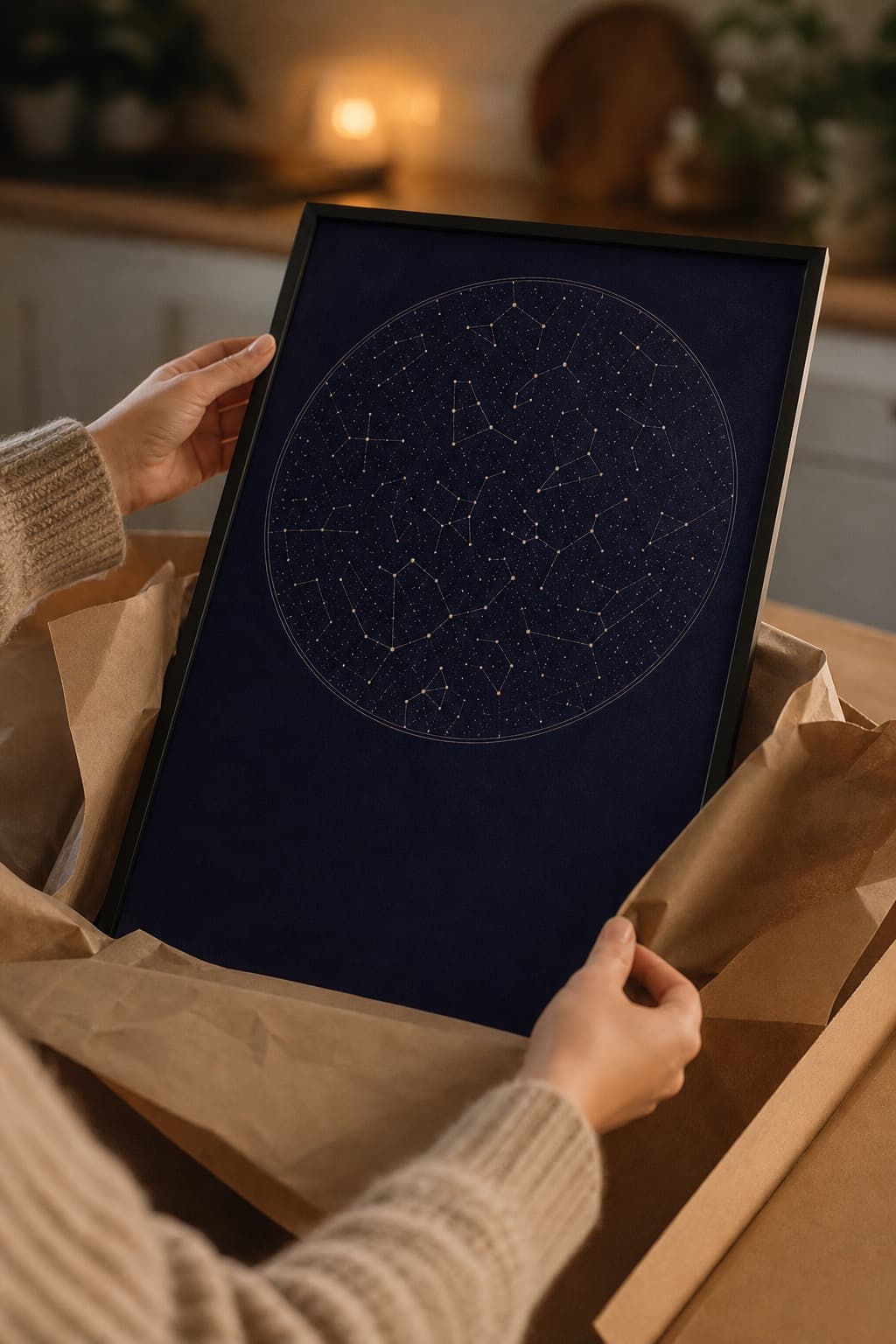
If you’re building a birthday gift, the most personal version isn’t the sign — it’s the whole sky on the night someone was born. Every constellation, every planet, the phase and position of the Moon. The sign is one feature on the map. The map is the gift.
That’s what the SkyWhen customizer renders. Pre-fill it from the tool above, add the birthplace, and the poster will show the exact stars that were overhead that night.
FAQ
What star was born on my birthday?
Nothing on this page answers that — your star sign is about the Sun’s position, not about a star of your own. And strictly, no star has a birthday: they take hundreds of thousands of years to form.
The question that does have a real answer is which star’s light left the year you were born, which depends on how far away it is. Our birthday star finder works that out and names the star.
What constellation was I born under?
Enter your birthday above and the tool names it: the constellation the Sun was actually passing through that day, using the official IAU boundaries. For most people it is not the same as their zodiac sign — usually it is the sign before.
That constellation sat behind the Sun, so it was hidden in daylight. The ones overhead the night you were born are a different set, and the sky on any date tool draws them for your birthplace.
Why does the tool show two different signs?
Because there are two different systems, and most people only know one. The tropical zodiac is what newspapers and astrology apps use — twelve signs, fixed dates, anchored to the spring equinox. The IAU constellations are where the Sun actually is in the sky, using the official boundaries astronomers drew up in 1930.
The two systems used to line up. They’ve drifted apart by about 24 days over the last 2,000 years because Earth’s axis wobbles slowly (a process called precession of the equinoxes). The astrology dates didn’t move with it; the actual sky did.
What is Ophiuchus and why isn't it in horoscopes?
Ophiuchus is the 13th constellation the Sun passes through, sitting between Scorpius and Sagittarius. The Sun spends about 18 days in it every November–December. NASA published an explanatory note about this in 2016 that briefly went viral as “NASA changed the zodiac” — they didn’t. They were just pointing out the gap between astrology and astronomy.
Western astrology has used exactly 12 signs since Babylonian times, each occupying 30° of the ecliptic. Adding Ophiuchus would mean redrawing every chart ever made, so astrologers don’t use it. Astronomers do.
Is my real sign the one the Sun was actually in?
Depends what you mean by “real.” Astrologically, your Western zodiac sign is what every horoscope and birth chart will use. Astronomically, the constellation the Sun was passing through on your birthday is the literal sky overhead (or below the horizon, technically — the Sun blots out the constellation behind it, but it’s there).
Both are real. They mean different things.
Why is Scorpius only 7 days but Virgo 45?
The astrological zodiac divides the sky into 12 equal 30° slices. The IAU constellation boundaries don’t — they follow the historical outlines of the constellations, which are wildly uneven. Virgo sprawls across a huge stretch of sky; Scorpius is compact. So the Sun whips through Scorpius in a week and lingers in Virgo for a month and a half.
Can I see a poster of the sky on my birthday?
Yes — the “See my birthday sky” button above opens our customizer with your date pre-filled. Add your birthplace and the poster renders the full sky over you on the moment you were born — every star, the Moon’s phase and position, and any visible planets.
$29 as a one-time download — print files, wallpapers, and social images included.
What if my birthday lands on the boundary day?
Sign boundaries (in both systems) actually move by ±1 day from year to year, because they’re tied to the exact moment of an astronomical event, not the calendar. If your birthday lands on a boundary date, the precise sign depends on your year, time, and timezone of birth.
For the tropical sign, you can look up your “cusp” in a proper birth chart. For the IAU constellation, you’ll need the Sun’s exact ecliptic longitude that day — which our customizer renders accurately if you want to see the underlying sky.