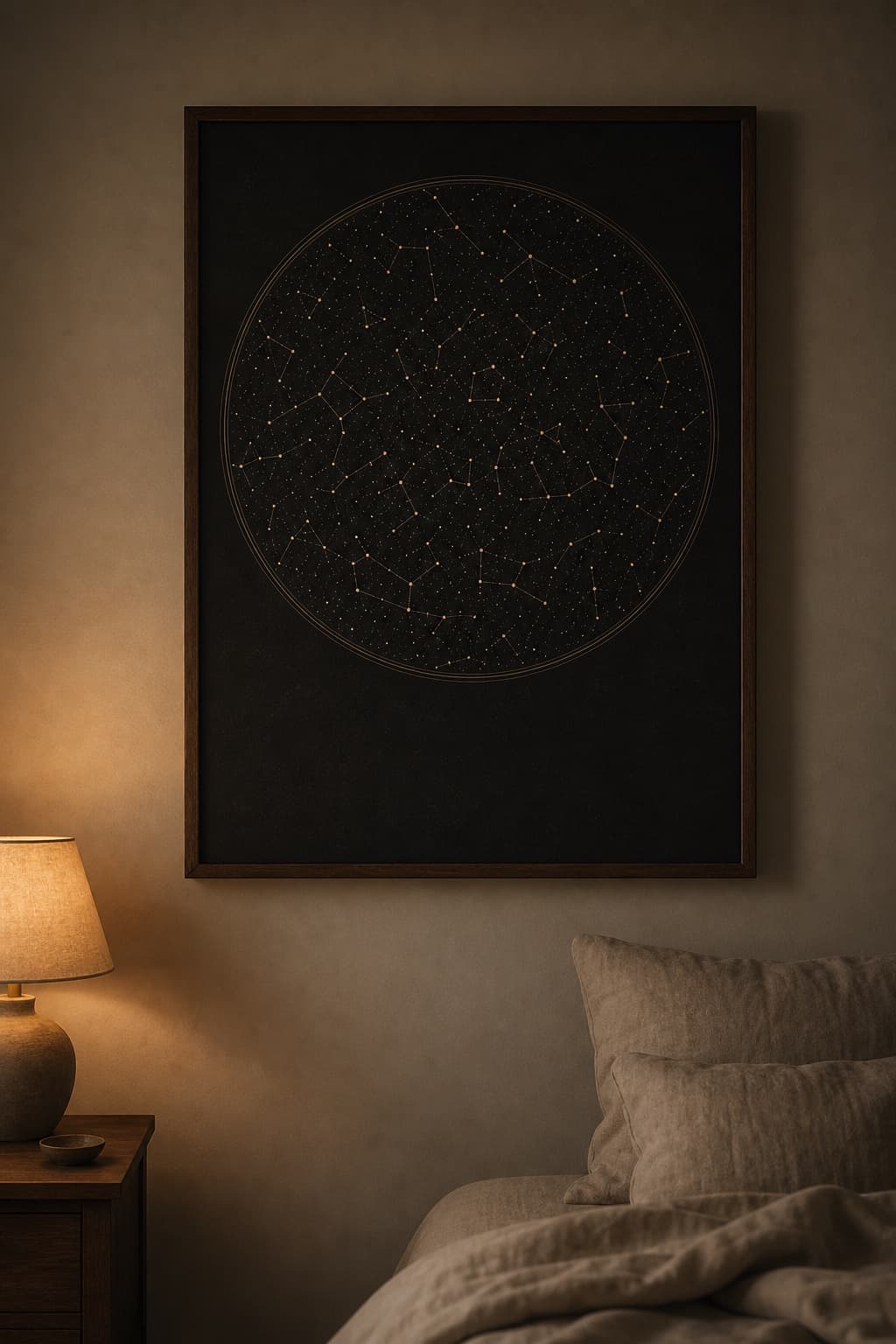
How to see the sky on any date
The tool above does the work. Pick a date with the date picker, set the time (9 PM local is a safe default if you don’t know the exact moment), and start typing a place in the location field.
As soon as all three are filled in, the canvas above renders the real sky. Stars in their actual positions, planets where they actually were, the Milky Way running through the parts of the sky it actually ran through that night.
No login. No email. No paywall. You can run this as many times as you want — every date is a different sky, and a lot of dates are worth seeing.
What the tool actually shows
Every dot on the map is a real star. The brighter ones are bigger; the dimmer ones are smaller; their positions match where they sit in the actual sky at the moment you picked. A few of the brightest points aren’t stars at all — they’re planets, and there’s a knack to telling them apart.
The lines connecting them are constellations — the familiar shapes that humans have been drawing for thousands of years. Orion, the Big Dipper, Cassiopeia, the Southern Cross when you’re south of the equator. The twelve the zodiac is named after are in there too.
The soft band running diagonally through some renders is the Milky Way — the disk of our own galaxy, seen from the inside.
If you want to go deeper on how a star map is built and why the numbers are accurate, the full breakdown is here, and there’s a separate post on how accurate star maps actually are if you want the trust-but-verify version.
Why anyone looks up an old sky
People search for the sky on a specific date for one of a few reasons, and they’re all variations of the same idea — a moment mattered, and the sky was the room it happened in.
Birthdays
The most common one. The sky you were born under, or the sky your kid was born under, or your parents’ sky on the day they were born. A birthday star map is the version of this that gets framed.
If that’s what brought you here, the birthday version of this tool is the shorter route — it doesn’t ask for a birth time, and it tells you the moon phase, the planets that were up, and the constellation the sun was really in that night.
Anniversaries and weddings
The night you met, the night you got engaged, the day you got married, the night you moved in together. Couples ask for these constantly — see the anniversary ideas post or the engagement gifts breakdown for context on which dates land best.
Births and big firsts
The night a child arrived. The night a family moved into a first home. The night someone passed. The night a long-running thing finally ended.
Historical moments you weren’t there for
The moon landing. The night Halley’s Comet last passed close. The Christmas Eve in 1968 when three astronauts read from Genesis in orbit around the moon. The sky over Athens during the night Plato gave a particular lecture, if you happen to know which one.
You don’t need a personal connection to a date for it to be worth seeing. A lot of history happened under skies we can still look at now.
How far back can it go?
Practically: any date in recorded human history. The underlying math is reliable from roughly 4,000 BC to about the year 3,000 AD — a six-thousand-year window with room on either side.
Inside that window, planetary positions are accurate to better than a sixtieth of a degree, and star positions are accurate to a fraction of a degree. That’s well past the precision a human eye can resolve.
The reason the window has edges at all is something called precession — the Earth’s axis slowly wobbles like a spinning top, completing one full wobble every twenty-six thousand years. Modern astronomy software accounts for it automatically inside that window. Push further out and the corrections start to drift.
For practical purposes that means anyone’s birthday, anyone’s anniversary, and any event that humans were around to witness — all of it works. The full piece on date range walks through the edges if you’re curious.
The sky tonight vs. the sky on a specific date
These are different questions. Both are valid; they just lead different places.
The sky tonight is a planning question — what’s up there right now that I’d see if I walked outside? Useful for stargazing, photography, knowing whether tonight’s the night for a meteor shower. The tonight breakdown is here.
The sky on a specific date is a memory question — what was up there at the moment that mattered? Useful for gifts, for posters, for sitting with a date you can’t go back to. This tool answers that one.
Famous skies — try these dates
If you want to test the tool against something familiar, here are dates and places that are fun to plug in. Each is a real sky over a real place at a real moment in history.
- July 20, 1969 · Houston, Texas — the sky over Mission Control as Apollo 11 landed on the moon.
- April 10, 1986 · London, UK — the night Halley’s Comet was closest during its last visit. It won’t pass again until 2061.
- December 24, 1968 · Houston, Texas — the Christmas Eve broadcast from Apollo 8, the first humans to leave Earth orbit.
- August 21, 2017 · Madras, Oregon — the path of totality of the Great American Eclipse, mid-afternoon.
- October 4, 1957 · Moscow, Russia — the night Sputnik launched. The space age starts here.
- December 21, 2020 · anywhere clear — the great Jupiter–Saturn conjunction, the closest the two have appeared since 1623.
- Your birthday · your hometown — start here. It’s usually the most surprising one.
The reason these land is that the sky is one of the few things from a date that you can actually still see. Everything else from a long-ago moment is gone — the air, the light, the people. The sky is the part that’s still there.
What you can do with the result
You can stare at it, which is honestly enough for a lot of people. You can screenshot it. You can send it to whoever the date is about.
If you want something that lasts longer than a screenshot, the same engine that powers this tool also powers our customizer — pick a layout, a color scheme, add a line of text, and we render a full bundle: print files at 300 DPI in four sizes, phone wallpapers, desktop wallpapers, and social-ready images. The whole set is $29 as a one-time digital download.
The walkthrough post covers what you get and how the customizer works. The short version: it’s the same tool you’re using above, with a few more knobs and the option to save the final piece.
The tool is here for free, forever. We built the paid version on top of the same engine because some skies are worth keeping — frozen, framed, on a wall. If yours is one of them, the customizer is one click away with the date and place already filled in.
FAQ
Can I see the sky on the day I was born?
Yes. Enter your birth date, the time you were born if you know it (around 9 PM works fine if you don’t), and the city where you were born. The map shows the actual stars and planets above that place at that moment.
The math the tool runs is reliable for any date in recorded human history, so birthdays from the 1900s, 1800s, and earlier all work.
What did the sky look like on this date?
Pick the date, the time and the place, and the map above answers it directly — the real positions of the stars, planets and constellations over that exact spot, not a generic star field.
It works for any date, backwards or forwards. If you don’t know the time, 9 PM local is a fair stand-in — the date and the place do most of the work.
How accurate is a historical star map?
Very. The positions of the planets are accurate to better than a sixtieth of a degree for any date in the last few thousand years, and the stars are accurate to a fraction of a degree.
The same data and equations power professional planetarium software. We use the open-source astronomy-engine library and the HYG star catalog — both built on the standards astronomers use.
What is the oldest date this works for?
Practically, the tool is reliable from about 4,000 BC to roughly 3,000 AD. That covers all of recorded human history with plenty of room on either side.
Outside that window the math starts to drift — Earth’s axial wobble (precession) and slow stellar motions accumulate enough error that the rendering would no longer match what an observer at that time actually saw.
Does the time of day matter?
It does. The sky rotates roughly fifteen degrees an hour, so the same date at 9 PM and 3 AM shows two very different views.
If you don’t know an exact time, 9 PM local is a good default. It catches the sky just after full darkness in most places and most seasons.
Can I save the image I see?
You can screenshot the preview, or use the customizer to generate the full bundle — high-resolution print files at 300 DPI plus wallpapers and social-ready images, all delivered as a digital download.
The preview here is meant to be a sketch. The customizer is where you turn it into something printable.