How to use the tool
You don’t need to click anything. The tool works out your city from your connection and draws the sky straight away — the calculation happens entirely in your tab, and we never store or transmit your location anywhere.
Somewhere else? Type a city in the box. The autocomplete handles neighborhoods worldwide, so “Shantinagar, Dhaka” works as well as “Tokyo”. There’s also an exact location link under it if you’d rather your browser pinned you precisely — though for a star map it makes no visible difference, since the sky only changes over hundreds of kilometres.
Either way, the canvas renders the real sky overhead at this exact moment. Stars in their actual positions, planets where they actually are, the constellations named on the map itself, and the Milky Way running through the part of the sky it’s actually in right now.
Some of the best sights come up late. In autumn, Orion doesn’t rise until around midnight. To see what’s up later on, pick a time in the Time box — 2am, 5am, whatever you like — and the map and the list jump to that hour tonight. Clear the box, or tap “Back to now”, to return to the live sky.
Which planets and stars are visible in the sky tonight
Beside the map, the “Visible right now” panel names what’s actually up at your location: the moon and its phase, every naked-eye planet above the horizon, the brightest named stars, and the constellations currently overhead. The map itself labels the constellations too, so the picture and the list agree.
The moon and the planets each show a compass direction (where to face) and an altitude in degrees (how high to tilt your head). A reading of “SW · 35° up” means face southwest, then tilt your head a bit more than a third of the way up the sky. Stars and constellations show the direction only — they sit inside the shapes the map draws, so find the shape and you’ve found the star.
If the planet list is empty, no naked-eye planets are up at the moment. That happens — they all rise and set on their own schedules. Pick a later time in the box, or check back in a couple of weeks, and the lineup will be different.
If you open this in daylight, the tool shows you tonight instead. The stars are overhead at noon too, but the sun drowns every one of them, so a chart of that moment is a chart of something nobody can see. While the sun is up we draw the sky as it will be at nightfall — the end of civil twilight, when stars actually start to appear — and the panel says which time it is showing you.
One thing the map deliberately leaves out is the moon. It moves against the stars from one hour to the next, so it belongs to a moment rather than to a night, and a poster of it would be wrong by the time you hung it. The panel still names it, because it’s the first thing anyone sees when they step outside.
For a deeper guide to telling planets apart from stars and identifying the brightest objects by eye, see how to identify bright stars and planets.
Why “tonight” is a moving target
The sky isn’t a still photograph — it rotates roughly fifteen degrees an hour as the Earth turns. A constellation that’s rising in the east at 8 PM is high overhead by midnight and setting in the west by dawn.
The planets move on their own slower rhythms on top of that. Mercury and Venus stick close to the sun, showing up briefly at sunset or before dawn. Mars, Jupiter, and Saturn shift across the sky over months, sometimes appearing in the same constellation for half a year.
The tool re-computes everything every few minutes, so leave the tab open and watch the sky rotate. The what’s in the sky tonight post is the long-form walkthrough of what to look for on any given night.
Best conditions for seeing what the tool shows
The tool draws the sky as it would look from a moderately dark spot. The brightest planets (Venus, Jupiter, sometimes Mars) punch through even bad city light. The dimmer stars and the Milky Way need real darkness.
Light pollution
The single biggest factor. From the middle of a major city, you might see twenty stars on a good night. From a dark-sky park you can see two thousand. If the version outside doesn’t match the version on screen, this is usually why. The dark-sky parks guide lists the closest spots in most regions.
Moon phase
A bright full moon washes out everything except the planets and the brightest few stars. The week around new moon is when fainter objects become visible. The cycle is roughly monthly.
Weather and your eyes
Clouds and humidity dim everything. And your eyes need fifteen to twenty minutes in real darkness to dark-adapt — any glance at a phone screen resets the clock. A red-tinted flashlight (or your phone in red mode) preserves it.
The stargazing-for-beginners guide walks through everything else — what to wear, when to go, how to find constellations the first time.
What to do once you’ve seen the sky
For most people, the answer is: just enjoy it. Sit outside for fifteen minutes, find one planet, follow it across the sky.
If you want a guide for the visible objects on a more granular level, free apps like Stellarium Mobile and Sky Tonight (the app, not us) are the standard recommendations. We rounded them up in the 2026 stargazing apps roundup.
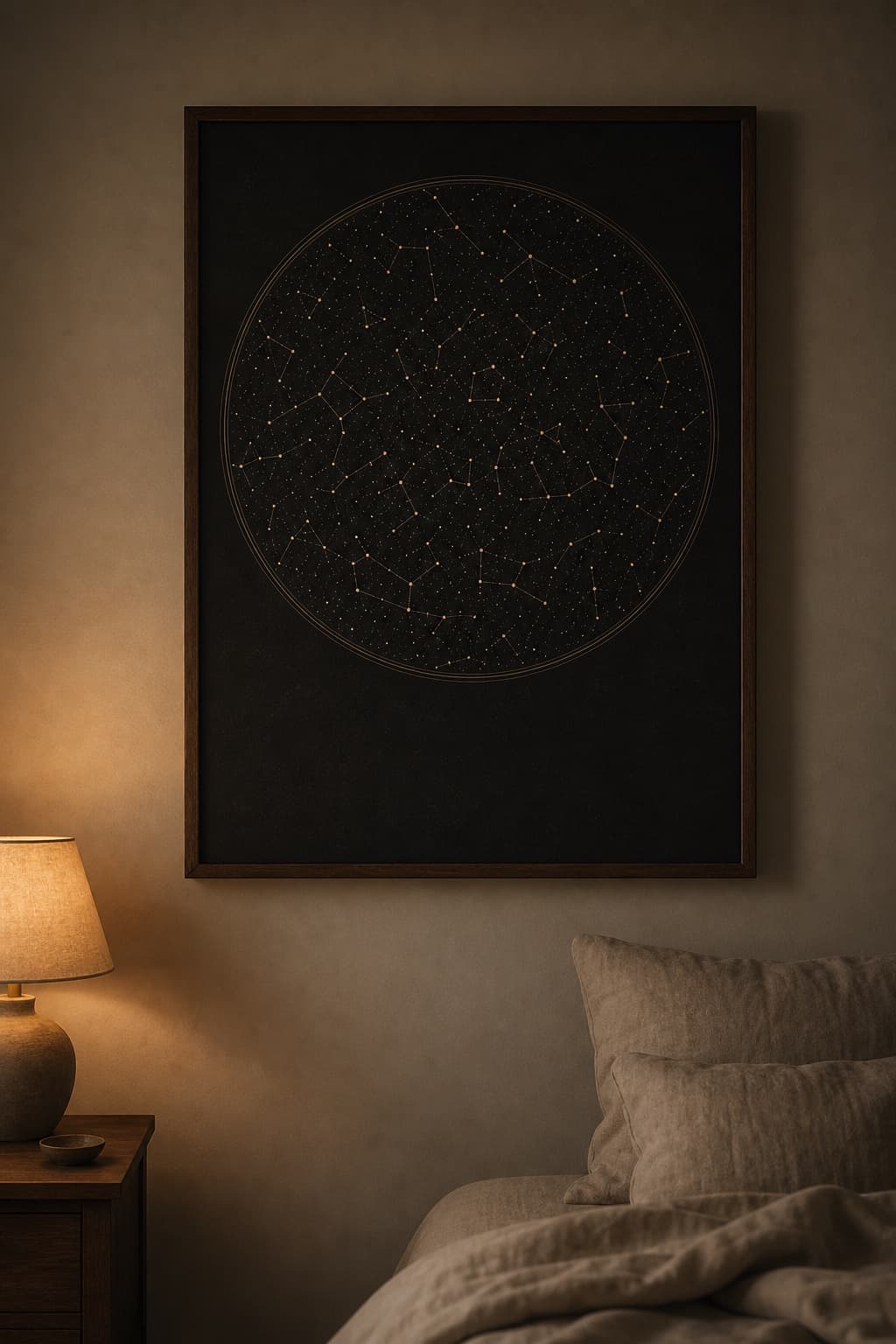
And if tonight happens to be a sky you want to keep — a date that matters, a moment with someone, the first clear night in weeks — the “Keep this sky” button opens our customizer pre-filled with this exact moment and your location. Same engine that’s drawing the preview above, just with the option to save it as a printable poster.
Other ways to use this tool
People come back to “the sky tonight” tools more often than you’d expect. A few honest use cases:
- Quick planet spotting. “What’s that bright thing in the west?” — the panel answers in a second.
- Planning a stargazing trip. Look at what’s up tonight, then decide whether to drive somewhere darker.
- Checking before a meteor shower. The meteor showers post tells you when each shower peaks; the tool tells you which constellation to face.
- Teaching kids. Open the tool, point at the screen, point at the sky.
- Settling arguments. Yes, that’s Venus. No, it’s not a plane.
How the calculation works
The tool uses astronomy-engine, an open-source library that implements the same orbital math NASA and professional planetarium software use. Planetary positions are accurate to better than a sixtieth of a degree — well past the precision a human eye can resolve.
The star catalog underneath is HYG, a public-domain merge of three professional star catalogs trimmed to the roughly ten thousand stars visible to the naked eye on a dark night.
For the long version of how this all fits together, see how star maps work and how accurate star maps actually are.
The tool is free, forever. We built the paid version on top of the same engine because some nights are worth keeping — the night you finally saw the Milky Way, the night a meteor crossed the whole sky, the night someone special looked up with you. If tonight is one of them, the customizer is one click away.
FAQ
Why does the tool ask for my location?
The sky looks different depending on where you stand. Someone in Sydney and someone in Reykjavík at the same instant are looking at almost opposite halves of the celestial sphere. To show you what’s actually above you, the tool needs to know roughly where you are.
It fills in your city automatically, so the sky above is already yours. Type a different city to change it, or use the “exact location” link if you want your precise spot. Nothing is stored or sent anywhere — the calculation runs in your browser.
Which planets are visible to the naked eye?
Five — Mercury, Venus, Mars, Jupiter, and Saturn. Uranus and Neptune are technically visible on a dark night with sharp eyes, but most people need binoculars to spot them at all. The five “classical” planets have been visible to humans since prehistory.
Which of the five are up on a given night depends on the time of year and the hour. Some nights all five are above the horizon at once; many nights only two or three are. The tool tells you which — and on a night with no planets up at all, it still names the moon, the bright stars, and the constellations overhead.
What does the compass direction mean?
It’s the direction you’d face to see that object, measured along the horizon — the panel gives one for the moon, the planets, the bright stars and the constellations. SE means southeast. If you don’t know which way you’re facing, west is wherever the sun went down, and everything else follows from that.
The altitude (“30° up”) is how high to tilt your head, where 0° is the horizon and 90° is straight overhead. A planet at 30° is about a third of the way up the sky.
The easiest way to measure it without any equipment: hold your fist out at arm’s length. It covers roughly 10° of sky, whatever size your hands are, because bigger hands come on longer arms. So “30° up” is three fists stacked above the horizon.
Why doesn’t the sky look like the picture when I go outside?
Three likely reasons. First, light pollution — most cities wash out everything but the brightest planets and a few first-magnitude stars. The tool shows the sky as it would look from a moderately dark spot. The dark-sky parks guide is a good starting point if you want to see the full version.
Second, weather — clouds, haze, and humidity dim everything. Third, your eyes need fifteen to twenty minutes in real darkness to adjust before fainter stars become visible. Bright phones or porch lights reset that adaptation instantly.
Can I save tonight’s sky as a poster?
Yes — the “Keep this sky” button opens the customizer with tonight’s date, time, and location already filled in. From there you pick a layout, a color scheme, and optional text, and we generate the full digital bundle — print files at 300 DPI, phone wallpapers, desktop wallpapers, and social-ready images.
The whole set is $29 as a one-time download. The free preview here is meant to be the sketch; the customizer is where you turn the sketch into something printable.