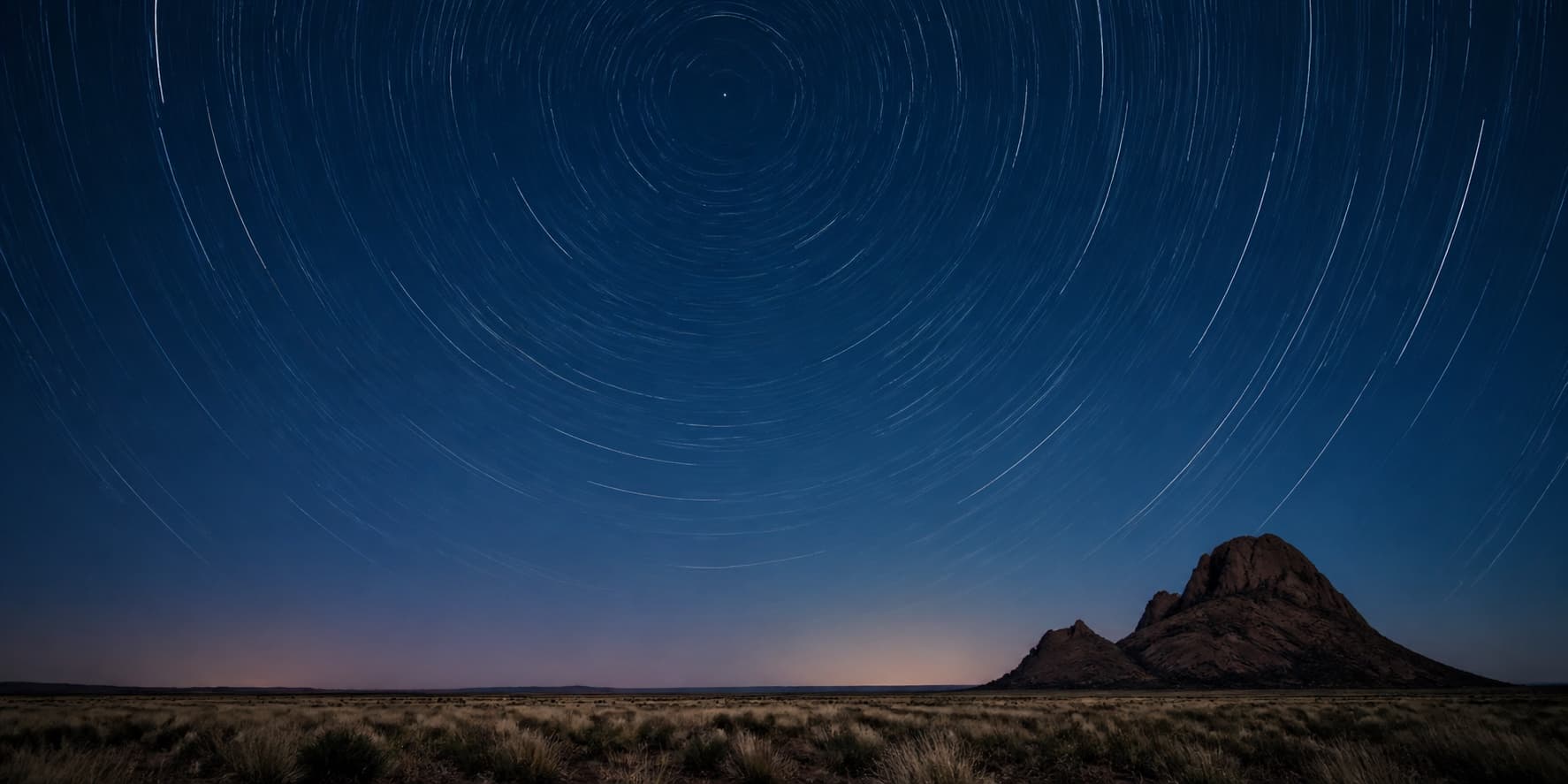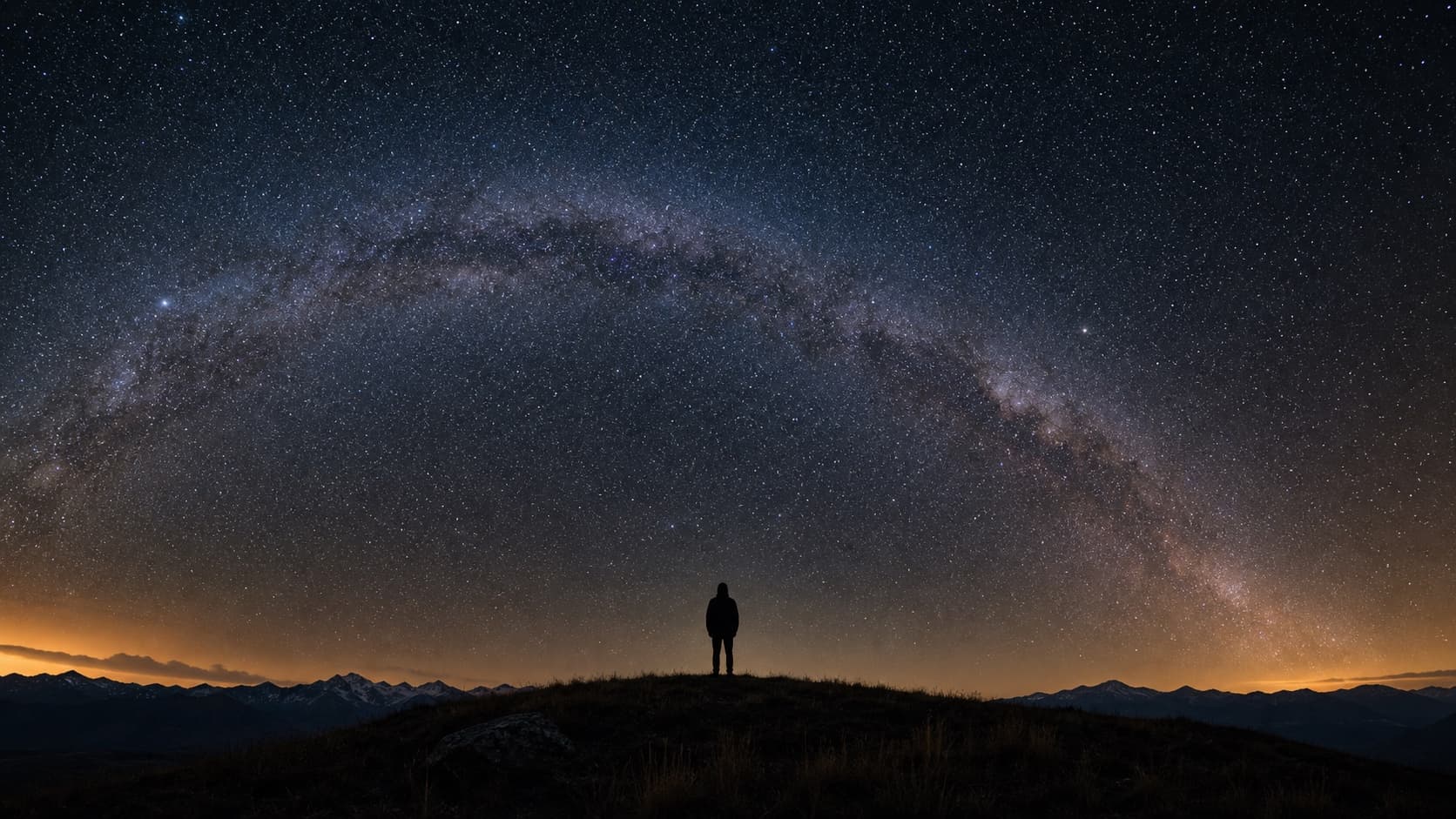
Your eyes are the only equipment you need for your first night of stargazing.
No telescope, no app, no expensive setup. The biggest skill you’re going to develop on your first night is patience — specifically, the 20 minutes it takes your eyes to adapt to the dark properly.
This is the no-fuss beginner’s guide. Where to start, what to look at first, and the order to learn things in.
Step 1: pick a night and a place
Three things matter for your first night: clear weather, not-too-bright a sky, and somewhere you feel safe spending an hour looking up.
Weather: check the forecast and look for “clear” or “mostly clear.” Even thin high cloud will mute the sky to the point of frustration.
Sky brightness: from a downtown city, you’ll still see the moon, the planets, and maybe two dozen bright stars. From a suburban backyard, hundreds.
From rural darkness, thousands. All three are valid first-night settings.
Place: your backyard, a park, a friend’s deck, a beach — anywhere you can sit comfortably for an hour without phone-checking. Bring a blanket and something warm to drink.
Set a location and this becomes a list of the actual dark nights near you — how many hours each one gives you, and between which times. The new moon is only the middle of the window.
New moons come round every 29 or 30 days.
Step 2: let your eyes adapt
This is the single biggest beginner-mistake. People walk outside, glance up for 30 seconds, see “not much,” and head back in.
Your eyes need 15 to 30 minutes in low light to switch from daytime vision to night vision — a biochemical process where your eyes produce more rhodopsin and your pupils widen. Once adapted, you’ll see roughly 10 times more stars than in your first 30 seconds.
The rule during adaptation: no phone screens.
A single look at a bright phone screen will reset your night vision and put you back at zero. If you need light, use a red light or set your phone to maximum red-shift dim.
Step 3: the moon (if it’s up)
The moon is the easiest target in the sky — you can’t miss it. It’s most interesting to look at when it’s a half moon or a gibbous (between half and full), because the shadow line (the terminator) shows mountains and craters in three dimensions.
A full moon is dazzlingly bright but visually flat — no shadows mean no depth. A new moon means no moon at all, which is great for seeing stars but obviously not for moon-watching.
What to look for: the dark patches on the moon (the “maria”) are ancient solidified lava flows.
The bright circles around them are impact craters. With binoculars you can start seeing individual craters and mountain ranges.
Step 4: spot Venus (or another bright planet)
Venus is the brightest object in the sky after the sun and moon. When it’s up, it’s the brightest “star” you’ll see, and it doesn’t twinkle the way real stars do — it’s a steady, bright point.
Venus is only visible in the few hours after sunset or before sunrise — never in the middle of the night. Check a sky app for whether it’s up tonight; if so, look low in the west after sunset, or low in the east before dawn.
Jupiter, Saturn, and Mars are also naked-eye visible most of the year. Brighter than most stars, no twinkle, often near the moon’s path.
See How to Identify Bright Stars and Planets for the longer guide.
Step 5: find the Big Dipper (Northern Hemisphere)
From anywhere in the Northern Hemisphere above about 35° north, the Big Dipper is in the sky every clear night. Seven bright stars in a ladle shape: four for the bowl, three for the handle.
Look generally north and slightly upward. The Dipper’s orientation changes by season (high overhead in spring, low in autumn, on its side in summer and winter), but the seven-star pattern is unmistakable once you see it.
Once you’ve got the Dipper, follow the two front-of-bowl stars outward to find Polaris (the North Star). Full guide: The Big Dipper and the North Star.
Step 6: find Orion (winter nights)
From November through March, look south after dark. You’re looking for three bright stars in a perfectly straight, evenly spaced line — that’s Orion’s belt, possibly the single easiest constellation pattern in the sky.
Around the belt: two bright shoulders (Betelgeuse, orange-red, and Bellatrix, blue-white), two bright knees (Rigel, bright blue-white, and Saiph). The whole constellation is the figure of a hunter.
Once you have Orion, you can find a dozen other things from it. Full guide: Orion the Hunter.
Step 7: try for the Andromeda Galaxy (autumn nights)
This one’s a real beginner challenge.
On a clear autumn night, away from major city lights, look for the constellation Andromeda (best in September through November). Inside it, you’re looking for a faint fuzzy oval patch — that’s M31, the Andromeda Galaxy.
It’s the farthest single thing the average human eye can see. 2.5 million light-years away. Most beginners don’t spot it on the first try; it’s faint and easy to miss.
Once you do see it — for the rest of your life you’ll spot it instantly. See Andromeda: The Constellation and Galaxy .
Equipment: binoculars first, not a telescope
Universal beginner advice: don’t buy a telescope as your first upgrade. Cheap telescopes ($50 to $200 range) often produce dimmer, more frustrating views than basic binoculars, and require setup, tracking, and patience that’s hard to develop without already loving the hobby.
Any decent pair of binoculars (10×50 or 7×50 is standard for astronomy) costs $50 to $200 and dramatically improves what you can see. They’re easy to use, portable, and useful for daytime nature watching too — so the investment isn’t wasted if you decide stargazing isn’t for you.
If you keep going after a year of binoculars and want a real telescope: an 8-inch Dobsonian reflector ($400 to $700) is the consensus best-value beginner’s telescope. Don’t buy one before you’ve done a year of binocular work.
Apps that actually help
For beginners, the easiest free option is Google Sky Map (Android) or Sky Tonight (iOS & Android). Hold the phone up to the sky and it labels what you’re pointing at.
For more advanced use, Stellarium Mobile and SkySafari are the gold standards. Detailed comparisons at The Best Stargazing Apps in 2026 .
Use them lightly though. The point of a first night is to actually look up, not to look at your phone with the sky in the background.
What if you live in a bright city?
You can still stargaze, but you’ll be limited to the moon, planets, and the brightest 20 to 40 stars.
Constellations are still findable. Faint things (galaxies, nebulae, the Milky Way itself) are usually invisible.
For better skies, the easiest move is driving 30 to 60 minutes out of the city. Even modest darkening of the sky reveals a dramatic difference.
For real dark skies, see The Best Dark Sky Parks in the World .
The bridge: the sky you saw, captured
If your first stargazing night happens to be a meaningful one — the night of a date, an anniversary, the eve of something important — you can capture the exact sky you saw and frame it.
Plug the date and your location into the SkyWhen customizer and the preview will show the same stars you were looking at, rendered cleanly. The preview is free.
For specific constellations, see Orion the Hunter, The Big Dipper, and How to Identify Bright Stars and Planets.
FAQ
Can you stargaze without a telescope?
Yes — most casual stargazing is naked-eye. The moon, planets, bright stars, and major constellations all visible without any equipment. Binoculars are the right first upgrade for anyone wanting more detail, not a telescope.
How long does it take for your eyes to adapt to the dark?
Fifteen to thirty minutes in low light. Most of the adaptation happens in the first 10 minutes; the rest is gradual. A single look at a bright phone screen resets the process completely.
What's the easiest constellation to find?
Orion in winter (the belt of three stars is the most distinct pattern in the sky) or the Big Dipper in the Northern Hemisphere year-round. The Southern Cross is the equivalent for Southern Hemisphere stargazers.
Can I stargaze from a city?
Yes, but limited. The moon, planets, and brightest 20 to 40 stars are visible from any city. Faint stars, the Milky Way, and galaxies are usually invisible. For better skies, drive 30 minutes out of town.
Should I buy binoculars or a telescope first?
Binoculars. They’re cheaper, easier to use, and reveal more for beginners than any telescope under $300. Reach for a real telescope only after a year of binoculars, when you know what you’re trying to see.