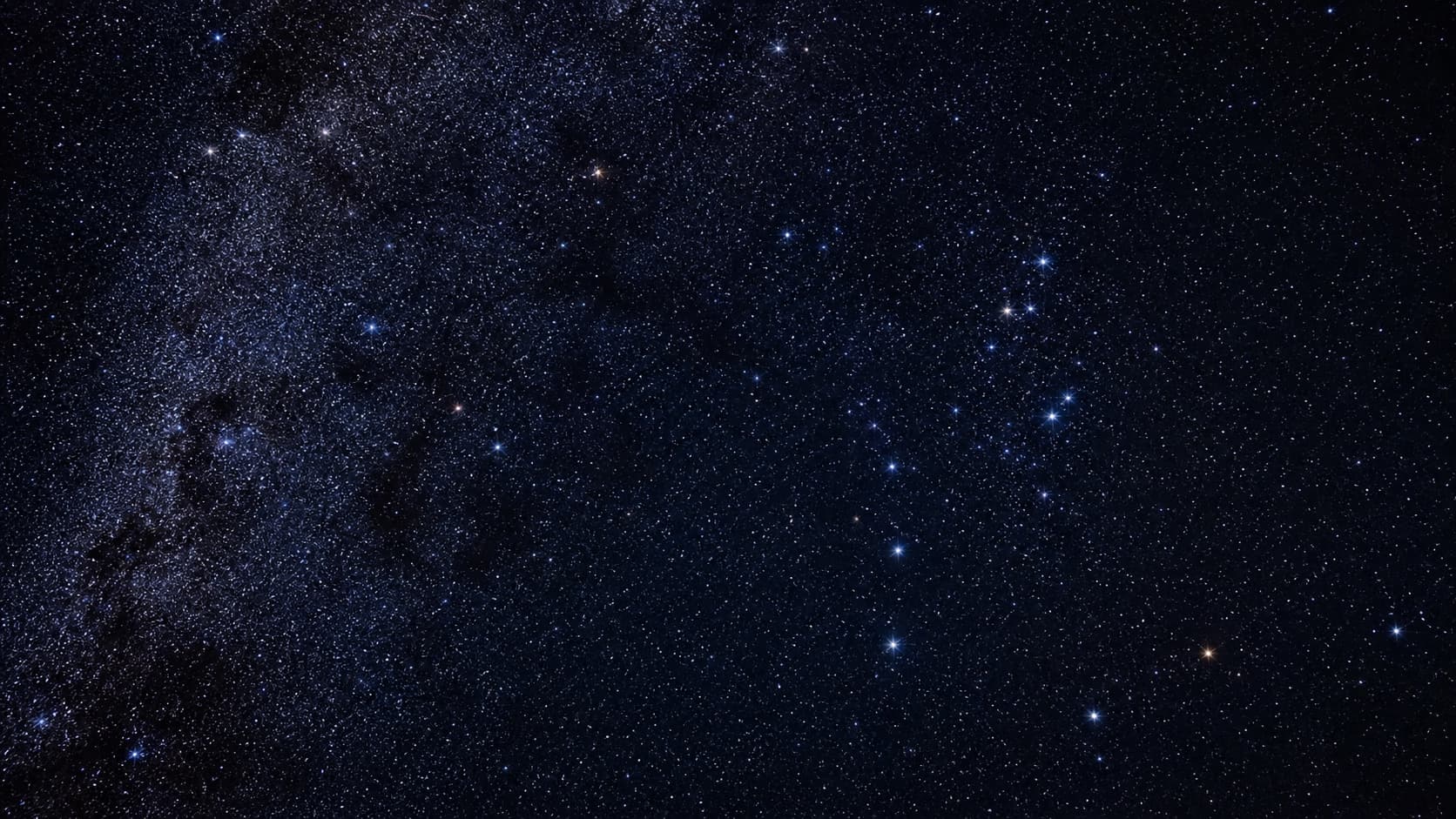
If you only ever learn one constellation, learn Orion. Three bright stars in a perfectly straight, evenly spaced line — that’s Orion’s belt, and it’s probably the single most recognizable pattern in the entire night sky.
Around the belt sits the rest of the hunter: two bright shoulders, two bright knees, a sword hanging from the belt, and arms holding a bow and a club. Orion is visible from almost everywhere on Earth, which is part of what makes it culturally universal.
How to find Orion’s belt
Step outside on a clear winter evening (Northern Hemisphere) or a clear summer evening (Southern Hemisphere) and look toward the southern sky.
You’re looking for three bright stars in a perfectly straight line, evenly spaced, fairly close together. No other pattern in the sky looks quite like this — once you see it, you’ll never lose it.
From left to right (Northern Hemisphere view), the three belt stars are Alnitak, Alnilam, and Mintaka. Each is a hot, bright, blue-white supergiant star hundreds of light-years away.
The full hunter
Once you’ve found the belt, the rest of Orion clicks into place around it.
- Betelgeuse — the bright orange-red star above and to the left of the belt. The hunter’s right shoulder.
- Bellatrix — the bright blue-white star above and to the right of the belt. The hunter’s left shoulder.
- Rigel — the brilliant blue-white star below and to the right. The hunter’s left knee, and the brightest star in the whole constellation.
- Saiph — the medium-bright star below and to the left of the belt. The right knee.
- The Sword — three faint dots hanging below the belt. The middle “star” isn’t a star; it’s the Orion Nebula (we’ll get to that).
The shoulders, belt, and knees together form a tall rectangle — the body of the hunter. From there, mythology adds a bow held up by his left arm and a club raised by his right.
Betelgeuse: the red supergiant about to die
Betelgeuse is one of the most interesting stars in the sky. It’s a red supergiant about 700 light-years away — meaning the light reaching your eye tonight left the star around the time of the Magna Carta.
It’s also huge. If you put Betelgeuse where our sun is, its outer edge would extend past the orbit of Jupiter, swallowing Earth and most of the solar system whole.
And it’s dying. Betelgeuse will go supernova within the next 100,000 years — could be tomorrow, could be millennia from now.
When it does, it will briefly be as bright as a half moon in the daytime sky and will be visible for months. (Don’t hold your breath; 100,000 years is a long window.)
Rigel: the brightest in the constellation
Despite being further down the body, Rigel is actually the brightest star in Orion. It’s a blue-white supergiant about 860 light-years away, ~120,000 times more luminous than our sun.
Rigel and Betelgeuse together are a study in contrast — one cool red supergiant on its way out, one hot blue supergiant in the prime of life. The warm-vs-cold color difference is visible to the naked eye if you look closely.
The Orion Nebula (M42)
Look at the middle star of the sword hanging from Orion’s belt — the one halfway down the three dots below the belt.
With your naked eye it looks slightly fuzzy. That’s because it isn’t a star at all — it’s a stellar nursery 1,300 light-years away.
The Orion Nebula (catalog name M42) is a vast cloud of gas and dust where new stars are being born right now. It’s one of the few deep-sky objects visible to the naked eye from light-polluted areas, and through binoculars or a small telescope it looks spectacular.
About 700 baby stars are forming inside it. Some of them will be sun-like in a few million years; some will be giants.
The Greek myth
Orion the hunter was a giant in Greek mythology, son of the sea god Poseidon. The myths around him are scattered and contradictory — he hunted with Artemis, boasted he could kill any creature on Earth, was killed by a giant scorpion sent to punish the boast, and was placed in the sky by Zeus.
The scorpion was placed on the opposite side of the sky, which is why the constellation Scorpius rises just as Orion sets — they never share the sky.
Different cultures saw very different shapes in the same pattern: a fishing canoe in Polynesian astronomy, a knot at the heart of the universe in Chinese astronomy, three Magi (the belt) in Christian European folklore. The pattern is universal; the story isn’t.
When and where to look
Northern Hemisphere
Best evening months: November through March. December and January are peak — Orion is high overhead in the southern sky around 9–10 PM.
In November you’ll see it rising in the east after sunset.
By March, it’s sliding toward the west. From April to October, Orion is in the daytime sky or too low at twilight to see well.
Southern Hemisphere
Same calendar months, opposite orientation.
From Sydney, Cape Town, or Buenos Aires, Orion appears high in the northern sky, with Betelgeuse at the bottom and Rigel at the top — effectively upside-down from the Northern Hemisphere view. Same stars, different rotation.
Orion as a sky pointer
Once you know Orion, you can find almost every other major winter constellation from it.
- Follow the belt up-and-to-the-right (NH): you’ll hit Aldebaran, the orange eye of Taurus, then the Pleiades cluster.
- Follow the belt down-and-to-the-left (NH): you’ll hit Sirius, the brightest star in the entire night sky (in Canis Major).
- Look up-and-to-the-left of Orion: the two bright stars Castor and Pollux mark Gemini.
- Look straight up from Betelgeuse: you’ll find Capella in Auriga.
For more on identifying named stars, see How to Identify Bright Stars and Planets.
The bridge: Orion as it actually looked overhead
On any clear winter night between November and March, Orion is overhead somewhere on Earth. If a meaningful date in your life falls in those months — a winter birthday, a December wedding, a January birth night — the print of that sky will have Orion in it, exactly where it was that evening.
Plug a date and place into the SkyWhen customizer and the preview will show whether Orion was visible. The preview is free.
For other constellations, see The Big Dipper and the North Star, Cassiopeia, and The 12 Zodiac Constellations.
FAQ
What is the brightest star in Orion?
Rigel, the blue-white supergiant at the hunter’s left knee — magnitude 0.13, the seventh-brightest star in the entire night sky. Betelgeuse is second-brightest in the constellation.
When can I see Orion?
From the Northern Hemisphere, November through March in the evening, with December and January being peak. From the Southern Hemisphere, the same months in the northern sky, but rotated upside-down.
Is Orion's belt three stars or a constellation?
Three stars within the constellation Orion. The full constellation has seven main bright stars; the belt is the three in the middle. The belt is sometimes called an “asterism” — a recognizable pattern that isn’t itself a constellation.
What is the Orion Nebula?
A stellar nursery 1,300 light-years away, hanging below the belt as the middle “star” of Orion’s sword. It’s a vast cloud of gas and dust where new stars are being born — visible to the naked eye as a fuzzy patch from dark skies.
Will Betelgeuse really explode?
Yes — sometime in the next 100,000 years. When it does, it will briefly be as bright as a half moon and visible in the daytime sky for months. Don’t hold your breath; the window is huge.