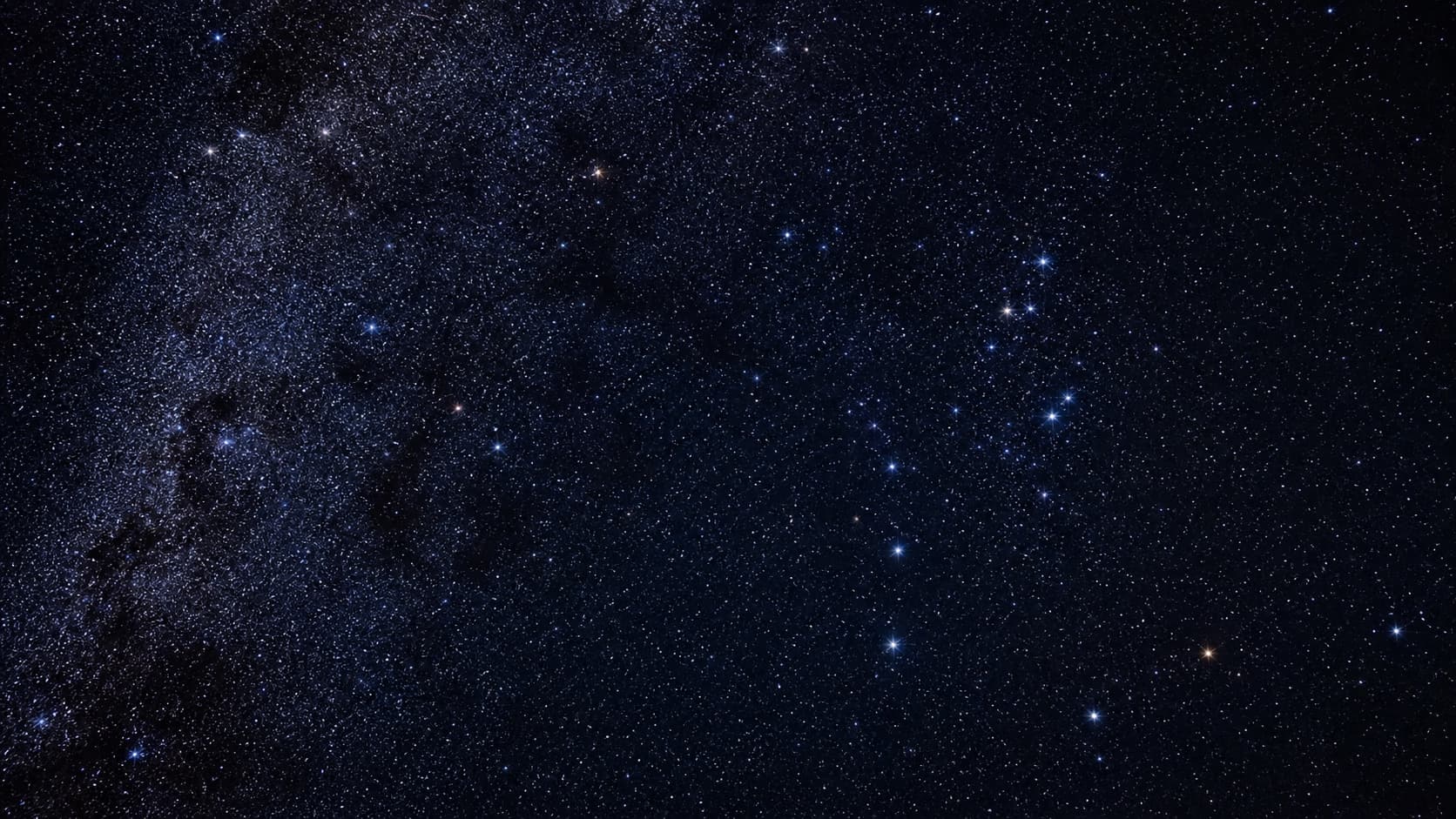
Cassiopeia is five bright stars arranged in a slightly lopsided W — or depending on the time of night and your latitude, an M, an E, or a Σ.
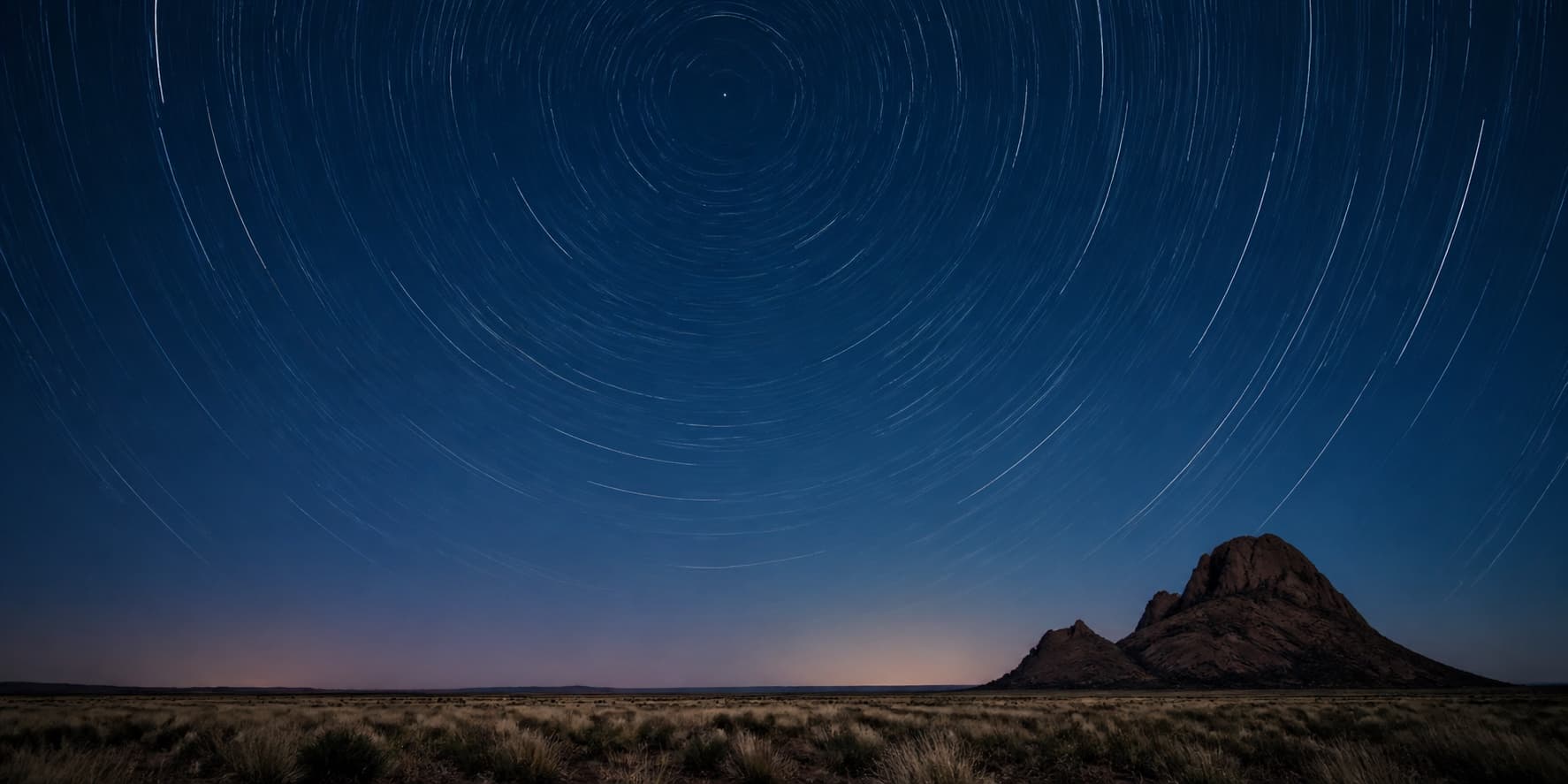
The shape is unmistakable. From most of the Northern Hemisphere, Cassiopeia is visible every clear night of the year, rotating slowly around Polaris.
It’s named after a vain queen in Greek mythology who was tied to her throne in the sky as punishment. Modern astronomy keeps the shape; the throne is gone.
The shape
Five bright stars, all of roughly similar magnitude, arranged in two zigzags that form the W. From bottom-left to bottom-right (Northern Hemisphere autumn-evening view), they are: Caph, Schedar, Gamma Cassiopeiae, Ruchbah, and Segin.
None of the five is especially famous, but together they make one of the most findable constellations in the entire northern sky.
The W rotates around Polaris through the night and the seasons. Sometimes it’s a W with the point upward.
Sometimes it’s an M with the point downward.
Sometimes the W is tilted sideways into an E or a Σ. The five-star pattern stays the same; only the orientation changes.
How to find it
Method 1: opposite the Big Dipper
The easiest method. Find the Big Dipper (you should already know how — see The Big Dipper and the North Star ).
Locate Polaris using the pointer stars. Then look on the opposite side of Polaris from the Dipper, roughly the same distance away.
The W of Cassiopeia will be right there, rotated to whatever orientation the current season gives you.
Method 2: along the Milky Way
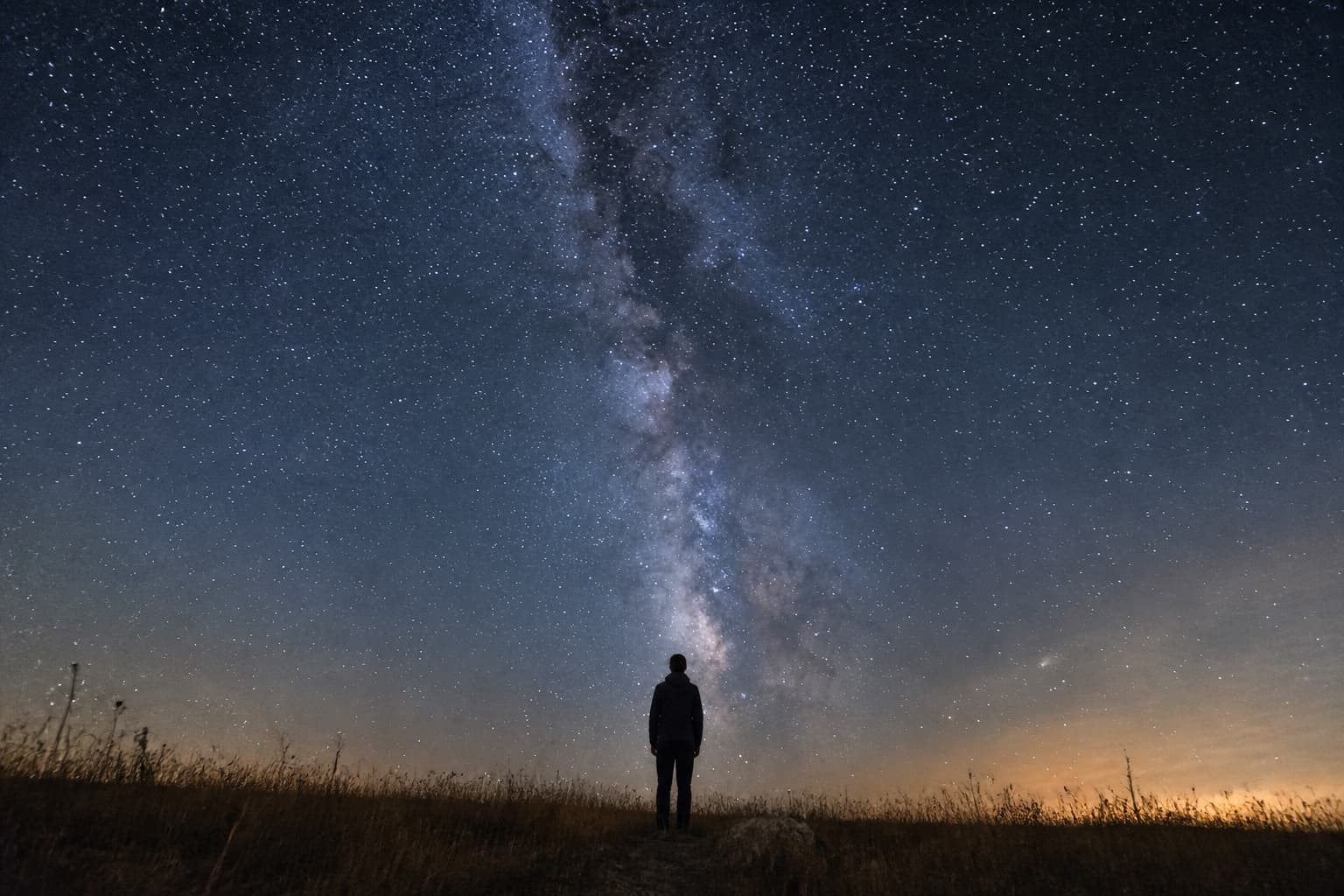
The Milky Way runs right through Cassiopeia.
On a dark night, the faint band of the Milky Way passes through the constellation, with the W draped across it. Following the Milky Way north from Cygnus (in summer) or south from Perseus (in winter) brings you to Cassiopeia.
When and where to look
Northern Hemisphere
Cassiopeia is circumpolar from anywhere above about 35° north. From New York, Chicago, London, or Berlin, it’s in the sky every clear night, somewhere.
Highest in the evening sky in autumn (September through December).
In summer, it’s low in the northeast at evening hours. In spring it’s low in the northwest.
Southern Hemisphere
From below about 20° south, Cassiopeia stays below the horizon and is invisible. From the tropics it’s briefly visible low in the north during certain months.
The Greek myth
Cassiopeia was the queen of ancient Aethiopia and the mother of Andromeda. The problem with her is that she boasted she and Andromeda were more beautiful than the Nereids — the sea nymphs and daughters of the sea god Poseidon.
Poseidon didn’t take it well. He sent a sea monster (Cetus) to attack Aethiopia’s coast, and Cassiopeia’s only way to save her kingdom was to chain her daughter Andromeda to a rock as a sacrifice.
Perseus, returning from killing Medusa, saw Andromeda chained to the rock, slew the sea monster, and rescued her.
The whole family ended up in the sky — Cassiopeia, Andromeda, Perseus, and Cepheus (the father). Cassiopeia’s punishment for her vanity was to be tied to her throne, which is why the W sometimes appears upside-down: she’s hanging from her chair.
The 1572 supernova
On November 11, 1572, a new star appeared inside the W of Cassiopeia — brighter than Venus, visible in the daytime. It stayed for 18 months and then faded away.
This was a Type Ia supernova — the explosion of a white dwarf in a binary system about 8,000 light-years away. The Danish astronomer Tycho Brahe studied it for over a year and proved that it was beyond the moon’s orbit, which was a big deal: the prevailing Aristotelian cosmology said the heavens were unchanging.
Tycho’s observations were one of the events that started the scientific revolution. The supernova’s remnant is still visible today in radio and X-ray wavelengths.
Cassiopeia’s neighbors
Cassiopeia sits in the middle of the family of mythological constellations built around the Andromeda story.
- Cepheus — the king (her husband), to the north-east, a faint constellation shaped like a house.
- Andromeda — her daughter, to the south, containing the famous Andromeda Galaxy.
- Perseus — the hero, to the east, with the variable star Algol marking the head of Medusa.
- Cetus — the sea monster, far to the south, the largest constellation in the family.
For the Andromeda details, see Andromeda: The Constellation, the Princess, and the Galaxy Inside It.
The bridge: a date when Cassiopeia was overhead
For any meaningful Northern Hemisphere date in late autumn or early winter, the star map will show Cassiopeia high overhead — possibly the most prominent shape in the print.
Plug a date into the SkyWhen customizer and the preview will show where the W was that night. The preview is free.
For neighboring constellations, see Andromeda, and for the system that points to it from the other side, see The Big Dipper and the North Star.
FAQ
What does Cassiopeia look like?
Five bright stars in a clear W or M shape (depending on rotation) in the northern sky. One of the most distinctive and findable constellations once you know the pattern.
When is the best time to see Cassiopeia?
Autumn evenings (September through December) from the Northern Hemisphere — that’s when it’s highest overhead. But from anywhere above 35° north, it’s circumpolar and visible every clear night of the year.
Is Cassiopeia visible from the Southern Hemisphere?
From below about 20° south, Cassiopeia stays below the northern horizon and isn’t visible. From the tropics it can be glimpsed low in the north during certain months.
What's the brightest star in Cassiopeia?
Schedar (Alpha Cassiopeiae), magnitude 2.24, an orange giant about 230 light-years away. Gamma Cassiopeiae is sometimes brighter, since it’s a variable star that fluctuates.
What's the myth behind Cassiopeia?
Cassiopeia was a queen in Greek mythology who boasted her daughter Andromeda was more beautiful than the sea nymphs. Poseidon sent a sea monster as punishment, and the whole family ended up in the sky. Cassiopeia was tied to her throne, which is why the W sometimes appears upside-down.