How the names came about
Most of the names you see in the calendar trace back to Indigenous North American naming conventions — Algonquin, Sioux, Ojibwe, and others — which assigned a name to each moon based on what was happening in the natural world that month. European colonists picked the names up, the Old Farmer’s Almanac codified them in the 1930s, and they spread from there into pop culture.
Different cultures have entirely different systems. Chinese tradition names the full moons by lunar month number (which shifts against the Gregorian calendar). Hindu, Buddhist, and Islamic calendars all anchor festivals to specific lunar months. The Almanac names below are the ones that became the English-language default.
Every month, on its own page
Each full moon has a page giving the exact moment of full phase in your own timezone and the moonrise for your latitude — the two numbers this list can’t give you, because both depend on where you are:
- Full moon January 2026 — the Wolf Moon (supermoon).
- Full moon February 2026 — the Snow Moon.
- Full moon March 2026 — the Worm Moon.
- Full moon April 2026 — the Pink Moon.
- Full moon May 2026 — the Flower Moon and the Blue Moon.
- Full moon June 2026 — the Strawberry Moon.
- Full moon July 2026 — the Buck Moon.
- Full moon August 2026 — the Sturgeon Moon.
- Full moon September 2026 — the Harvest Moon.
- Full moon October 2026 — the Hunter's Moon (supermoon).
- Full moon November 2026 — the Beaver Moon (supermoon).
- Full moon December 2026 — the Cold Moon (supermoon).
- Full moon January 2027 — the Wolf Moon (supermoon).
- Full moon February 2027 — the Snow Moon (supermoon).
- Full moon March 2027 — the Worm Moon.
- Full moon April 2027 — the Pink Moon.
- Full moon May 2027 — the Flower Moon.
- Full moon June 2027 — the Strawberry Moon.
- Full moon July 2027 — the Buck Moon.
- Full moon August 2027 — the Sturgeon Moon.
- Full moon September 2027 — the Harvest Moon.
- Full moon October 2027 — the Hunter's Moon.
- Full moon November 2027 — the Beaver Moon.
- Full moon December 2027 — the Cold Moon (supermoon).
The 2026 lineup, month by month
January 3 · Wolf Supermoon
The first full moon of the year — and one of 2026’s four supermoons, at 362,300 km from Earth. Named for the wolves heard howling outside winter villages — likely a mix of hunger calls and mating-season territorial behavior. Rises with the long winter night, which means it’s above the horizon for hours and easy to photograph.
February 1 · Snow Moon
Almost-shortest full-moon-to-full-moon gap of the year. Named for February being the snowiest month across much of the temperate Northern Hemisphere.
March 3 · Worm Moon (Total Lunar Eclipse)
Two events in one night. Worm Moon for the earthworms returning as the ground thaws — and a total lunar eclipse, with the moon passing fully through Earth’s shadow. Totality runs about 58 minutes. Visible across the Pacific, Asia, Australia, and western North America.
April 1 · Pink Moon
Not pink. Named for moss phlox — an early-spring wildflower that carpets fields and roadsides in eastern North America. The moon itself looks the usual cream-yellow.
May 1 · Flower Moon
Peak wildflower season across the temperate latitudes. Tends to rise with a warm orange tint because of the low spring-evening angle through more atmosphere.
May 31 · Blue Moon
Second full moon in the same calendar month — hence the expression “once in a Blue Moon.” They happen about every 2.5 years; 2026 is one of them. The moon itself won’t look blue, but it’s a nice excuse for an evening walk.
June 29 · Strawberry Moon
Strawberry season is short in the eastern North American woodlands, and June’s full moon marked when wild strawberries were ready to pick. (Cultivated strawberries are ready earlier — the name predates modern agriculture.)
July 29 · Buck Moon
Male deer’s antlers reach full size in late summer, just before the rut. Some traditions call this the Thunder Moon for the summer storm season.
August 28 · Sturgeon Moon (Partial Lunar Eclipse)
Lake sturgeon spawn in late summer in the Great Lakes, where they were once a staple catch. The moon is well outside supermoon range here (390,400 km), but the night is special for a different reason — a partial lunar eclipse. About 93% of the moon enters Earth’s umbra at maximum, visible from the Americas, most of Africa, and Europe.
September 26 · Harvest Moon
The Harvest Moon is the full moon closest to the autumn equinox. For several nights running it rises shortly after sunset, giving farmers extra light to bring in the crop before the first frosts.
October 26 · Hunter’s Supermoon
First of three consecutive year-end supermoons (368,900 km). Named for hunters using the bright early moonrise to track game across stubble fields after the harvest.
November 24 · Beaver Supermoon
Second of the three (360,800 km). Named for beavers finishing dam-building before lakes freeze; in the colonial era this also marked the opening of the beaver-trapping season.
December 24 · Cold Supermoon
Christmas Eve full moon — and the closest full moon of 2026 at 356,700 km, making it the year’s biggest, brightest supermoon. Rides high in the sky because the ecliptic tilts high in winter from the Northern Hemisphere — the opposite of the Cold Moon’s sun, which is at its lowest. Long, bright winter nights.
2026’s supermoons
Supermoons cluster. The moon’s perigee — its closest point to Earth — slowly drifts around its orbit, and when perigee happens to land near full phase for several months in a row, you get a run of supermoons. 2026 has four — the Wolf Moon kicking off the year in January, and then a tight October–December run as perigee converges on the winter full moons.
The Cold Moon on December 24 is the closest of the year — the biggest, brightest supermoon of 2026. It will be visibly larger than the regular full moons of mid-year — most easily seen if you compare side-by-side photos taken at the same time of night.
Note: you may see other 2026 dates described as supermoons elsewhere online. Definitions vary — looser thresholds will count the Sturgeon (August) and Harvest (September) moons too. We use a 370,000 km cutoff, close to the Espenak/Nolle convention, which captures genuine perigee-near-full pairings and skips the borderline ones.
For the why-and-how of supermoons, see Supermoons and Full Moon Names. For the two 2026 lunar eclipses, see Lunar Eclipse Explained.
Watching a full moon properly
A few small things to make a full-moon night feel like an event rather than “the moon is up”:
- Look at moonrise. The horizon moon looks much larger than the overhead moon — partly an optical illusion, partly atmospheric magnification. It’s also tinted warm orange because of the long atmospheric path. The tool above gives you the exact moonrise time for your location.
- Have something in the foreground. A tree, a building, a hilltop. The moon photographs and looks larger with foreground context.
- Bring binoculars if you have them. The terminator (the line between lit and shadowed lunar surface) is where the texture is. Full moon has no terminator on the near side, so binoculars instead reveal the dark marias and bright ray craters.
- Phone photos: try the lower exposure. A full moon’s “automatic” exposure tends to overexpose into a white blob. Drop the exposure compensation by 1–2 stops and the texture reappears.
And if it’s a night that matters
Full moon nights tend to anchor memories. A first date under a warm summer moon. A long winter walk under the Wolf Moon. A September supermoon glowing through fall leaves.
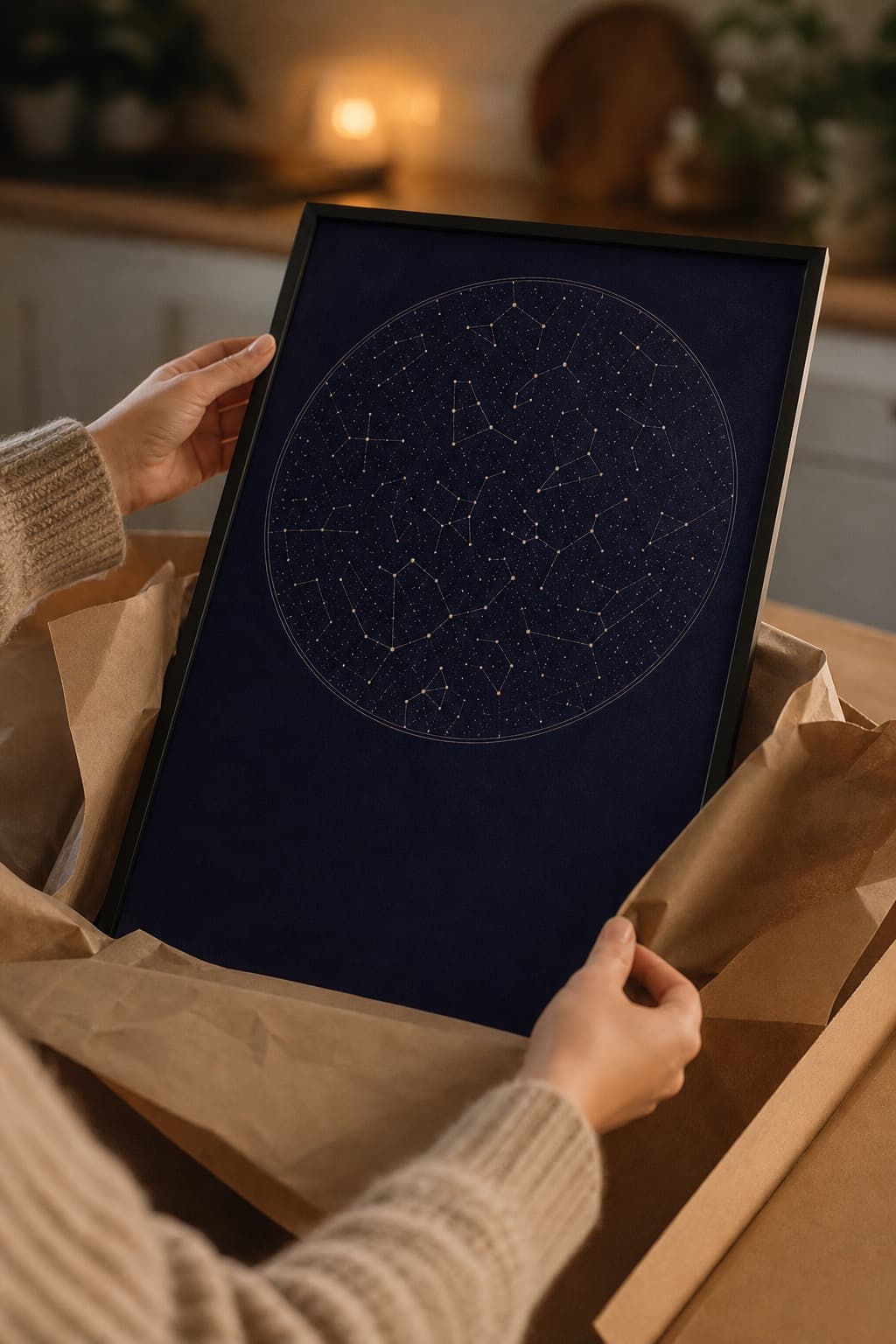
The “Save this sky” button next to each entry opens our customizer with that exact night and your location pre-filled. The poster renders the full moon, the surrounding constellations, and any visible planets — same engine that powers every other tool on this site.
FAQ
When is the next full moon?
The countdown card at the top of this page shows the next full moon for your location — its name, date, and how many nights away it is. Full moons happen roughly every 29.5 days, which is why most calendar months have exactly one.
Why do full moons have names like Wolf, Snow, and Worm?
These are traditional Almanac names — most of them passed down from Indigenous North American naming conventions and adopted into European-American almanacs in the 1800s. Each name tags a seasonal marker: wolves howling in January, snow falling heaviest in February, worms reappearing as the ground thaws in March, and so on.
Different cultures around the world have entirely different naming systems. The names you see here are the ones that became standard in English-language almanacs and pop culture.
What is a supermoon?
A full moon that happens while the moon is unusually close to Earth. The moon’s orbit is slightly elliptical, so its distance varies by about 50,000 km across the month. A full moon within ~370,000 km of Earth is generally called a supermoon — it appears roughly 7% wider and 15% brighter than an average full moon.
2026 has four supermoons: the Wolf Moon (January 3), then a tight year-end run with the Hunter’s (October 26), Beaver (November 24), and Cold (December 24). The Cold Moon on Christmas Eve is the closest of all four — the biggest, brightest full moon of 2026.
What is a Blue Moon?
A second full moon in the same calendar month. It happens roughly every 2.5 years, hence the phrase “once in a Blue Moon.” Astronomically, there’s nothing special about it — it’s just a quirk of how a 29.5-day lunar cycle lines up with 30- and 31-day calendar months.
2026 has one Blue Moon — May 31, the second full moon of that month after the Flower Moon on May 1.
Why do the dates seem ‘off’ from the calendar I usually see?
Full moon times are precise instants in UTC, and the corresponding local date can fall on either side of midnight depending on your timezone. The full moon of July 29 at 14:35 UTC, for example, is late on July 29 in Europe but mid-day on July 29 in California — where the “moon you see at night” will be the moon as it rises that evening, not the precise full-phase instant earlier in the day.
We show the UTC date here; for the moonrise time you’ll actually use, the tool resolves that against your location once you’ve shared it.
Can I get a poster of a specific full moon night?
Yes — the “Save this sky” button next to each moon opens the customizer pre-filled with that night’s date and your location. The poster renders the moon as full (because the date is the full-moon date) along with the surrounding constellations and any visible planets.
The full digital bundle is $29 as a one-time download — print files, wallpapers, and social-sized images.