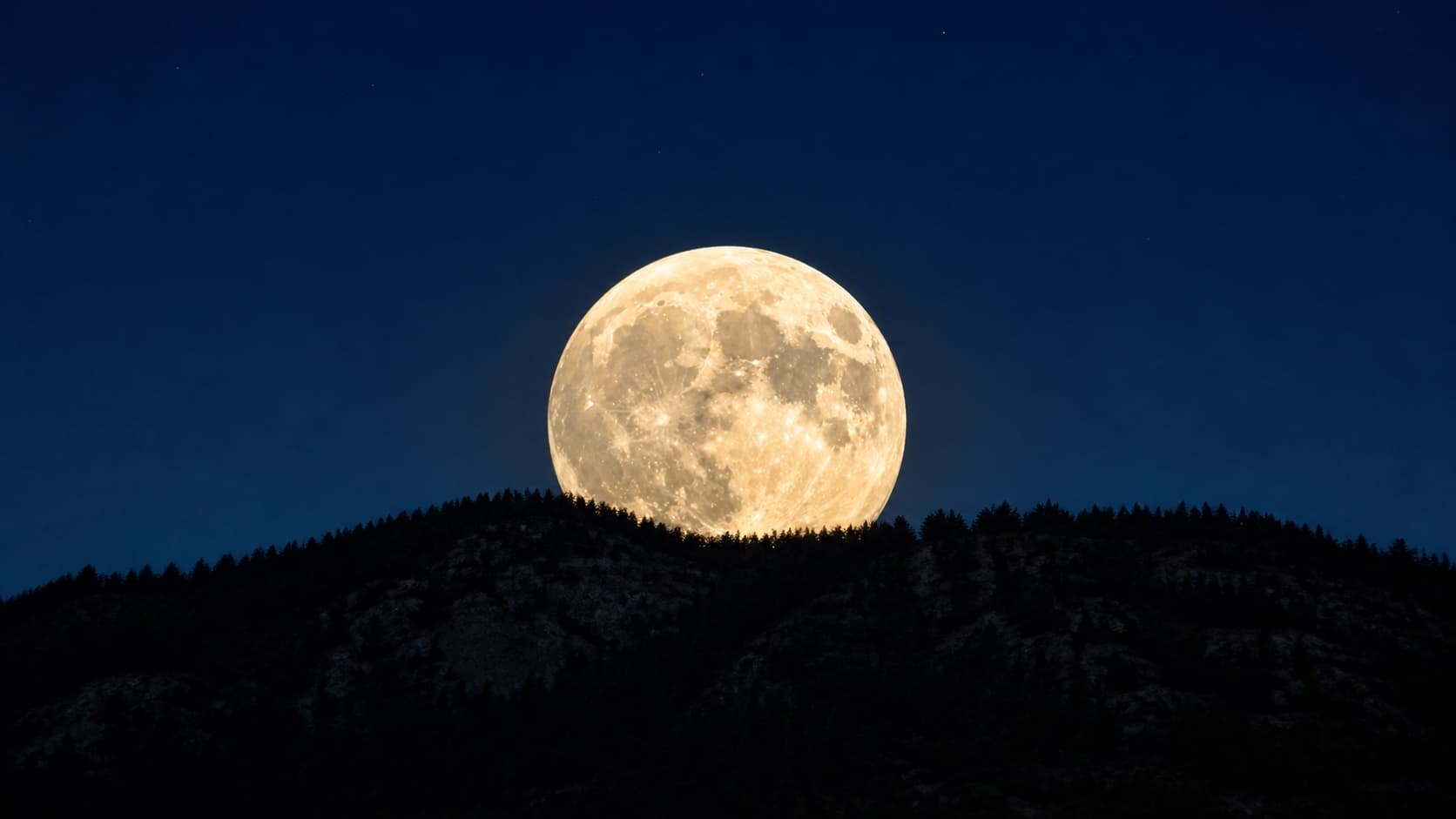
A supermoon is a full moon that happens to land on a date when the moon is close to its closest approach to Earth. It looks roughly 14% larger and 30% brighter than a full moon at its farthest — small enough that you wouldn’t notice without a side-by-side, big enough to be worth a calendar reminder.
Every month’s full moon also has a traditional name — Wolf, Snow, Worm, Pink, and so on.
Most of those names come from Native American, Old English, and colonial almanac traditions. They’re not astronomical terms, but they’re the lens through which most people now talk about the year’s lunar calendar.
The live tool above shows what’s overhead from your location right now — handy for checking whether tonight is a moonlit night or a dark-sky one. Standalone page at skywhen.com/tools/sky-tonight.
What a supermoon actually is
The moon’s orbit around Earth isn’t a perfect circle. It’s an ellipse — slightly stretched — so the moon is closer to us at some points in its month and farther at others.
The closest point is called perigee, the farthest is apogee. The difference between them is about 50,000 kilometers — significant in solar-system terms, small enough relative to the average lunar distance that the visual difference is subtle but real.
A supermoon is just a full moon that falls within a window of perigee. There’s no official astronomical definition; the term was coined by an astrologer in 1979 and adopted by NASA and the press because it gave the public a useful way to talk about close full moons.
- JAN3★QuadrantidsMeteor shower
Sharp, short peak (~120/hour) in a six-hour window. Northern Hemisphere, pre-dawn.
- JAN3●Wolf supermoonSupermoon
First of four supermoons in 2026, 362,300 km from Earth. Same night as the Quadrantids — but the bright moon will wash out the shower.
- FEB17◐Annular solar eclipseSolar eclipse
“Ring of fire” eclipse. Path crosses Antarctica and the tip of South America; partial phases visible across the Southern Hemisphere.
Annularity from Antarctica / southern South America
- MAR3○Total lunar eclipseLunar eclipse
Blood moon — the moon passes through Earth's shadow and turns coppery red. Visible across the Pacific, Asia, Australia, and western North America.
Best from the Pacific, Asia, Australia, western North America
- MAR8◇Venus and SaturnConjunction
Bright Venus and pale Saturn less than a degree apart, low in the western evening twilight. Catch them soon after sunset before they set.
- MAR20—March equinoxEquinox
Day and night equal across the globe. Spring begins in the Northern Hemisphere, autumn in the Southern.
Set a location above to see which events are above your horizon at peak.
That’s the live 2026 calendar with each supermoon’s date and Above horizon / Below horizon flag for your location. Full filterable year at skywhen.com/tools/2026-sky-calendar.
How big does a supermoon actually look?
At perigee, the moon’s apparent diameter is about 14% larger than at apogee.
It’s about 30% brighter. Both are real differences, both are roughly unnoticeable to a person looking at the sky on any one night.
Most of the “wow” you feel about a low-on-the-horizon supermoon is the moon illusion — a separate, well-known optical phenomenon where the moon looks much bigger when it’s near the horizon, regardless of whether it’s a supermoon or not.
Photos that show a giant moon hanging over a city skyline are almost always taken with a long telephoto lens that compresses perspective, making the moon look disproportionately huge compared to the buildings below. The moon doesn’t actually look that big — but it’s a fun illusion.
Where the full moon names come from
Most of the names commonly used in English (Wolf Moon, Snow Moon, Harvest Moon, etc.) come from a mix of Native American and colonial American traditions for tracking the seasons. The Old Farmer’s Almanac codified them in the 1930s, drawing primarily from Algonquian peoples in the northeastern United States.
Each name reflects what was happening in the natural world during that month — animals, weather, planting, harvest.
They were a kind of agricultural calendar. Different tribes had different names; what gets used in mainstream English is one common version among many.
The traditional names by month
- January — Wolf Moon. Named for the howling of wolves heard in the deep cold of midwinter.
- February — Snow Moon. Named for the heaviest snowfall month of the year in the northeastern US.
- March — Worm Moon. Named for the earthworms beginning to surface as the ground thaws.
- April — Pink Moon. Named for moss pink (creeping phlox), one of the first widespread spring wildflowers — not for the moon’s color.
- May — Flower Moon. Named for the abundance of spring blooms.
- June — Strawberry Moon. Named for the brief wild strawberry harvest in the northeastern US in early summer.
- July — Buck Moon. Named for the time when young male deer (bucks) start growing new antlers.
- August — Sturgeon Moon. Named for the abundance of sturgeon in the Great Lakes during this month.
- September — Corn Moon (or Harvest Moon). Named for the corn harvest. The Harvest Moon name moves to October when the full moon nearest the autumn equinox falls there instead.
- October — Hunter’s Moon (or Harvest Moon). Named for the time hunters traditionally tracked game across cleared autumn fields.
- November — Beaver Moon. Named for the time beavers reinforce their lodges before winter.
- December — Cold Moon. Named for the onset of true winter cold.
The 2026 full moons
The calendar above tracks all thirteen, with moonrise times resolved for your location. The static list below is here for reference.
- January 3 — Wolf Moon (supermoon)
- February 1 — Snow Moon
- March 3 — Worm Moon (total lunar eclipse — also a blood moon)
- April 2 — Pink Moon
- May 1 — Flower Moon
- May 31 — Blue Moon (second full moon in May)
- June 29 — Strawberry Moon
- July 29 — Buck Moon
- August 28 — Sturgeon Moon (partial lunar eclipse)
- September 26 — Harvest Moon
- October 26 — Hunter’s Moon (supermoon)
- November 24 — Beaver Moon (supermoon)
- December 24 — Cold Moon (supermoon — closest of the year)
May 31 is a Blue Moon — a second full moon in the same calendar month, which happens roughly every 2.5 years. The technicalities live in What Is a Blue Moon?.
Why four supermoons in 2026
The moon’s perigee is not fixed at one calendar date — it drifts through the year. When perigee happens to line up near full phase for several months, you get a run of supermoons.
2026 has four.
The Wolf Moon kicks off the year as a supermoon in January, and then three more close out the year — the Hunter’s (October 26), Beaver (November 24), and Cold (December 24). The Cold Moon is the closest of the year at 356,700 kilometers, making it the biggest, brightest supermoon of 2026.
You’ll see other 2026 dates described as supermoons in the press — the Sturgeon Moon in August and the Harvest Moon in September get the label often.
Both are well outside the standard supermoon distance window. The looser definitions some outlets use end up counting moons that don’t actually look distinguishable from any other full moon.
How to actually watch a supermoon
The best moment to watch a supermoon is at moonrise — the moment the moon first clears the horizon. The combination of the moon illusion (which makes the horizon-moon look bigger) and the warm colors of an atmospheric-filtered moon at low angle is the best version of the experience.
- Check moonrise time. It’s different every day. The full moon rises around sunset on the exact day of full phase.
- Find an eastern horizon. Ideally with something for scale — trees, a city skyline, mountains, a bridge.
- Bring a phone or DSLR. Most phones from the iPhone 13 Pro onward can capture a moon photograph that’s actually shareable.
- Watch the first ten minutes. The moon climbs about one moon-diameter every two minutes. The horizon period is the visually richest part of the night.
The bridge: the full moon as a date marker
One useful thing about the full moon calendar is that it gives people who don’t track astronomy a way to remember a date. “We met during the Strawberry Moon” is the kind of detail that sticks.
A custom star map of that night renders the actual moon phase (full, in the case of a full-moon date) and the surrounding stars from the location you watched. Plug in a date you remember at the SkyWhen customizer — the preview is free, and the moon will show as it actually appeared.
For a single special supermoon, see The 2026 Sky Calendar. For the technicalities of blue moons (when a calendar month gets two full ones), see What Is a Blue Moon?
FAQ
How often is there a supermoon?
There are usually three to four supermoons per year, often in a consecutive run because lunar perigee drifts slowly through the calendar.
2026 has four in a row from August through November.
How much bigger does a supermoon look?
About 14% larger and 30% brighter than the smallest full moon of the year. Real but subtle — hard to notice without a side-by-side comparison.
Most of the dramatic “huge moon over the city” photos are long-lens compression, not actual size differences.
Why is it called a Pink Moon if it's not pink?
The April full moon is named for moss pink (creeping phlox), an early spring wildflower that blooms across the eastern United States. The moon itself isn’t pink.
When is the next supermoon?
The next supermoon in 2026 is August 28 (the Sturgeon Moon). Three more follow in September, October, and November.
Why does the moon look bigger when it's near the horizon?
The moon illusion — a well-known optical effect where the brain perceives objects near the horizon as larger than the same objects high overhead. It has nothing to do with the moon’s actual distance.
A simple test: photograph the moon at moonrise and again at zenith with the same lens. The two images will be the same size.