Most years, the night sky has a handful of events worth setting an alarm for. 2026 is a busy one. There are seven significant meteor showers, two solar eclipses, two lunar eclipses, four supermoons (one in January, three at year-end), and a string of close planetary pairings.
This is the one-page version. Dates, what each event actually is, and how to actually see it without expensive gear.
- JAN3★QuadrantidsMeteor shower
Sharp, short peak (~120/hour) in a six-hour window. Northern Hemisphere, pre-dawn.
- JAN3●Wolf supermoonSupermoon
First of four supermoons in 2026, 362,300 km from Earth. Same night as the Quadrantids — but the bright moon will wash out the shower.
- FEB17◐Annular solar eclipseSolar eclipse
“Ring of fire” eclipse. Path crosses Antarctica and the tip of South America; partial phases visible across the Southern Hemisphere.
Annularity from Antarctica / southern South America
- MAR3○Total lunar eclipseLunar eclipse
Blood moon — the moon passes through Earth's shadow and turns coppery red. Visible across the Pacific, Asia, Australia, and western North America.
Best from the Pacific, Asia, Australia, western North America
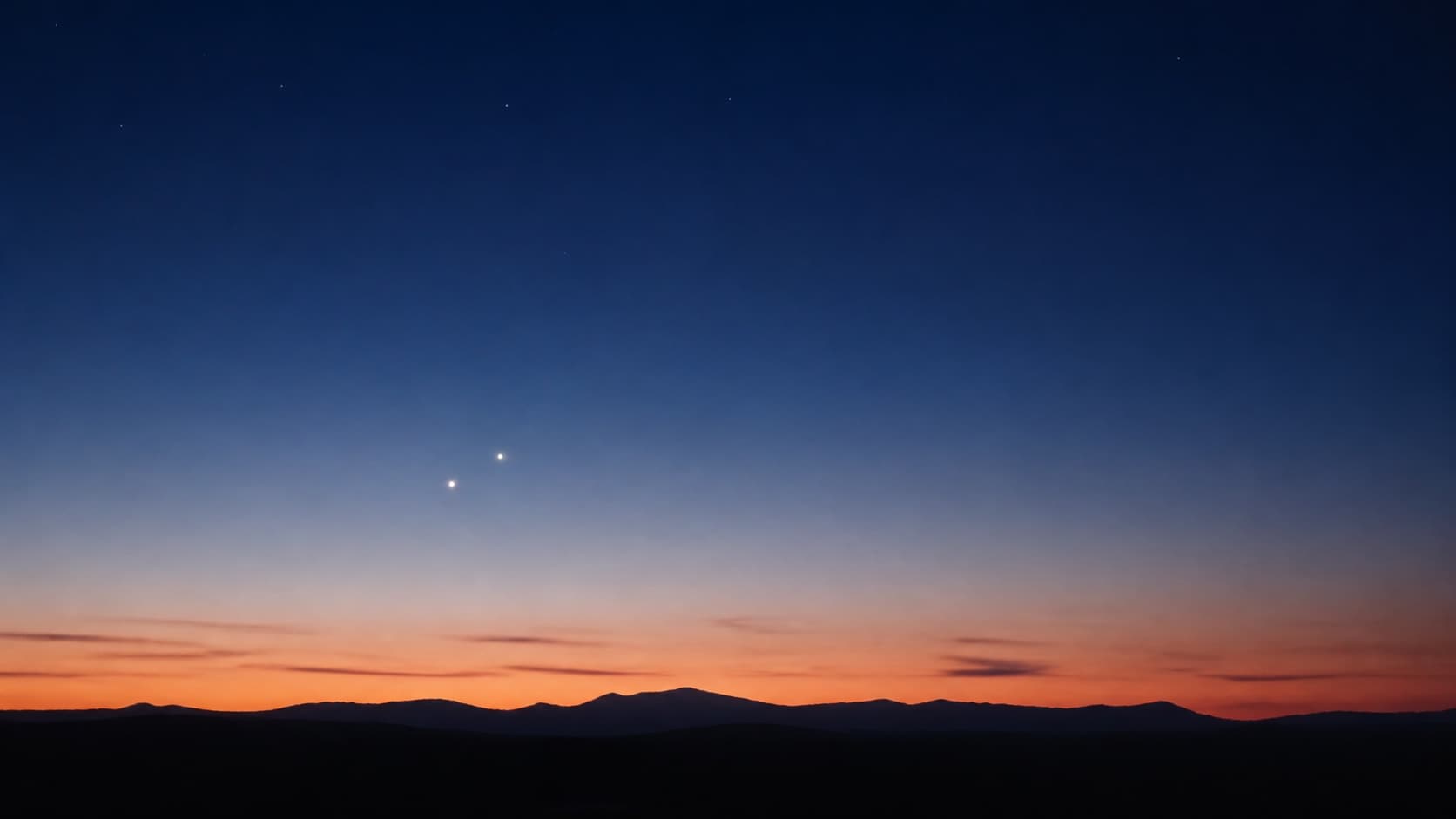
- MAR8◇Venus and SaturnConjunction
Bright Venus and pale Saturn less than a degree apart, low in the western evening twilight. Catch them soon after sunset before they set.
- MAR20—March equinoxEquinox
Day and night equal across the globe. Spring begins in the Northern Hemisphere, autumn in the Southern.
Set a location above to see which events are above your horizon at peak.
That’s the live calendar — set a location and you’ll see which events are actually above your horizon at peak. The full year, filterable, lives at skywhen.com/tools/2026-sky-calendar.
The meteor showers
Meteor showers are nights when Earth flies through a trail of comet or asteroid dust.
The dust burns up in the upper atmosphere and you see streaks. Most years there are about a dozen showers worth a look; the seven below are the ones worth planning around.
None of them need equipment. You need a dark sky, a chair you can lean back on, and roughly thirty minutes for your eyes to adjust to the dark.
Quadrantids — peaks January 3
Sharp peak, short window.
Most of the show happens inside a six-hour spike, so the night before or after barely counts. Best viewed from the Northern Hemisphere in the early hours.
Lyrids — peaks April 22
Modest rate (around 15–20 per hour at peak) but reliable, and one of the oldest showers humans have recorded. Best after midnight, looking northeast.
Eta Aquariids — peaks May 5–6
Debris from Halley’s Comet. Favors the Southern Hemisphere and tropical latitudes — from London or New York you’ll see maybe ten an hour, from Sydney or Cape Town more like fifty.
Perseids — peaks August 12–13
The headline summer shower.
Up to 100 meteors per hour in a dark sky, warm northern-hemisphere nights, no special gear. The 2026 peak coincides with a waning crescent moon, which is excellent — the sky stays dark.
Orionids — peaks October 21–22
The other Halley’s Comet shower. Around 20 per hour, fast streaks, often with long persistent trails.
Leonids — peaks November 17–18
Variable. Usually quiet (10–15 per hour) but occasionally explosive every 33 years or so when Earth crosses the densest dust ribbon. 2026 is a normal year.
Geminids — peaks December 13–14
The best shower of the year, hands down. 120+ per hour at peak, bright slow meteors, and unusually colorful (yellows, greens, blues). The only catch is the cold — December in the Northern Hemisphere is not a comfortable place to lie on the ground.
The eclipses
Four eclipses in 2026 — two solar and two lunar. Two of them are dramatic enough to be worth traveling for.
Annular solar eclipse — February 17
The “ring of fire” eclipse.
The moon passes in front of the sun but doesn’t quite cover it, leaving a bright ring around the edge. Path of annularity crosses Antarctica and the southern tip of South America; partial phases are visible across much of the Southern Hemisphere.
Total lunar eclipse — March 3
A blood moon. The moon passes through Earth’s shadow and turns coppery red.
Visible across the Pacific, Asia, Australia, and western North America. No equipment needed, no eye protection needed — lunar eclipses are completely safe to stare at.
Total solar eclipse — August 12
The big one.
Path of totality crosses Iceland, Spain, and a thin slice of Portugal. Totality lasts about two minutes in the best spots.
For partial-phase observers in nearby Europe and northern Africa, this is still a very interesting eclipse — just remember that the only safe time to look directly is during totality itself, and only if you’re actually inside the path of totality.
Partial lunar eclipse — August 28
Earth’s shadow takes a small bite out of the moon for a few hours.
Pretty, but not the same as a blood moon. Visible from the Americas, most of Africa, and Europe.
The supermoons
A supermoon is just a full moon that happens to fall on a date when the moon is at its closest point to Earth.
It looks about 14% larger and 30% brighter than a full moon at its farthest. The effect is real but subtle — most of the “wow” comes from the moon’s position low on the horizon, not from the distance itself.
2026 has four — one in January, then three in a row at year-end:
- Wolf Moon — January 3 (362,300 km)
- Hunter’s Moon — October 26 (368,900 km)
- Beaver Moon — November 24 (360,800 km)
- Cold Moon — December 24 (356,700 km — closest of the year)
The Cold Moon on December 24 is the closest full moon of the year — the biggest, brightest supermoon of 2026, and a Christmas Eve full moon at that. Worth a calendar reminder.
Planetary conjunctions worth watching
A conjunction is when two or more planets appear close together in the sky from Earth’s point of view. They’re not actually close in space, but the visual effect is striking — two or three bright dots within a few degrees of each other.
Venus and Saturn — March 8
Bright Venus and pale Saturn less than a degree apart, low in the western evening twilight. Catch them soon after sunset, before they sink toward the horizon.
Venus and Jupiter — June 10
The two brightest planets side by side in the evening sky, in the west after sunset. The showpiece pairing of the year — impossible to miss, even from a city.
Mars and the Beehive Cluster — October 7–9
Less famous, but charming if you have binoculars. Mars drifts through the heart of the Beehive Cluster (a loose group of stars in Cancer) over a couple of nights.
The aurora outlook
Solar Cycle 25 peaked in 2024–2025, so 2026 is the gentle slope downward. That’s still a very strong aurora year — the sun stays active for several years after its formal peak.
From inside the auroral oval (Iceland, Norway, Finland, northern Canada, Alaska) you can expect aurora activity on most clear nights from September through April. From mid-latitudes (UK, northern US, southern Canada) the spectacular displays will be less frequent than 2024 but still meaningfully more common than in a quiet solar year.
We wrote a deeper guide in Northern Lights 101 .
How to actually plan a night
Pick the event, find the date, get to a dark spot, and let your eyes adjust. Five things make the difference between a frustrating night and a memorable one:
- Dark sky. Even a small city kills meteor visibility. Aim for at least an hour’s drive from major light pollution.
- Moon phase. A full moon during a meteor shower can wash out most of the show. Cross-check the lunar calendar before the event.
- Cloud cover. Check the forecast the day before. If the local forecast is bad, you can sometimes find clear sky an hour’s drive away.
- Comfort. Reclining chair, sleeping bag if it’s cold, no screens to wreck your night vision.
- Patience. Most events ramp up slowly. Plan to stay at least an hour after your eyes adjust.
The bridge: keeping the night
Most of these events are gone the next day. The Geminid meteor that almost made you cry, the August 12 totality, the supermoon you watched rise over your favorite stretch of coast — they happen, and then they don’t happen again.
One thing you can keep is the sky itself, on the exact date and place you saw it. A custom star map renders the actual arrangement of stars, planets, and moon phase from that night, anchored to that latitude and longitude.
Try a date you cared about at the SkyWhen customizer — the preview is free.
If you want to dive into a single event, we have explainers on meteor showers, lunar eclipses, and solar eclipses — each one goes a level deeper than this calendar.
FAQ
What is the biggest sky event of 2026?
The total solar eclipse on August 12, crossing Iceland and Spain. About two minutes of totality at the centerline — the kind of event people travel across continents for.
A close second is the total lunar eclipse on March 3, which is visible across most of Asia and the Pacific without any travel or equipment.
When is the next meteor shower in 2026?
After the Quadrantids in early January, the next major one is the Lyrids in late April, then the Eta Aquariids in early May.
The two best of the year are the Perseids in mid-August and the Geminids in mid-December.
When is the next supermoon in 2026?
The Wolf Moon on January 3 kicks off the year as a supermoon. Then three more close it out — the Hunter’s (October 26), Beaver (November 24), and Cold (December 24). The Cold Moon on Christmas Eve is the closest and brightest of 2026.
Do I need a telescope to watch a meteor shower or eclipse?
No. Meteor showers, lunar eclipses, and supermoons are all naked-eye events. A reclining chair and a dark sky are the only requirements.
Solar eclipses require certified eclipse glasses for the partial phases. The brief moment of totality itself is safe to view directly.
Is there a meteor shower tonight?
The big showers each have a specific peak date, but the wider activity often runs for a week or more on either side. Check the dates in the meteor-shower section above against today.
On any clear night you can also catch sporadic meteors — random, unaffiliated streaks — at a rate of maybe four to six per hour from a dark site.