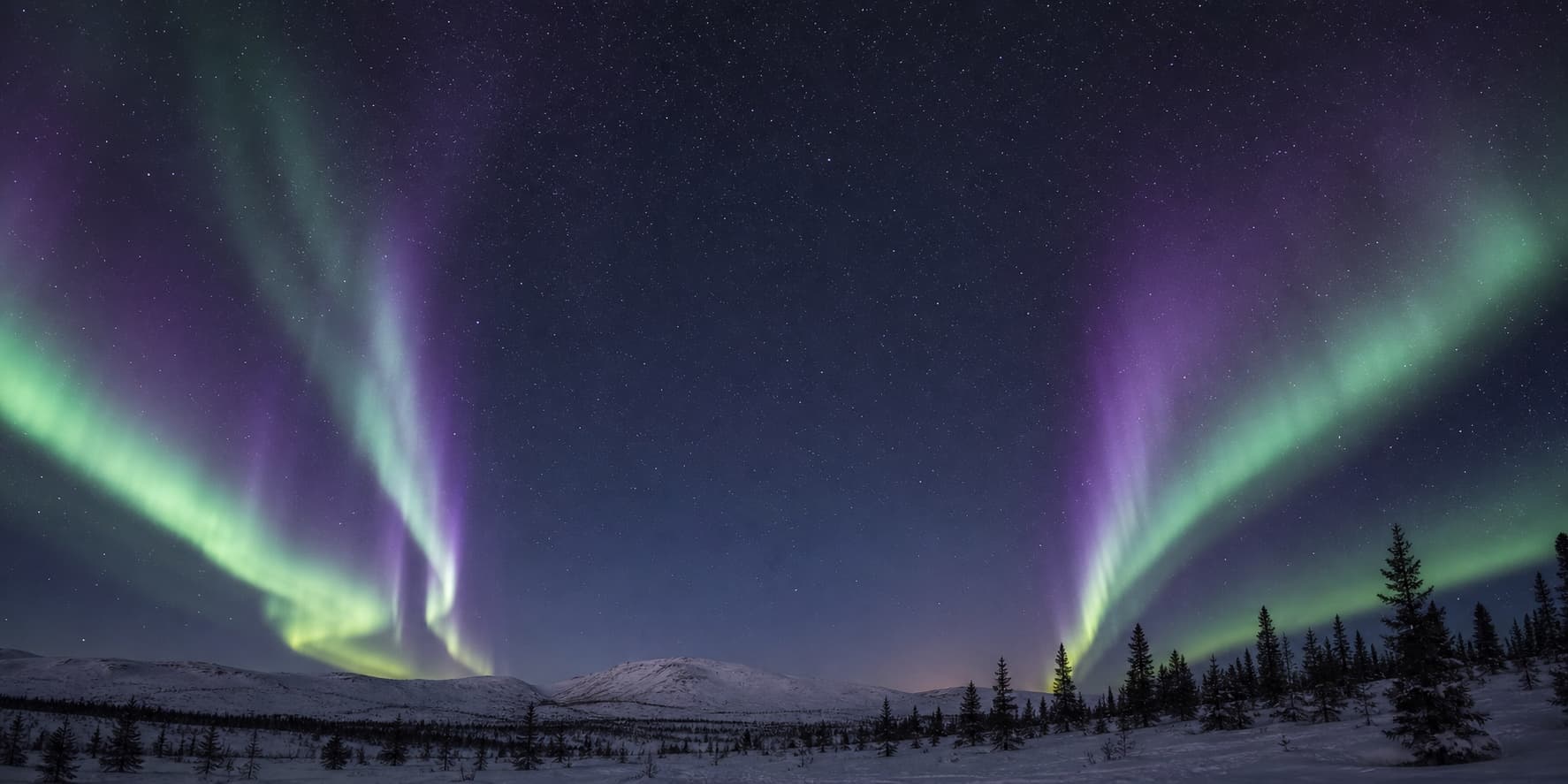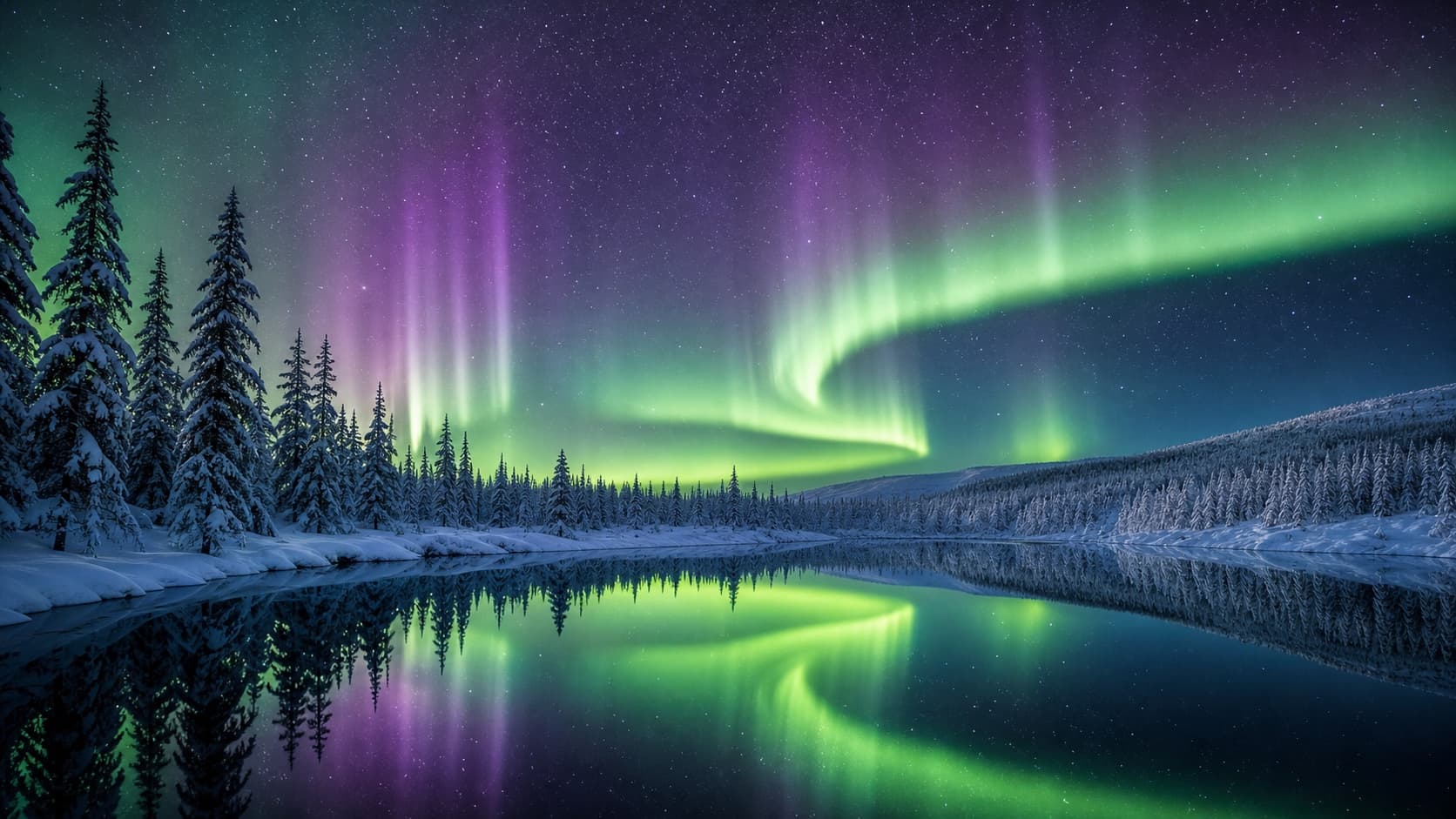
The northern lights, or aurora borealis, are caused by particles from the sun hitting the air above our heads.
The particles excite molecules of oxygen and nitrogen in the upper atmosphere; the molecules calm back down by releasing light. That’s the green, purple, and red curtain you see.
They happen in a roughly circular zone around each magnetic pole — the auroral oval — at all times. Sometimes that oval is small and faint; sometimes a solar storm punches it outward and the lights become visible at lower latitudes.
Share your location, or type a city, to see if aurora is reachable tonight.
The forecaster above reads NOAA’s Kp index for the next 24 hours and weighs it against your latitude — “likely overhead,” “possible,” “horizon glow,” or “not from here.” A 72-hour outlook lives on the standalone page at skywhen.com/tools/aurora-tonight.
What the aurora actually is
The sun constantly throws charged particles — electrons and protons — out into space.
This stream is called the solar wind. When it reaches Earth, our planet’s magnetic field deflects most of it, funneling some toward the poles.
Near the poles, the particles spiral down magnetic field lines into the upper atmosphere. There, they collide with oxygen and nitrogen molecules at altitudes of around 100 to 300 kilometers.
Each collision bumps the molecule into an excited state. When the molecule relaxes back down, it releases the extra energy as a photon of light.
Different molecules release different colors. Oxygen at lower altitudes glows green, the most common aurora color.
Oxygen at high altitudes glows deep red.
Nitrogen glows blue and purple. The mix you see depends on which gases were hit at which altitudes.
Why the aurora moves and shifts
The aurora isn’t a fixed glow. It’s a complex three-dimensional pattern of glowing gas, constantly changing as the solar wind interacts with Earth’s magnetic field.
On quiet nights, the aurora is often a soft arc along the northern horizon — beautiful but understated.
On active nights, it grows into towering curtains that ripple and sweep across the sky in seconds, sometimes directly overhead. The most active displays — called auroral substorms — can fill the entire sky for minutes at a time.
Auroral colors and what they mean
Green (most common)
Oxygen at about 100–200 km altitude.
The green you see in most aurora photos and videos. Often described as glowing or pulsing.
Red (rare but striking)
Oxygen above 200 km.
Less common because at higher altitudes, oxygen atoms have more time between collisions to lose their energy to red emission. Red aurora is often visible at lower latitudes during major geomagnetic storms.
Purple, blue, and pink
Nitrogen, usually below the green oxygen layer. The pinkish edges along the bottom of an active green curtain are nitrogen, mixed with the green oxygen above.
Yellow and white
Mixing of red and green light, or unusually intense emission across multiple wavelengths.
Rare. Usually only seen during very active storms.
When the aurora is most active
Aurora activity follows the 11-year solar cycle.
When the sun is near its peak — solar maximum — more solar wind reaches Earth, and the auroral oval expands. When the sun is at minimum, the oval shrinks and aurora gets harder to see, even at high latitudes.
Solar Cycle 25 peaked in 2024–2025. 2026 is the gentle slope downward — still a very active year, with strong displays on most clear nights inside the oval. Cycle 25 is also turning out to be the strongest cycle in two decades, which is why so many low-latitude aurora sightings have happened recently.
By season
The aurora itself is active year-round, but you can only see it when the sky is dark. From inside the auroral zone, summer means perpetual daylight or twilight — no aurora visible, even when active.
The classic aurora-viewing season runs from late August through April. Peak statistical activity falls around the equinoxes (March and September) because of the way the magnetic axis tilts relative to the solar wind direction at those times.
By time of night
Activity peaks around magnetic midnight — the time when your location is rotated directly opposite the sun, which is typically between 10 p.m. and 2 a.m. local time. Outside that window the aurora is often quieter.
Where the aurora is visible
The auroral oval is centered on each magnetic pole, not the geographic pole — which means it’s offset toward North America. The reliable aurora-viewing zone includes:
- Iceland (entire country)
- Norway above the Arctic Circle (Tromsø, Lofoten, Senja)
- Northern Sweden and Finland (Abisko, Rovaniemi)
- Northern Canada (Yukon, Northwest Territories, northern Manitoba)
- Alaska (especially Fairbanks)
- Greenland
During strong geomagnetic storms — usually rated G3 or higher on NOAA’s five-step scale — the oval expands south. G3 storms can bring aurora to the northern US, the UK, and southern Scandinavia.
G4 storms can push the lights into the central US, central Europe, and even northern Mexico. G5 storms (very rare) can produce aurora into the tropics.
For destination-specific recommendations, see The Best Places to See the Northern Lights.
How to actually see the aurora
Three conditions need to line up
Active sun, clear weather, dark sky. Missing any one of the three usually means you don’t see anything.
Forecasts that actually help
The two main aurora forecasts are the 30-minute short-term forecast (good for tonight) and the 3-day forecast (good for travel planning).
- NOAA Space Weather Prediction Center publishes both, plus a Kp index — a 0-to-9 number that estimates global aurora activity. Kp 5+ is usually when low-latitude aurora becomes possible.
- Aurora-specific apps like My Aurora Forecast and Aurora Alerts translate the underlying data into push notifications and probability maps. Useful for getting an alert when the activity spikes.
Phone photos can show aurora your eyes can’t
A common experience: you’re in a good aurora spot, the sky looks faintly green, you take a phone photo, and the photo shows a bright vivid display. Modern phones in Night Mode collect light for several seconds — long enough to bring out aurora that’s too dim for your eyes to clearly register.
This is real.
The phone isn’t lying. What looks like a faint glow to the eye is, on photons-per-second terms, a real auroral display — just below the sensitivity of your retina.
The bridge: the sky over your aurora night
An aurora trip is one of those trips that becomes a story for years. The anticipation, the cold, the moment the sky finally lights up.
A custom star map of that night doesn’t render the aurora itself — that changes too fast to map — but it does render the constellations, planets, and moon phase that were over your head that night, anchored to the exact place you stood. Try the date at the SkyWhen customizer and the preview will show the sky as it actually was.
For destination planning, see The Best Places to See the Northern Lights. For the full 2026 sky picture, see The 2026 Sky Calendar.
FAQ
What causes the northern lights?
Charged particles from the sun hit Earth’s upper atmosphere and excite oxygen and nitrogen molecules. When the molecules calm back down, they release light — green from oxygen, purple from nitrogen.
When is the best time to see the northern lights?
Late August through April, after dark, ideally near magnetic midnight (around 10 p.m. to 2 a.m. local time). Activity is statistically highest around the spring and fall equinoxes.
Why are the northern lights green?
Most aurora is caused by oxygen atoms at altitudes of 100–200 km, which glow green when excited. Red comes from oxygen higher up; purple and pink come from nitrogen.
Can you see the northern lights from the US?
Reliably from Alaska. Occasionally from Washington, Montana, Minnesota, Michigan, Maine, and the northern Midwest during strong storms. Once or twice a decade, major storms push aurora into the central or even southern US.
Are the northern lights and southern lights the same thing?
Yes — same physical process, mirrored around Earth’s southern magnetic pole. The southern version is called aurora australis. They often happen simultaneously, mirror images of each other.