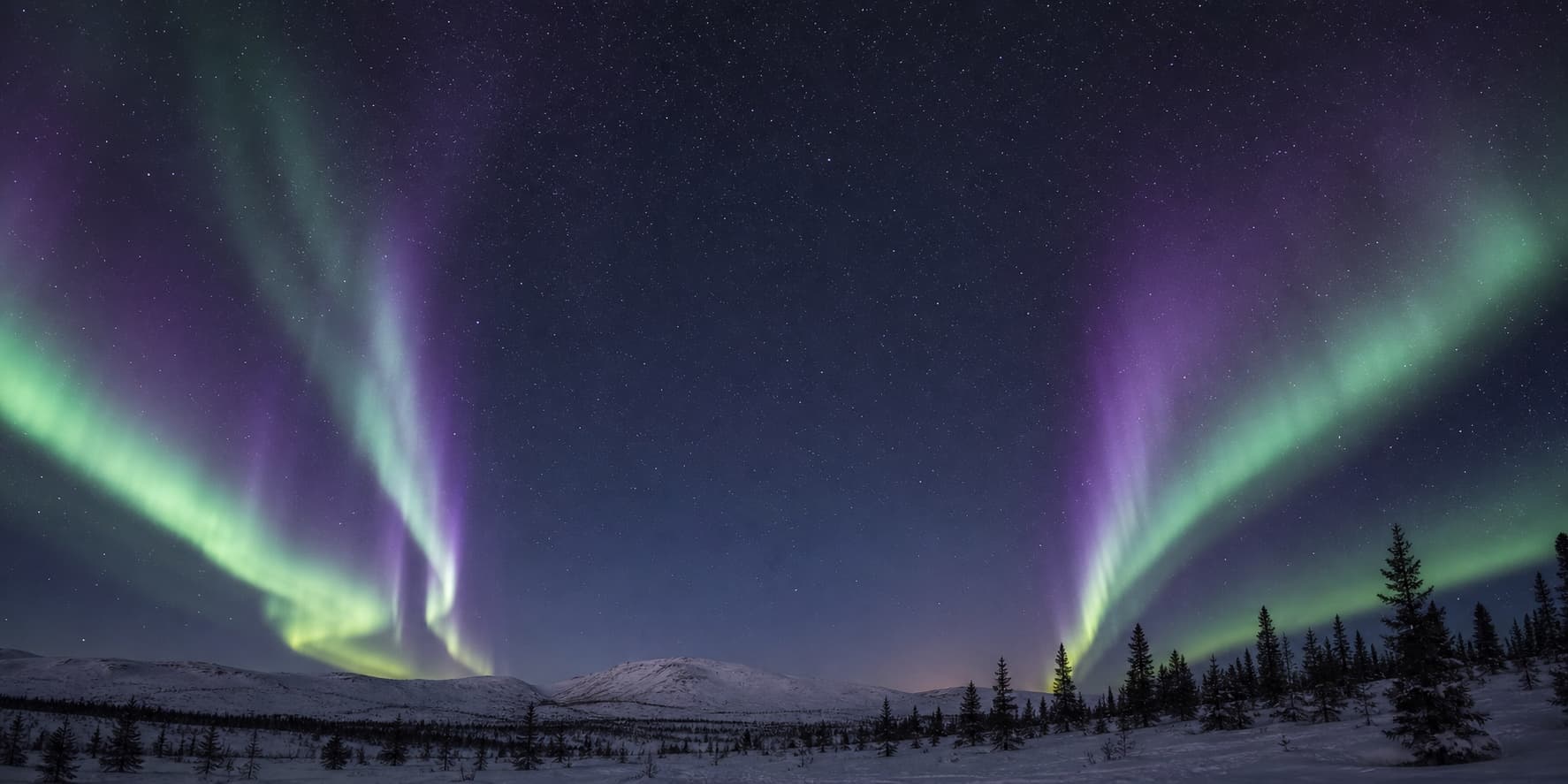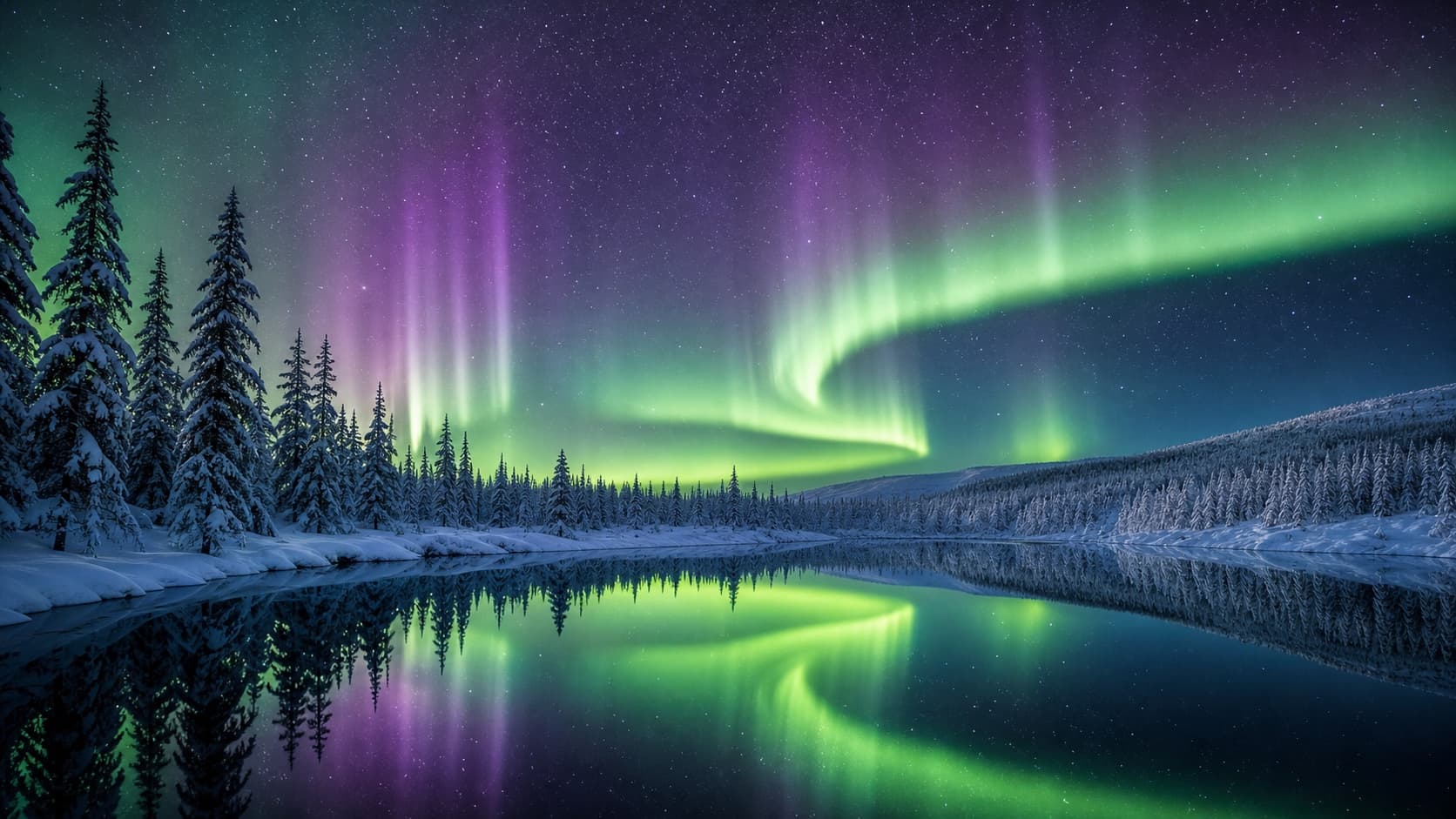
The aurora is brightest, most active, and most reliable inside the auroral oval — a ring around the magnetic pole that includes Iceland, northern Norway, Sweden, Finland, Alaska, and northern Canada.
From inside the oval, you don’t need a solar storm to see the lights. You just need a clear, dark night.
The hard part of an aurora trip isn’t finding the lights — it’s the weather, the logistics, and the time of year. This is the destination-by-destination breakdown.
Share your location, or type a city, to see if aurora is reachable tonight.
Already on the trip? The forecaster above reads NOAA’s Kp index for the next 24 hours and tells you whether aurora is reachable from where you stand tonight.
The full 72-hour outlook lives at skywhen.com/tools/aurora-tonight .
How to think about aurora destinations
Three things vary by destination: how far inside the auroral oval you are (closer = more activity), how often it’s cloudy (the dealbreaker most visitors underestimate), and how easy it is to get there.
Iceland sits roughly on the southern edge of the oval, so activity is slightly weaker than further north, but it’s accessible from most of Europe and North America. Tromsø in Norway sits well inside the oval and has more reliable activity, but is harder to reach and statistically cloudier.
Northern Finland is dryer than Norway but offers similar levels of aurora activity, and the cabin-rental infrastructure is excellent. The Yukon and northern Alaska sit deep inside the oval and have lower cloud cover than Norway, but require more travel.
No one destination is best for everyone. The right choice depends on what you’re flying from and how much trip flexibility you have.
Iceland
The most popular aurora destination for Americans and Western Europeans. Easy to reach (3 hours from London, 5–6 hours from the US East Coast).
Activity is good but not extraordinary — Iceland sits on the southern edge of the oval. Weather is the biggest issue.
Where to base
Reykjavík for convenience, with rented car day trips to the south and west coasts.
Or Akureyri in the north, which has clearer weather statistics. The north is also slightly higher latitude, so the aurora sits more directly overhead instead of low on the northern horizon.
Best months
September through mid-April. The shoulder months (September, March, April) often have better weather than the deep winter ones.
What to expect
Roughly half the nights of a 5–7 day trip will have some aurora visibility if you’re willing to drive away from clouds. Combine the trip with daytime activities (waterfalls, glaciers, hot springs) so a cloudy aurora night still feels like a productive day.
Northern Norway (Tromsø, Lofoten, Senja)
More activity than Iceland, more complicated weather. Tromsø is the unofficial aurora capital — direct flights from much of Europe, well-developed tourism infrastructure, and a position deep inside the oval.
Where to base
Tromsø itself for the largest selection of tours and easy logistics. The Lofoten Islands and Senja are smaller and quieter — more dramatic landscapes for aurora photos, but a longer trip from Oslo to reach.
Best months
Late September through early April. The polar night runs from late November to mid-January, with no real daylight — long aurora windows but constrained daytime options.
What to expect
Aurora activity on most clear nights.
The catch is the weather: the Norwegian coast gets a lot of cloud and rain off the Gulf Stream. Joining a guided tour that chases clear skies (driving inland or to the coast as needed) often makes the difference.
Northern Finland (Rovaniemi, Saariselkä, Levi)
Drier than coastal Norway, deep inside the oval, and the cabin and glass-igloo infrastructure is the best in the world for aurora viewing. Easier on families and non-hardcore travelers.
Where to base
Rovaniemi for international convenience (direct flights from many European cities, plus the “Santa Claus Village” tourism angle if you’re traveling with kids). Saariselkä, Levi, or Inari for quieter, darker villages further north.
Best months
Late August through mid-April. The longest reliable aurora-with-snow combination is December through March, but the weather is generally clearer in the shoulder months.
What to expect
Slightly drier weather than Norway, which translates to noticeably more clear nights on a typical trip. Aurora glass igloos and lakeside cabins let you stay indoors and still see the lights — useful when temperatures drop below -25°C.
Northern Sweden (Abisko, Kiruna)
Abisko has a microclimate that produces among the highest clear-sky percentages of anywhere in the auroral zone. The surrounding mountains shelter the area from coastal cloud, producing the “blue hole” — a small region of often-clear sky in the middle of an otherwise cloudy region.
Where to base
Abisko village itself — small, simple, surrounded by national park land. Kiruna (an hour and a half south) is larger and has more dining and accommodation options.
Best months
Late September through March. The Abisko Sky Station chairlift (running on aurora tours) offers viewing above any low cloud.
Yukon (Whitehorse, Dawson City) and Northwest Territories (Yellowknife)
Quieter than the European destinations, deeper inside the oval, and statistically drier. The trade-off is significantly more travel from major US and European cities, and a smaller selection of tour operators.
Where to base
Yellowknife for the most aurora-focused tourism infrastructure in North America.
Whitehorse for a slightly easier flight from western US cities. Dawson City for a quieter, more remote experience.
Best months
Mid-August through April. Yellowknife is one of the few aurora destinations that has reliable late-August activity — useful if you want to travel before the deep cold arrives.
What to expect
High aurora visibility per trip due to the dry climate.
Major temperature swings — -40°C is not unusual in deep winter. Most tour operators provide insulated suits and heated viewing pods.
Alaska (Fairbanks, Coldfoot)
Fairbanks sits directly under the auroral oval. Activity is consistent, the weather is variable, and the city has a long history of aurora-focused tourism.
Where to base
Fairbanks proper, with night excursions to nearby Chena Hot Springs or Cleary Summit. For more remote dark skies, Coldfoot Camp inside the Arctic Circle.
Best months
Mid-September through mid-April. Winter solstice gives the longest dark hours but also the deepest cold.
The quieter spots worth considering
Greenland
Deep inside the auroral oval, very dark, very dry, and almost no light pollution.
Limited tourism infrastructure outside Nuuk and Kangerlussuaq. For travelers willing to commit to a quieter trip, Greenland has some of the most dramatic aurora viewing anywhere.
Scotland and northern England
On the rare strong-storm nights (G3 or higher), the aurora is visible from the Shetlands, Orkney, the Outer Hebrides, and occasionally as far south as the Lake District. Don’t plan a trip around it, but watch the forecasts if you live in the area.
The northern US
Northern Minnesota, Michigan’s Upper Peninsula, northern Maine, and occasionally northern New York and Washington. Dependent on geomagnetic storms; most years see 5–15 nights with significant low-latitude aurora during strong cycle periods.
How long to plan a trip
Five nights is the minimum that gives a reasonable chance.
Three is gambling. One is almost always a disappointment unless the timing is extraordinarily lucky.
Each night, you have roughly a 30–60% chance of aurora visibility depending on destination, weather statistics, and how willing you are to drive to chase clear sky. A 5-night trip means 5 chances; the probability of seeing aurora at least once usually lands somewhere between 80% and 95%.
The bridge: the sky over your trip
An aurora trip is exactly the kind of trip people keep talking about for years — the cold, the waiting, the moment the sky finally lit up. It’s a natural date for a custom star map.
The star map renders the actual constellations, planets, and moon phase that were overhead that night, anchored to the exact latitude and longitude you watched from. The aurora itself doesn’t appear on the poster (it’s in motion; we’re a snapshot), but everything else around it is real and exact.
Plug in the date and place at the SkyWhen customizer — the preview is free.
For the science behind what you’re actually seeing, read Northern Lights 101. For the year’s sky events at a glance, see The 2026 Sky Calendar.
FAQ
Where is the best place in the world to see the northern lights?
For reliability per trip, hard to beat Abisko in northern Sweden — it has among the highest clear-sky rates in the auroral zone. For activity level alone, Tromsø, Yellowknife, and Fairbanks all sit directly under the oval.
When is the best time of year to see the aurora?
September through April. Statistical activity peaks around the spring and fall equinoxes (March and September), but the practical winter months (November–February) offer longer dark periods.
How many nights should I plan for an aurora trip?
At least five. Each night gives you a 30–60% chance of clear sky and aurora; over five nights, your cumulative chance is around 90%.
Single-night trips frequently get clouded out and lead to a disappointed visitor.
Can I see the northern lights from Iceland in summer?
No. From May through August, Iceland has too much daylight for the aurora to be visible, even on active nights. The viewing season runs from September through mid-April.
Do I need a tour to see the northern lights?
No, but they help in coastal destinations like Norway and Iceland where the weather changes fast — a tour chases clear sky for you. In drier destinations like Finland and northern Canada, a rental car and a clear view of the northern horizon are often enough.