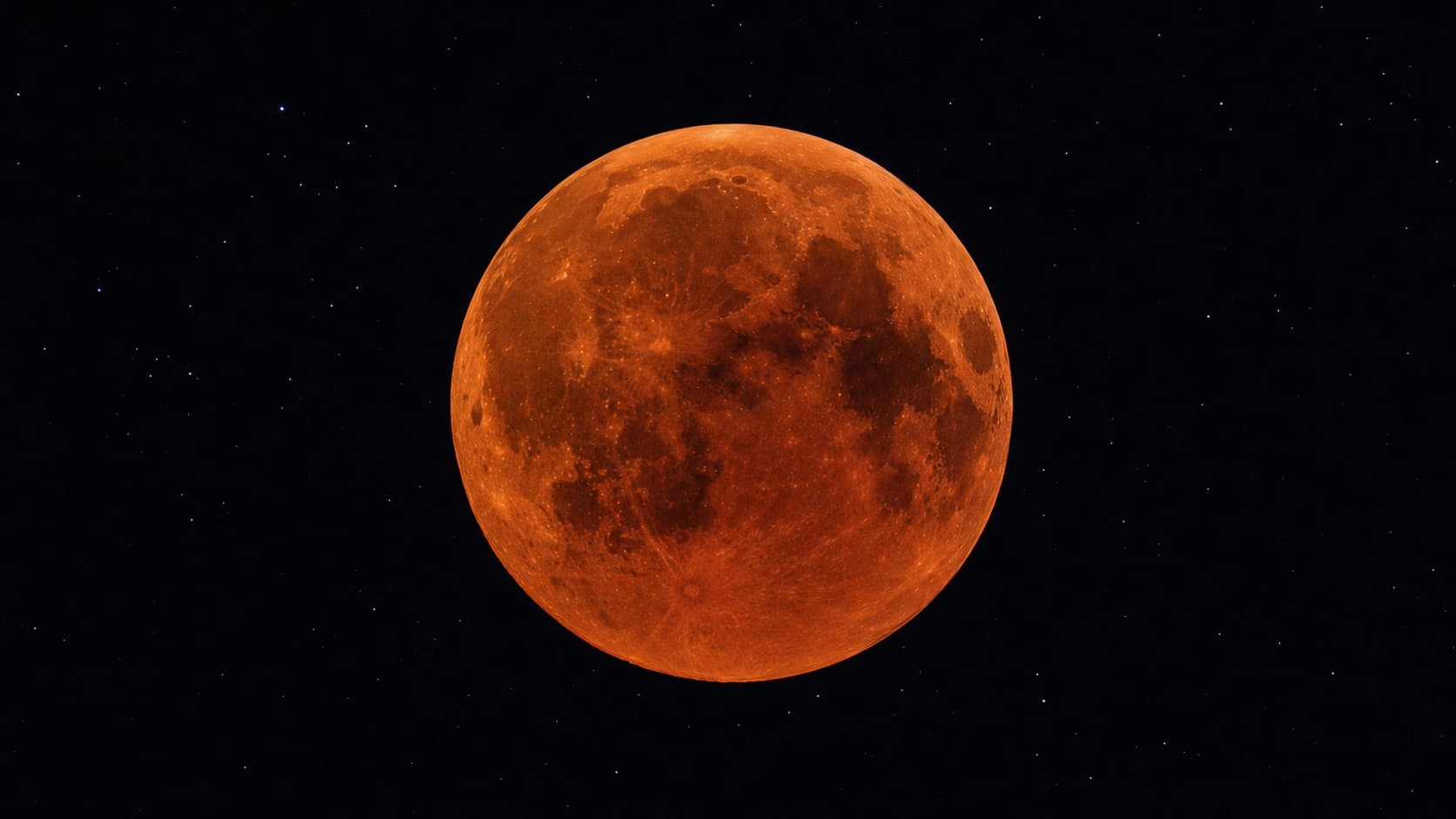
A lunar eclipse happens when Earth gets between the sun and the moon, and casts a shadow on the moon. The moon doesn’t go dark, though — it turns a deep coppery red, sometimes orange or brown, depending on the conditions in Earth’s atmosphere.
That’s why lunar eclipses are often called blood moons.
They’re free, safe to look at directly, and usually visible for hours. Here’s the explainer.
How a lunar eclipse actually works
Three things have to line up: the sun, Earth, and the moon, in that order. Earth has to be in the middle, with the moon directly behind it from the sun’s point of view.
This lineup only happens at full moon, because that’s the only time the moon is on the opposite side of Earth from the sun. (At new moon, the moon is between us and the sun — which is when solar eclipses happen instead.)
But the moon’s orbit is tilted by about five degrees relative to Earth’s orbit around the sun.
So most full moons, the moon passes slightly above or below Earth’s shadow rather than through it. A lunar eclipse only happens when the geometry lines up precisely — roughly two or three times a year.
- JAN3★QuadrantidsMeteor shower
Sharp, short peak (~120/hour) in a six-hour window. Northern Hemisphere, pre-dawn.
- JAN3●Wolf supermoonSupermoon
First of four supermoons in 2026, 362,300 km from Earth. Same night as the Quadrantids — but the bright moon will wash out the shower.
- FEB17◐Annular solar eclipseSolar eclipse
“Ring of fire” eclipse. Path crosses Antarctica and the tip of South America; partial phases visible across the Southern Hemisphere.
Annularity from Antarctica / southern South America
- MAR3○Total lunar eclipseLunar eclipse
Blood moon — the moon passes through Earth's shadow and turns coppery red. Visible across the Pacific, Asia, Australia, and western North America.
Best from the Pacific, Asia, Australia, western North America
- MAR8◇Venus and SaturnConjunction
Bright Venus and pale Saturn less than a degree apart, low in the western evening twilight. Catch them soon after sunset before they set.
- MAR20—March equinoxEquinox
Day and night equal across the globe. Spring begins in the Northern Hemisphere, autumn in the Southern.
Set a location above to see which events are above your horizon at peak.
The 2026 calendar above shows both of this year’s lunar eclipses — the total on March 3 and the partial on August 28 — with an Above horizon / Below horizon flag for your location. Full filterable year at skywhen.com/tools/2026-sky-calendar.
Why the moon turns red
You’d expect a moon in Earth’s shadow to just go dark. But sunlight doesn’t move only in straight lines through space — when it grazes Earth’s atmosphere on its way past, the atmosphere bends and filters it.
Blue light scatters out (which is why our daytime sky is blue, and our sunsets are red — the blue has been scattered away by the longer path through the atmosphere). What’s left over is the red and orange end of the spectrum.
That red and orange light bends around Earth and falls on the moon. So a moon inside Earth’s shadow is, in effect, lit by every sunset and sunrise on Earth at once.
The three types of lunar eclipse
Penumbral
The moon passes through the outer, faint part of Earth’s shadow. The effect is subtle — most people don’t notice.
The moon dims slightly but doesn’t change color. Not really worth setting an alarm for.
Partial
Only part of the moon enters the dark inner shadow (the umbra).
You see a dark bite taken out of the moon, but the unshadowed portion stays normal-colored. Pretty, but not as striking as a total eclipse.
Total
The entire moon enters the umbra.
This is when you get the deep red color. Totality usually lasts somewhere between 30 minutes and an hour and 45 minutes — the longest possible totality is about 1 hour 40 minutes.
The whole eclipse, from first contact with the umbra to the moon leaving it, takes roughly three hours.
How often lunar eclipses happen
On any given year, Earth gets two to four lunar eclipses. (At least two — that’s guaranteed by orbital geometry — and up to five in an unusually busy year.)
A total lunar eclipse happens, on average, every two to three years from any one location on Earth. Unlike solar eclipses, which require you to be in a narrow path, lunar eclipses are visible from the entire night side of Earth at once — anyone in the right hemisphere can see one without traveling.
How to watch one
No equipment needed.
No eye protection needed. Step outside, look up.
- Check the times. Local times for first contact, totality start, greatest eclipse, totality end, and last contact are available from any astronomy calendar.
- Skip the city centers if you can. A bright urban sky still lets you see a total lunar eclipse fine, but the surrounding stars look much more striking from a darker spot.
- Binoculars are a nice upgrade. They make the color more vivid and show texture on the moon’s shadowed surface. Not necessary.
- Plan for 2–3 hours. The partial phases on either side of totality are interesting too — the moon visibly walks into and out of the shadow.
The 2026 lunar eclipses
Total — March 3, 2026
Visible across the Pacific, Asia, Australia, and western North America.
Totality lasts about 58 minutes. The moon is at average distance for this one (about 382,600 km), so it’s not a supermoon — but the red color during totality is what matters anyway.
Partial — August 28, 2026
About 93% of the moon enters Earth’s umbra at maximum.
Visible from the Americas, most of Africa, and Europe. Not a total eclipse, but close enough to feel like one.
The Danjon scale
Lunar eclipses aren’t all the same color.
The exact shade depends on how much dust, volcanic ash, and cloud cover is in Earth’s atmosphere at the time. The Danjon scale rates lunar-eclipse darkness from 0 (almost black) to 4 (bright orange-red).
After major volcanic eruptions, the next year or two of eclipses tend to be very dark — sometimes barely visible.
After clean-atmosphere years, eclipses can be startlingly bright. Most fall somewhere in the middle.
The bridge: keeping the night
Lunar eclipses are slow events.
You stand outside for an hour while the moon gradually changes color. The conditions of the night — who’s with you, where you’re standing, whether you bring a thermos — become part of the memory.
A custom star map of the eclipse night captures the moon’s position in the sky, the phase, and the surrounding stars from your exact location. The moon shows as full (because lunar eclipses always happen at full moon), and the constellation backdrop reflects the true sky from that night.
Try the date at the SkyWhen customizer — the preview is free.
For solar-eclipse explainers, see Solar Eclipse Explained. For the “why is it called a blood moon” angle, see Blood Moon Explained.
FAQ
How often is there a lunar eclipse?
Two to four per year somewhere on Earth, but only a fraction of those are total. From any single location, a total lunar eclipse happens about once every two to three years on average.
When is the next total lunar eclipse?
March 3, 2026 — visible from the Pacific, Asia, Australia, and western North America. Totality runs about 58 minutes.
The next one after that is March 2, 2027.
Is it safe to look at a lunar eclipse?
Yes — completely safe. A lunar eclipse is just the moon dimmed and color-shifted. There’s no harmful radiation involved. Look as long as you like with the naked eye, binoculars, or a telescope.
Why is a lunar eclipse red?
Sunlight passes through the edges of Earth’s atmosphere on its way past, which filters out the blue and lets the red through. That red light bends around Earth and falls on the moon.
In effect, the moon is being lit by every sunset and sunrise on Earth happening simultaneously.
How long does a lunar eclipse last?
The full event, including partial phases on either side, runs about three hours. Totality itself usually lasts between 30 minutes and an hour and 45 minutes.