A solar eclipse happens when the moon passes between the sun and Earth, and blocks some or all of the sun’s light. Depending on the geometry, you get one of three types: a partial eclipse, an annular eclipse (the “ring of fire”), or the rare total eclipse.
Total eclipses are one of the most extraordinary events nature offers, and they don’t come around often. Here’s how all three types work, and the dates worth planning your year around.
How a solar eclipse actually works
The moon orbits Earth, and Earth orbits the sun.
Every new moon, the moon is on roughly the same side of Earth as the sun. If the alignment is precise enough, the moon’s shadow falls on Earth.
Most new moons, the alignment isn’t precise enough — the moon’s orbit is tilted by about five degrees relative to Earth’s, so the moon usually passes above or below the sun from our point of view. Solar eclipses happen only two to five times a year, when the geometry lines up.
- JAN3★QuadrantidsMeteor shower
Sharp, short peak (~120/hour) in a six-hour window. Northern Hemisphere, pre-dawn.
- JAN3●Wolf supermoonSupermoon
First of four supermoons in 2026, 362,300 km from Earth. Same night as the Quadrantids — but the bright moon will wash out the shower.
- FEB17◐Annular solar eclipseSolar eclipse
“Ring of fire” eclipse. Path crosses Antarctica and the tip of South America; partial phases visible across the Southern Hemisphere.
Annularity from Antarctica / southern South America
- MAR3○Total lunar eclipseLunar eclipse
Blood moon — the moon passes through Earth's shadow and turns coppery red. Visible across the Pacific, Asia, Australia, and western North America.
Best from the Pacific, Asia, Australia, western North America
- MAR8◇Venus and SaturnConjunction
Bright Venus and pale Saturn less than a degree apart, low in the western evening twilight. Catch them soon after sunset before they set.
- MAR20—March equinoxEquinox
Day and night equal across the globe. Spring begins in the Northern Hemisphere, autumn in the Southern.
Set a location above to see which events are above your horizon at peak.
The 2026 calendar above lists this year’s solar eclipses — the annular on February 17 and the total on August 12 (Iceland, Spain, Portugal). Each event notes where the path of totality runs.
Full filterable year at skywhen.com/tools/2026-sky-calendar .
Why we have three types
The moon and the sun look the same size in our sky, which is one of the more remarkable coincidences of our solar system. The sun is roughly 400 times the diameter of the moon — and roughly 400 times farther away.
But the moon’s orbit is slightly elliptical, so the moon’s apparent size changes a little through the month.
When the moon is closer to Earth than average, it looks slightly bigger than the sun and can fully cover it — that’s a total eclipse. When the moon is farther than average, it looks slightly smaller than the sun, can’t quite cover it, and leaves a thin ring of sun visible around the edge — that’s annular.
A partial eclipse is what you see when your location is near the path of a total or annular eclipse but not inside it. The moon covers part of the sun, but not all of it.
Total solar eclipses
The moon fully covers the sun for one to seven minutes.
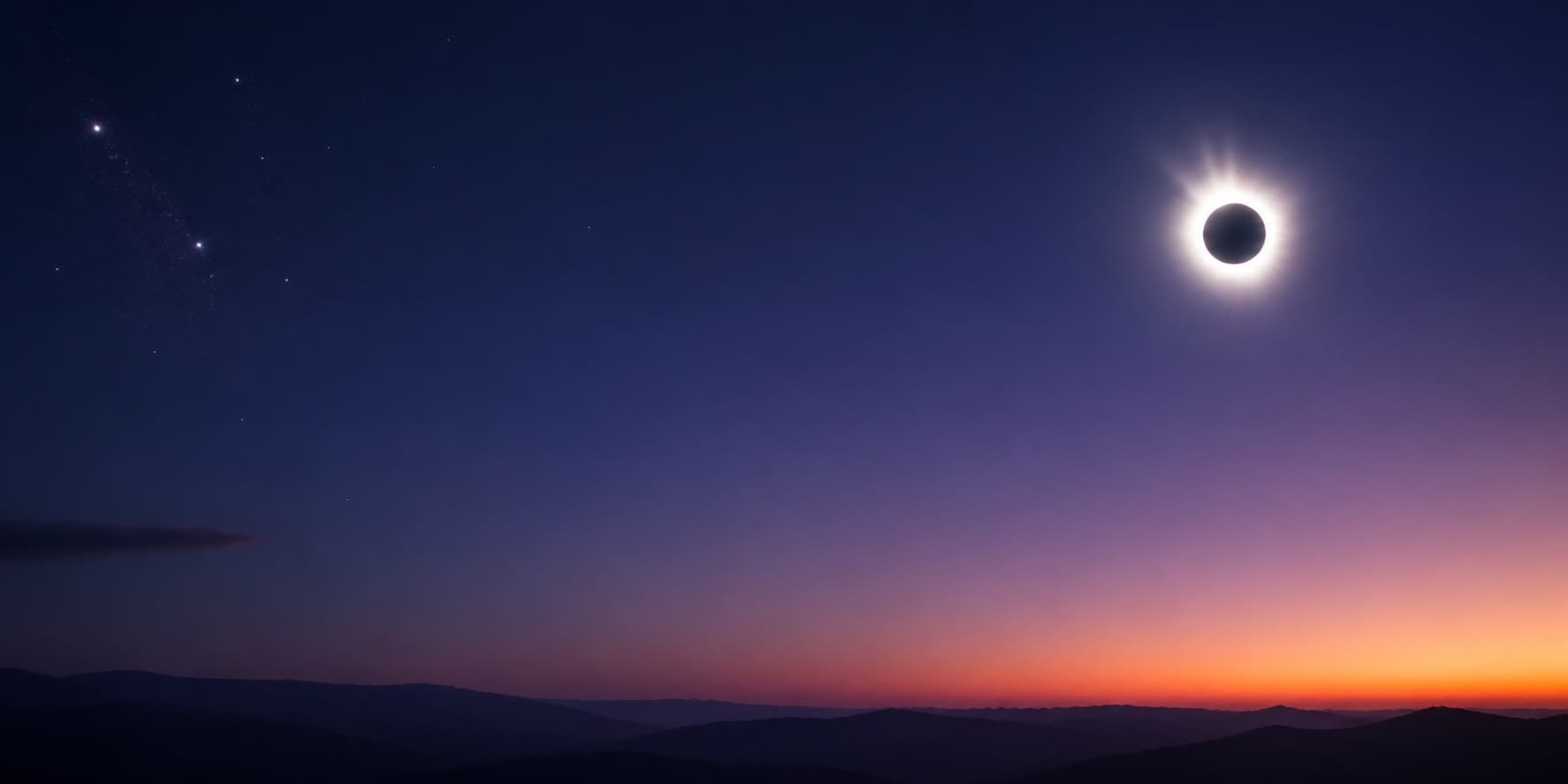
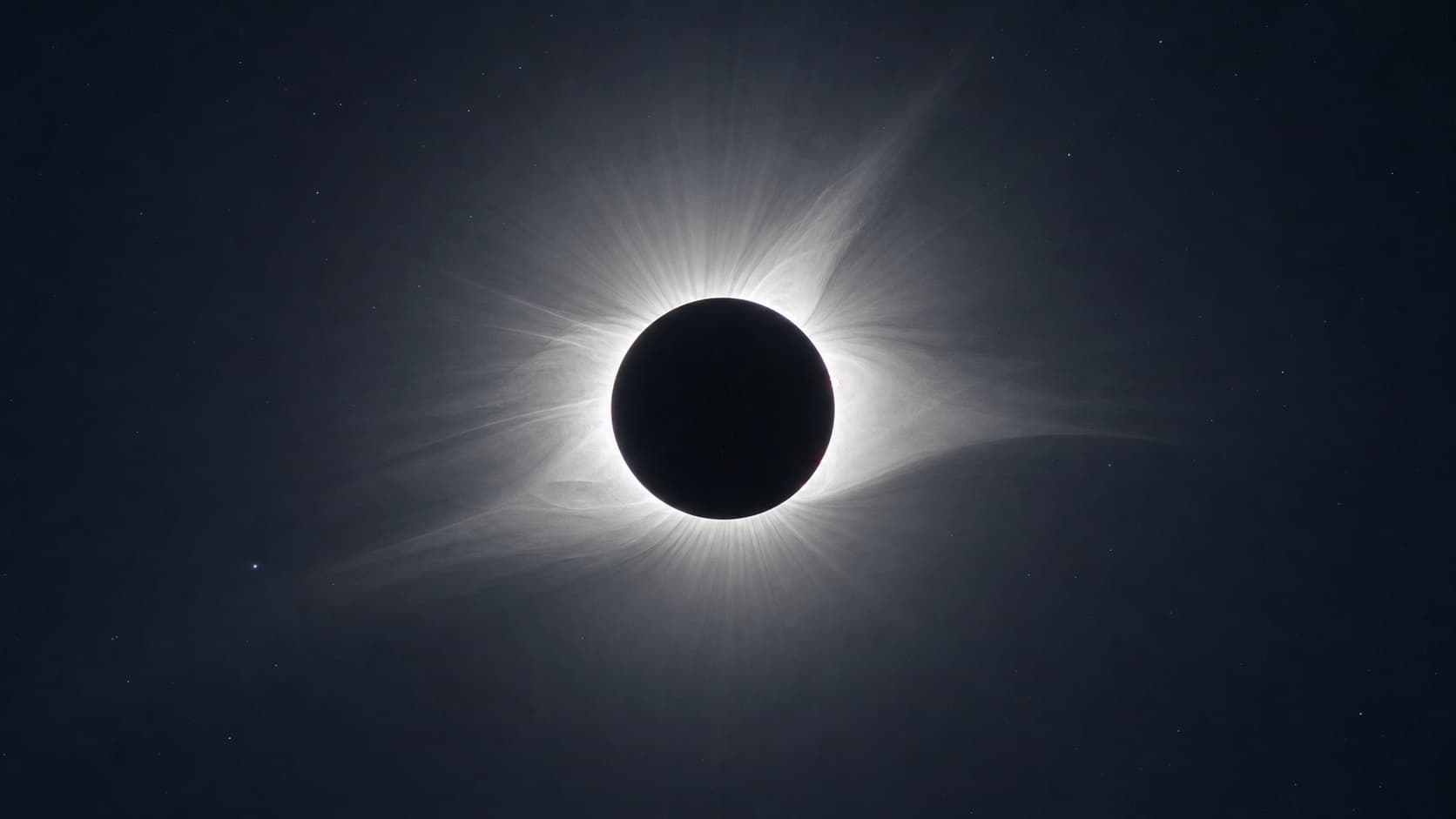
The sky goes dark, you can see stars and planets in the middle of the day, animals get confused, and the temperature drops. The sun’s outer atmosphere — the corona — becomes visible as a ghostly halo around the black disk of the moon.
If you’re lucky enough to be standing in the path of totality, you also see two other phenomena: Baily’s beads (sunlight breaking through gaps in lunar mountains as the moon slides into place) and the diamond ring effect (the last and first ray of direct sun, looking like a brilliant diamond on a black ring).
Total eclipses happen somewhere on Earth roughly once every 18 months, but the path of totality is usually only 100–300 kilometers wide and traces a particular arc across the planet’s surface. Most people will never accidentally find themselves inside one.
Annular solar eclipses
The moon passes in front of the sun but is too far from Earth to fully cover it, leaving a bright ring around the edge. Often called a “ring of fire” eclipse.
Annular eclipses don’t produce true darkness — the unblocked sun is still too bright.
The sky dims a little, but it stays full day. You also can’t see the corona, and you must use certified eclipse glasses the entire time (unlike total eclipses, where the brief totality is safe to view directly).
How to watch a solar eclipse safely
The sun is bright enough to damage your retina permanently in seconds. Looking at the partially-eclipsed sun without protection is the same as looking at a normal uneclipsed sun — bad idea, and the eclipse itself doesn’t make it safer.
The rules:
- Partial phases: Use ISO 12312-2 certified eclipse glasses, or a welding shield rated 14 or higher. Sunglasses do not count. Stacked sunglasses do not count. Smoked glass does not count.
- Annular eclipses (the entire event): Same — never look directly, ever. The ring of sun is still bright enough to do damage.
- Total eclipses (totality only): Safe to view directly with the naked eye for the one to seven minutes when the sun is fully covered. The moment the moon starts to slide off, glasses go back on.
Pinhole projectors and proper solar telescopes with solar filters are also fine. Phone cameras can technically photograph an eclipse, but never aim the lens at the sun without a proper solar filter — it can damage the sensor and is unsafe to look at through the viewfinder.
The big upcoming eclipses
February 17, 2026 — Annular
Path of annularity crosses Antarctica and clips the southern tip of South America. Partial phases visible across much of the Southern Hemisphere.
August 12, 2026 — Total
Path of totality crosses Iceland, Spain, and a thin slice of Portugal.
Totality lasts about two minutes in the best spots. The first total solar eclipse over continental Europe since 1999.
August 2, 2027 — Total (the big one)
Up to six minutes and 23 seconds of totality at the centerline — among the longest totalities of the 21st century. Path crosses southern Spain, North Africa (Morocco, Algeria, Tunisia, Libya, Egypt), the Red Sea, Saudi Arabia, Yemen, and Somalia.
For anyone who hasn’t seen a total eclipse and is willing to travel, this is the trip to plan. Long totalities are rare — most total eclipses run 2–4 minutes — and the August 2027 path crosses several major historical sites at the centerline, so the trip has weight beyond just the eclipse.
January 26, 2028 — Annular
A long annular eclipse — up to 10 minutes 27 seconds of ring of fire. Path crosses northern South America, parts of the Atlantic, and ends in Spain and Portugal at sunset.
July 22, 2028 — Total
Long totality (over five minutes at the centerline) across Australia and New Zealand. The full path runs from the Cocos Islands through central Australia (including Sydney) and out into the South Pacific.
How to plan an eclipse trip
Two factors decide whether your trip succeeds: weather and crowds.
Weather
Cloud cover on eclipse day decides everything. Climatologists publish historical cloud-cover statistics for each eclipse path; pick a viewing spot where the average August (or whichever month) cloud cover is below 30%.
For the 2027 eclipse, the driest centerline locations are in Egypt’s Western Desert and along the Red Sea coast of Saudi Arabia.
Crowds and logistics
Major eclipses can saturate small towns.
Hotels along the 2024 North American eclipse path were booked years in advance. For the 2027 eclipse, accommodations in Luxor and along the Egyptian centerline have been filling up since 2024.
Book early. If the date is more than two years away, you have time; less than 18 months, you’re already in a tight market.
The bridge: a once-in-a-lifetime sky
Total eclipses are the kind of event that people structure travel and even careers around. The combination of darkness in the middle of the day, the corona, and the unique feeling of standing under a sky that has temporarily stopped behaving normally — it sticks with you.
One thing you can keep from the day is the literal sky over the place you watched. A custom star map renders the constellations, planets, and even the moon’s position (covering the sun) for your exact date and location.
Try the eclipse date and location at the SkyWhen customizer — the preview is free.
For the lunar-eclipse counterpart, see Lunar Eclipse Explained. For the year’s full event list, see The 2026 Sky Calendar.
FAQ
When is the next total solar eclipse?
August 12, 2026, crossing Iceland and Spain. About two minutes of totality at the centerline.
The much longer one is August 2, 2027 — up to six minutes and 23 seconds of totality, crossing North Africa and the Middle East.
Is it safe to look at a solar eclipse?
Only during the brief totality of a total eclipse, and only if you’re inside the path of totality. Every other phase — including the entirety of annular and partial eclipses — requires ISO 12312-2 certified eclipse glasses.
What is the difference between annular and total solar eclipses?
In a total eclipse, the moon fully covers the sun. In an annular eclipse, the moon is slightly too far from Earth to fully cover it, leaving a bright ring of sun around the edge.
Total eclipses produce darkness; annular eclipses do not.
How long does a total solar eclipse last?
Totality typically lasts one to seven minutes. The longest possible totality is about seven and a half minutes.
The 2027 eclipse will be unusually long at six minutes and 23 seconds at the centerline.
Can I see a solar eclipse from anywhere?
Partial phases of most eclipses are visible across a wide area. Totality itself is visible only inside a narrow path — usually 100–300 kilometers wide.
Outside the path, the eclipse looks partial — and the experience is dramatically different from totality.