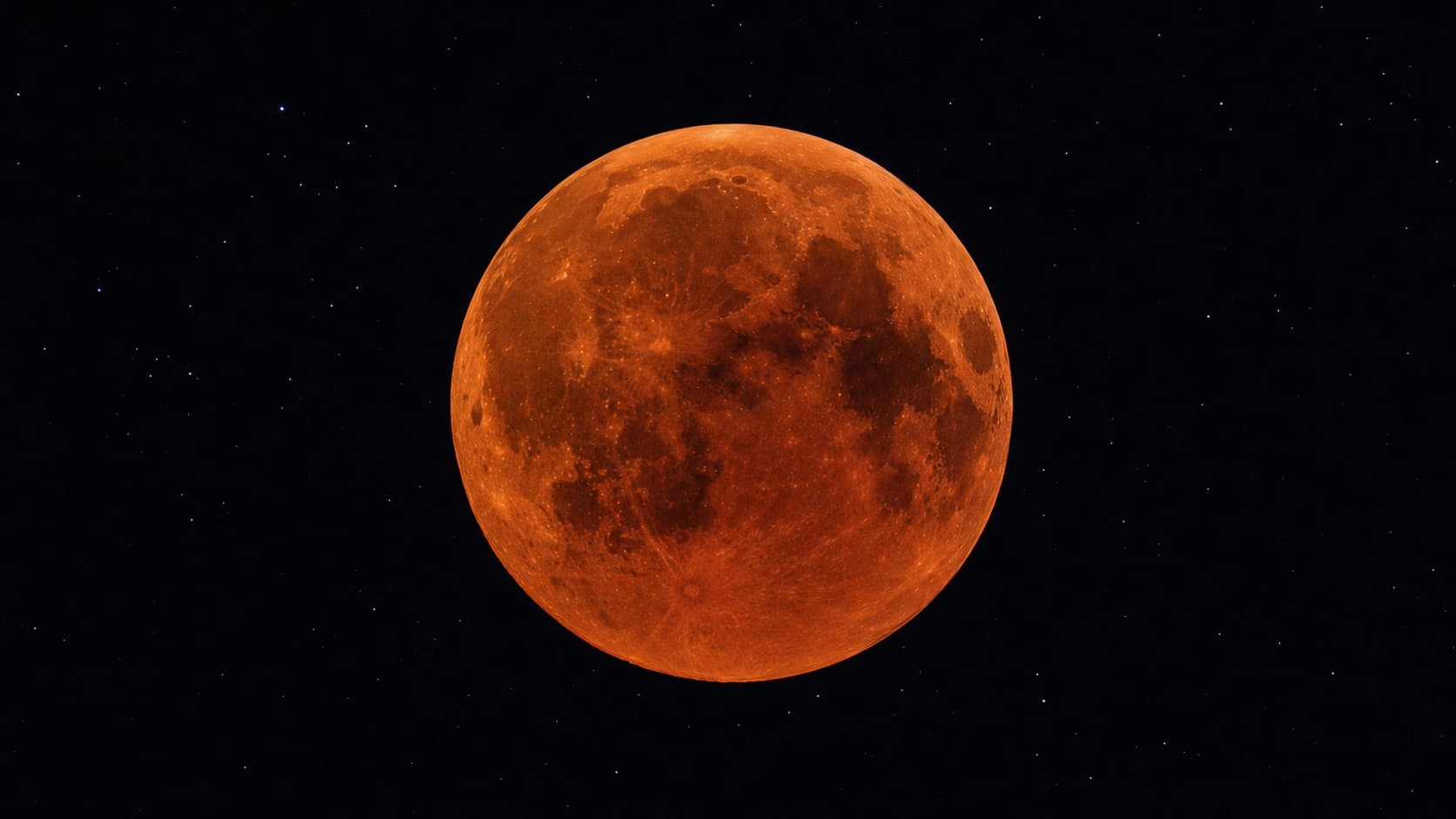
A blood moon — also called a red moon — is a total lunar eclipse.
The moon passes into Earth’s shadow, and instead of going dark, it turns a deep coppery red. The reason is, in one sentence, every sunset on Earth bending around the planet at once and falling on the moon.
The term is dramatic, the science is straightforward, and the event itself is one of the gentlest in astronomy — completely safe to look at, visible for hours, no equipment needed.
Where the name comes from
“Blood moon” is a popular term, not a scientific one.
Astronomers usually just say total lunar eclipse. The dramatic version of the name dates back centuries — appears in old Anglo-Saxon writings, in biblical translations, and in various folk traditions.
The modern revival of the term came largely from a 2014 book that grouped four specific total lunar eclipses into a “blood moon tetrad” and gave the term wide press coverage. It stuck, and now most people use it interchangeably with total lunar eclipse.
Why the moon turns red
During a total lunar eclipse, Earth sits directly between the sun and the moon, casting a shadow on the moon. The moon doesn’t go dark, though, because Earth’s atmosphere refracts sunlight around the planet.
Sunlight is white — a mix of all visible colors.
When it passes through Earth’s atmosphere at a low angle (around the edge of the planet), the blue and green parts get scattered out. (This is the same reason sunrises and sunsets look red.) What’s left over is mostly red and orange.
That red and orange light bends through Earth’s atmosphere and falls on the moon. Every sunrise and sunset on Earth happens once a day, and at the moment of a total lunar eclipse, the moon is being lit by all of them at once.
Why the exact color varies
Not every blood moon glows the same red. Some are bright orange, some are deep copper, some are so dark they almost vanish.
The difference comes from what’s in Earth’s atmosphere at the time. Dust, volcanic ash, smoke, and cloud cover all affect how much light makes it around the planet’s edge.
After major volcanic eruptions, the following year or two of total eclipses tend to be unusually dark — sometimes so dark the moon is barely visible.
After a clean atmosphere, blood moons can be a startlingly vivid orange. The Danjon scale rates this brightness from 0 (almost invisible) to 4 (bright orange-red).
How a total lunar eclipse unfolds
The whole event takes about three hours from start to finish.
Penumbral phase
The moon enters the outer (faint) part of Earth’s shadow.
Subtle dimming. Most people don’t notice this stage unless they’re looking for it.
Partial phase
The moon starts entering the dark inner shadow (the umbra).
A dark bite appears on one edge of the moon and grows over the next hour. By the end of this phase, only a thin rim of unshadowed moon is visible.
Totality
The entire moon is inside Earth’s shadow.
The red color is now fully visible. Totality lasts somewhere between 30 minutes and an hour and 45 minutes, depending on how close to the centerline of the shadow the moon is passing.
Out the other side
The moon emerges into the partial shadow, then the penumbral shadow, then back to normal. Mirror image of the entry.
How often blood moons happen
On any given year, there are usually two total or partial lunar eclipses somewhere on Earth, and one of them is often total. From any single location, a total lunar eclipse happens about once every two to three years on average.
Lunar eclipses are visible from the entire night side of Earth at once, so unlike solar eclipses, you don’t need to travel — anyone in the right hemisphere sees one without any planning.
How to watch a blood moon
The simplest astronomy event there is. Step outside, look up.
- Find the local times. Penumbral start, partial start, totality start, mid-eclipse, totality end, partial end. They’re fixed for the location.
- Skip city centers if you can. A dark sky makes the surrounding stars visible during totality, which is part of the experience.
- Binoculars are a nice upgrade. They make the color more vivid and let you see surface detail on the shadowed moon.
- Bring something warm. Standing outside for 2–3 hours, mostly motionless, is colder than you’d think — even in summer.
Eclipses are also genuinely photogenic. A phone on a tripod with night mode or a DSLR with a long lens can both capture the red color well.
The next blood moons
March 3, 2026
Total lunar eclipse visible from the Pacific, Asia, Australia, and western North America.
Totality lasts about 58 minutes. The moon is at average distance for this one (around 382,600 km), so it’s a regular blood moon, not a super-anything — but the red still looks the same to your eyes.
March 2, 2027
Another total lunar eclipse.
Visible from Europe, Africa, and the Americas. Totality close to an hour.
August 28, 2026 (partial)
Not a blood moon strictly — 93% of the moon enters the umbra, but the small unshadowed sliver stays bright white, so the rest doesn’t go fully red. Visible across the Americas, Europe, and Africa.
Does a blood moon mean anything?
Astronomically, no. A blood moon is orbital geometry plus atmospheric optics — the same physics as a sunset, just projected onto the moon.
That hasn’t stopped people from reading meaning into it. A sky that normally glows white turning the color of dried blood is the kind of thing cultures notice.
So blood moons show up in old prophecies, harvest folklore, and omen traditions around the world. None of it changes what’s physically happening.
But the unease is understandable. For most of human history a red moon was genuinely mysterious — now it’s just beautiful.
The bridge: the night the moon turned red
Blood moons are slow, quiet, and oddly memorable. There’s a real chance the people next to you will be the people you remember it with — they tend to be the kind of event you watch with someone, rather than alone.
A custom star map of an eclipse night renders the moon’s exact position in the sky, the moon phase (full, by definition), and the surrounding constellations from your exact location. The poster is the literal sky from the night you stood outside watching it turn red.
Try the date at the SkyWhen customizer — the preview is free.
For the full how-it-works on lunar eclipses, see Lunar Eclipse Explained. For the full year of moons, eclipses, and supermoons, see The 2026 Sky Calendar.
FAQ
What causes a blood moon, and why does the moon turn red?
Earth passes directly between the sun and the moon, casting its shadow on the moon. Sunlight bends through Earth’s atmosphere on the way past, gets filtered down to red and orange, and lights the moon copper instead of plunging it into darkness.
Why is it called a blood moon?
Because of the color — during a total lunar eclipse the moon glows a deep red rather than its usual white.
“Blood moon” is a popular nickname, not a scientific term. Astronomers just call it a total lunar eclipse.
Is a red moon the same as a blood moon?
Usually, yes — “red moon” is another name for the red color of a total lunar eclipse.
The moon can also look orange or red when it’s low on the horizon, for an unrelated reason (the same haze that reddens a sunset). That one isn’t an eclipse.
How often does a blood moon happen?
From any single place on Earth, a total lunar eclipse is visible about once every two to three years on average.
Worldwide there are usually one or two lunar eclipses a year, and you don’t have to travel — anyone on the night side of Earth sees it.
When is the next blood moon?
March 3, 2026 — visible across the Pacific, Asia, Australia, and western North America. Totality lasts about 58 minutes.
The next one after that is March 2, 2027.
Is it safe to look at a blood moon?
Completely safe with the naked eye, binoculars, or a telescope. Unlike solar eclipses, lunar eclipses produce no harmful radiation, so you can stare as long as you like.
Does a blood moon have any meaning?
Astronomically, no — it’s a geometric coincidence with a striking result, fully explained by orbital geometry and atmospheric optics.
Many cultures have attached omens and folklore to red moons over history, but nothing about the sky is actually changing.