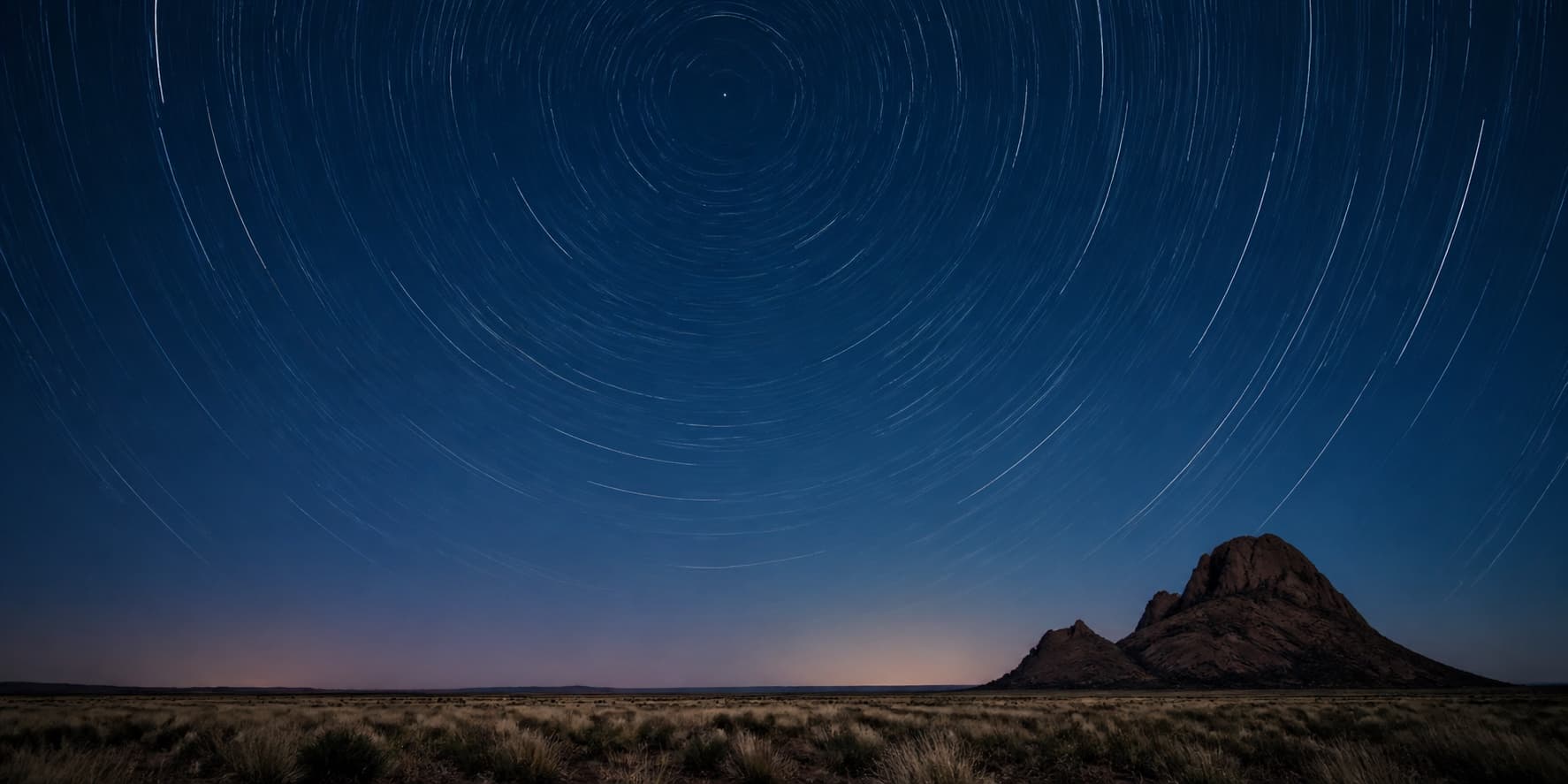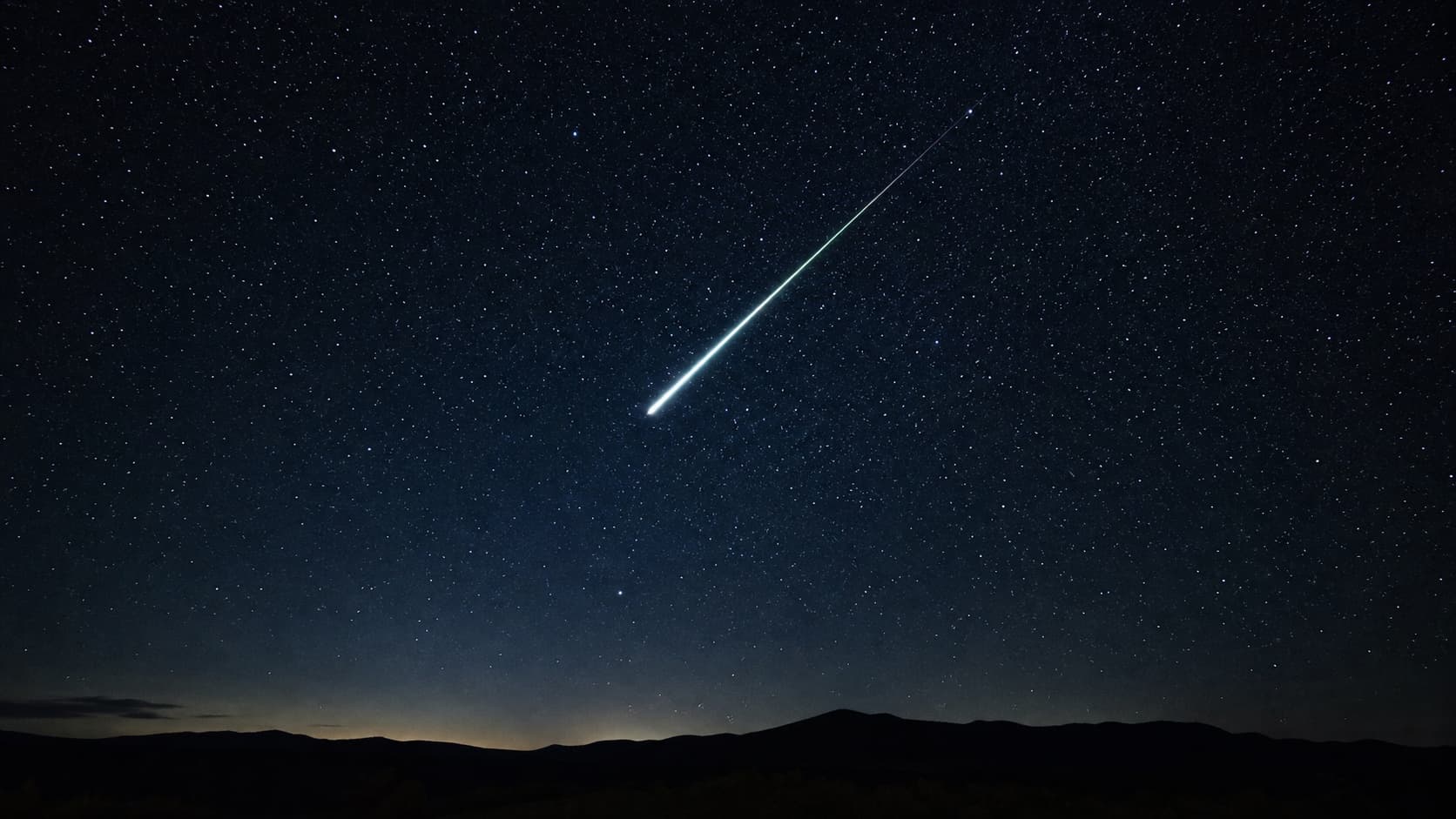
A meteor shower is Earth flying through a trail of dust.
The trail was left behind by a comet (sometimes an asteroid), and the dust burns up high in our atmosphere as we plow through it. Each speck of dust becomes a streak of light — what we call a shooting star.
They’re free, no equipment is needed, and the best ones happen on roughly the same dates every year. Here’s the beginner’s version of everything you need to know to actually go watch one.
Before you head out, check the live tool above — it’ll show what’s overhead from your location right now, so you know which direction the radiant will be. Standalone page at skywhen.com/tools/sky-tonight.
What a meteor shower actually is
Comets are mostly ice and dust. When a comet gets close to the sun, it warms up, and the dust on its surface gets pushed off into a long trail that follows the comet’s orbit around the sun.
Earth’s orbit happens to cross some of these comet trails.
Each time we cross, we sweep up the dust the comet has been shedding for centuries. The dust grains are tiny — most are smaller than a grain of sand — but they hit our atmosphere at 30 to 70 kilometers per second.
At that speed, they vaporize at about 80 kilometers up. The streak of light you see isn’t the dust itself; it’s a column of glowing air, briefly heated by the dust grain’s passage.
- JAN3★QuadrantidsMeteor shower
Sharp, short peak (~120/hour) in a six-hour window. Northern Hemisphere, pre-dawn.
- JAN3●Wolf supermoonSupermoon
First of four supermoons in 2026, 362,300 km from Earth. Same night as the Quadrantids — but the bright moon will wash out the shower.
- FEB17◐Annular solar eclipseSolar eclipse
“Ring of fire” eclipse. Path crosses Antarctica and the tip of South America; partial phases visible across the Southern Hemisphere.
Annularity from Antarctica / southern South America
- MAR3○Total lunar eclipseLunar eclipse
Blood moon — the moon passes through Earth's shadow and turns coppery red. Visible across the Pacific, Asia, Australia, and western North America.
Best from the Pacific, Asia, Australia, western North America
- MAR8◇Venus and SaturnConjunction
Bright Venus and pale Saturn less than a degree apart, low in the western evening twilight. Catch them soon after sunset before they set.
- MAR20—March equinoxEquinox
Day and night equal across the globe. Spring begins in the Northern Hemisphere, autumn in the Southern.
Set a location above to see which events are above your horizon at peak.
That’s the live 2026 calendar — the meteor showers (and everything else worth watching) for the rest of the year. Full filterable list at skywhen.com/tools/2026-sky-calendar.
Why showers happen on the same dates every year
Earth’s orbit is consistent. The comet’s orbit is consistent.
The trail of dust the comet left is roughly in the same place from year to year. So the date on which our orbit crosses the trail is also roughly the same.
This is why the Perseids peak around August 12 every year, the Leonids around November 17, and the Geminids around December 13. The peak shifts by a day or two depending on the geometry of the year, but it’s never radically different.
The single thing that ruins most viewing nights
Light pollution. From inside a major city you’ll see maybe two or three meteors during a peak shower; from a dark rural site under the same conditions you’ll see thirty or forty.
The fix is geography. An hour’s drive out of a small city is usually enough.
An hour-and-a-half out of a large one. Once you can see the Milky Way faintly with your naked eye, you’re dark enough.
The second thing that ruins nights is a bright moon.
If a full moon is up during the shower’s peak, the show is washed out. Cross-check the lunar phase against the shower date — sometimes a year offers a perfect dark-moon peak, sometimes a frustrating bright one.
Set a location and this becomes a list of the actual dark nights near you — how many hours each one gives you, and between which times. The new moon is only the middle of the window.
New moons come round every 29 or 30 days.
How to actually watch one
Meteor watching is a passive sport.
You don’t look at a particular point in the sky; you look at as much of the sky as possible at once. The best position is on your back.
Bring
- A reclining lawn chair, a yoga mat, or a blanket and a sleeping bag.
- Warm clothes. Even in summer, lying still for an hour at 3 a.m. is colder than you’d expect.
- A thermos of something warm.
- No screens — your phone’s glow wrecks your night vision instantly.
- Patience. The first thirty minutes are mostly your eyes adjusting; the show really starts at minute forty-five.
Where to look
Up.
Anywhere up. People sometimes get hung up on finding the radiant (the point in the sky that the meteors appear to fan out from), but you don’t need to look at the radiant.
Meteors with the longest streaks actually appear far away from the radiant.
If you stare directly at the radiant, you mostly see short bright pricks. Let your eyes sit on a region 30 to 50 degrees away from the radiant and you’ll see the best streaks.
What the radiant is, and why people keep mentioning it
All the meteors in a shower appear to come from the same patch of sky. That patch is called the radiant, and showers are usually named after the constellation it sits in.
The Perseids appear to fan out from the constellation Perseus. The Geminids from Gemini.
The Leonids from Leo. (The dust doesn’t actually start there — it’s a perspective effect, like raindrops on a windshield appearing to fan out from the direction you’re driving.)
The practical takeaway: a shower’s peak is best viewed after the radiant has risen above your horizon. Most showers radiate from a constellation that rises late at night, which is why “after midnight” is the standard advice.
Reading the rate numbers
You’ll see meteor showers described by their ZHR — Zenithal Hourly Rate. This is a theoretical maximum: how many meteors you’d see per hour if the radiant were directly overhead and your sky were perfectly dark.
In the real world, you see less.
The Perseids have a ZHR of ~100, but a typical observer at a decent dark site sees roughly 50–60 per hour at peak. A typical urban observer with the same shower sees 5–10.
Treat ZHR as the upper bound, not the prediction. Halving the listed ZHR is usually a reasonable real-world expectation.
The bigger ones, in one paragraph each
Perseids — August
The headline summer shower. Comet 109P/Swift-Tuttle.
Up to 100 per hour at peak, warm nights, friendly hours (after 11 p.m. through dawn). Best northern-hemisphere shower of the year.
Geminids — December
The strongest shower of the year, but cold. Up to 120 per hour.
Unusual because the parent body is an asteroid (3200 Phaethon) rather than a comet. Meteors are bright, slow, and unusually colorful.
Quadrantids — January
High peak (~100/hour) but sharply concentrated in a six-hour window. Easy to miss if your timing is even a few hours off.
Leonids — November
Quiet most years (~15/hour) but legendary every 33 years when it produces meteor storms with thousands per hour. The next anticipated storm year is 2033.
Eta Aquariids and Orionids — May and October
Both leftover dust from Halley’s Comet.
The Eta Aquariids favor the Southern Hemisphere; the Orionids favor everyone equally. About 20 per hour at peak for the Orionids.
For dates, rates, and 2026 viewing notes for each one, see Perseids, Geminids, Leonids: A Guide to the Big Annual Meteor Showers.
The bridge: the sky on the night you watched
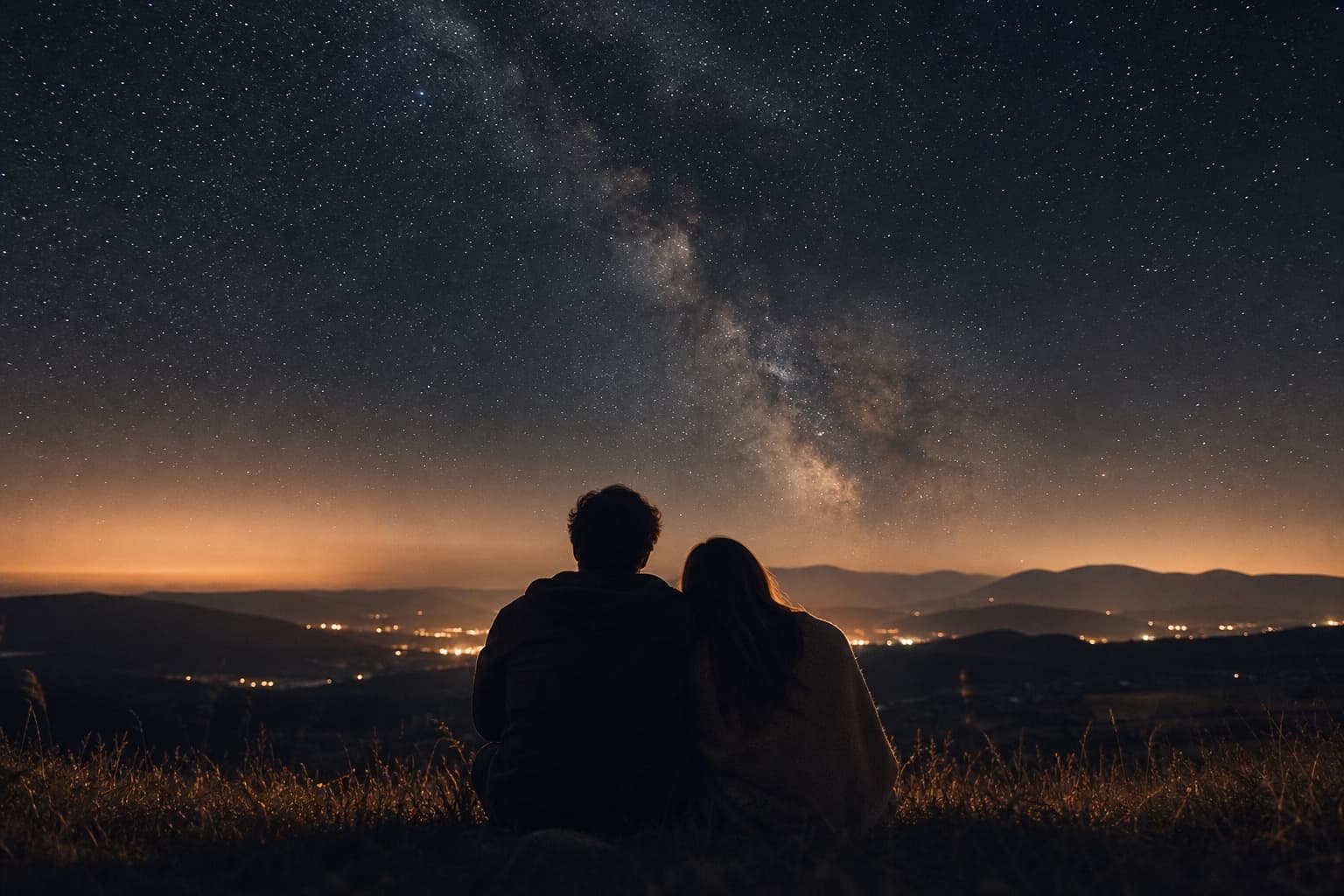
One thing meteor showers do that few other events do is give you a memory tied to a specific night. Not just a year, not just a season — a specific date, a specific place, a specific group of people lying on the same patch of grass.
That makes it a natural date for a custom star map. The poster renders the actual sky from the date and place you watched — the constellation the meteors came from, the moon phase that night, the planets that were up.
Try a meteor-shower date you remember at the SkyWhen customizer .
For the broader 2026 picture, see The 2026 Sky Calendar. For the math behind “what was actually in the sky that night,” see How Star Maps Work.
FAQ
What time is best to watch a meteor shower?
Generally between midnight and dawn. That’s when your patch of Earth is facing the direction of our orbital motion, so you’re on the forward-facing side that’s plowing into the dust.
Some showers (like the Quadrantids and Geminids) start earlier in the evening because of where their radiant sits, but post-midnight is the safer default.
Do I need a telescope or binoculars?
No. A telescope makes things worse because it dramatically narrows your field of view. Meteor watching is a wide-field activity — your eyes are the perfect instrument.
How many meteors should I expect to see?
Take the shower’s ZHR (Zenithal Hourly Rate), halve it, and that’s a realistic expectation from a moderately dark site at the peak hours.
A 100-ZHR shower like the Perseids will give a careful observer about 50 meteors per hour. From a city, more like 5.
Can I photograph a meteor shower with my phone?
iPhones from the 12 Pro onward and recent Pixel and Samsung flagships can, using Night Mode on a tripod. You’ll catch the brighter meteors but miss the dimmer ones.
A real DSLR or mirrorless camera with a wide lens at f/2.8, ISO 1600, and a 20-second exposure is the standard setup if you’re serious.
Is there a meteor shower tonight?
On any given night you can catch sporadic meteors — random unrelated ones — at a rate of about four to six per hour from a dark site. The big showers happen on specific dates.
For a year-by-year list, see The 2026 Sky Calendar.