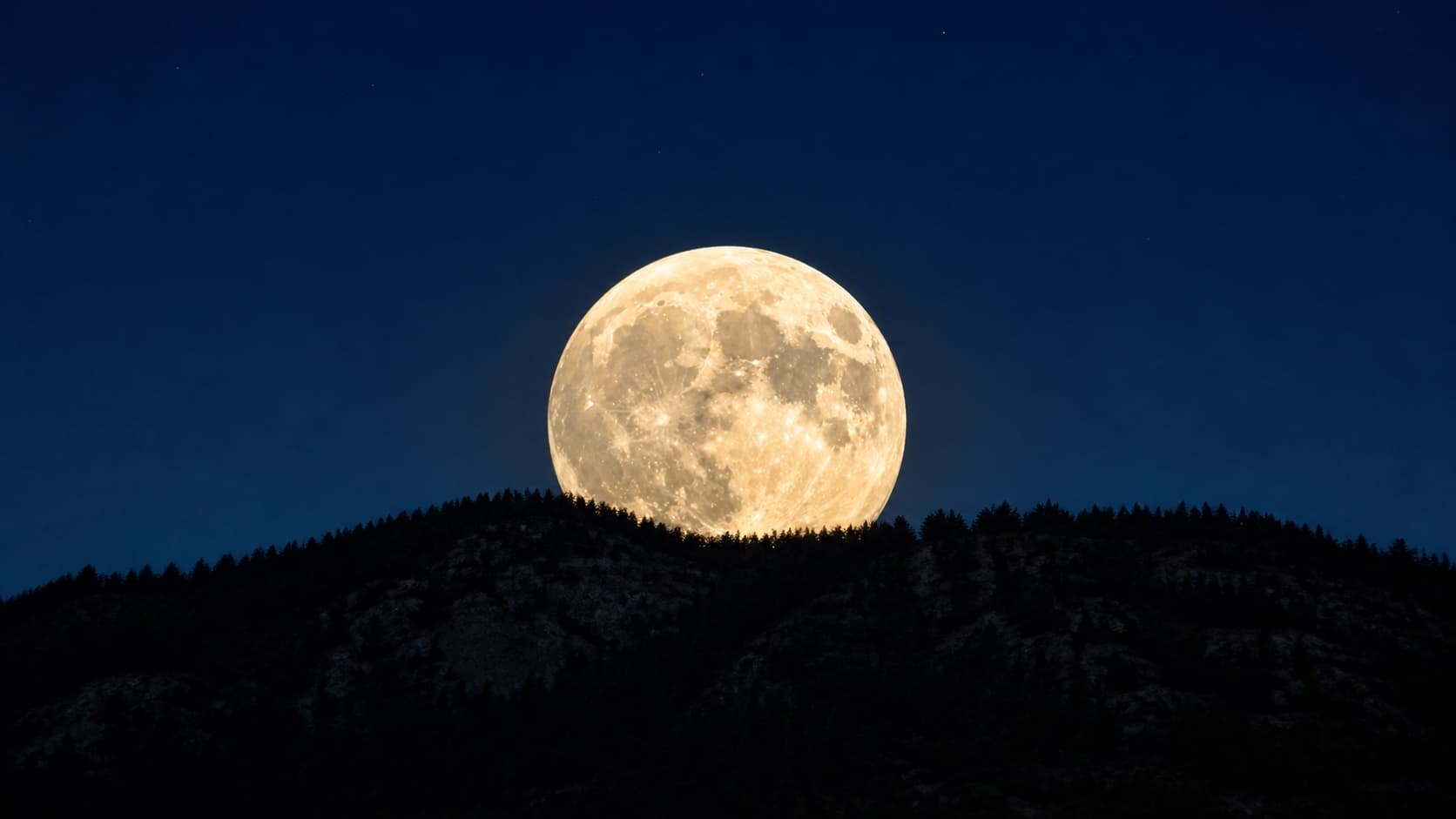
A blue moon is not blue, and it’s not particularly rare.
The phrase “once in a blue moon” gives the impression that we’re dealing with a once-a-decade event. In practice, a blue moon happens every two and a half years on average.
There are also two competing definitions, and most articles online use the wrong one. Here’s the honest version.
The two definitions
There are two different definitions of a blue moon in common use, and they both exist for historical reasons.
Seasonal blue moon (the original)
The third full moon in a season that contains four full moons.
(Most seasons have three.) This is the definition that comes from the Maine Farmer’s Almanac in the 1930s. It’s the older, more technically correct definition.
Monthly blue moon (the modern misreading)
The second full moon in a calendar month.
This definition came from a 1946 article in Sky & Telescope magazine that misinterpreted the older Almanac rule. The misreading stuck, and now most people — and most articles online — use this one.
For practical purposes, both definitions are now considered valid. The monthly version is what most people mean when they say blue moon.
Why blue moons happen
The moon’s synodic month — the time from one full moon to the next — is 29.5 days.
Most calendar months are 30 or 31 days long. That difference of a few days means that occasionally, a full moon falls in the first day or two of a calendar month, and a second full moon arrives 29.5 days later, before the month ends.
That happens about once every 33 months on average. Roughly two and a half years.
For the seasonal definition, the math is similar — a year has 12 full moons most years, but every two or three years it fits in 13. The 13th one becomes the seasonal blue moon, by definition the third of four in whichever season got the extra.
How rare is “once in a blue moon” actually?
About once every two and a half years on average, under the monthly definition. Less rare than most people assume from the phrase.
That said, double blue moons in the same calendar year are genuinely uncommon — two calendar-month blue moons in twelve months happens roughly four times per century. That feels closer to what the idiom was reaching for.
The phrase “once in a blue moon” predates the modern definitions entirely.
It dates back to at least 1528, when it appeared in an English satire as a way of describing something obviously absurd. The astronomical meaning came much later.
Does the moon ever actually look blue?
Yes — but not because of the calendar.
A genuinely blue-tinged moon happens when the atmosphere has unusually large particles in it — soot from major wildfires, or volcanic ash. The particles preferentially scatter red light, which is the opposite of normal atmospheric scattering, and what reaches your eye is a moon shifted toward blue.
Well-documented cases include the months after the 1883 Krakatoa eruption, when blue-tinged moons were reported worldwide; the 1950 Alberta forest fires; and occasionally after major California wildfires.
So a literally-blue moon is real, and rare, but has nothing to do with the calendar definition.
How many blue moons in 2026?
One — and only under the modern monthly definition.
- May 31. The second full moon of May, falling about a month after the May 1 Flower Moon. It’s the only month in 2026 that catches two full moons.
Under the older seasonal definition (the third full moon in a season of four), there’s no Blue Moon in 2026.
For the full year of full moons and their traditional names, see What Is a Supermoon? (And Every Full Moon Name in 2026).
The bridge: a date marked by the calendar quirk
Blue moons are one of those dates people remember because the calendar made them unusual. The second full moon of a month is, by accident, a memorable night — a slightly stranger sky than usual, even if the moon itself looks identical to any other full moon.
A custom star map of a blue-moon night renders the actual moon (full, of course) and the constellation backdrop from your exact location. The poster is the literal sky on the night that happened to be a calendar oddity.
Plug in the date at the SkyWhen customizer and the preview will show the sky as it actually was.
For the rest of the year’s notable moons, see Supermoons & Full Moon Names. For the year’s eclipses (one of which is also a blue moon in 2026), see Lunar Eclipse Explained.
FAQ
Why is it called a blue moon if it's not blue?
The phrase “once in a blue moon” is from the 1500s and originally meant something absurd or impossible — the moon obviously isn’t blue. The astronomical definition came later, borrowed the idiom, and applied it to a calendar quirk.
When is the next blue moon?
May 31, 2026 — the second full moon of that calendar month. The next after that under the monthly definition is August 28, 2026.
How often does a blue moon happen?
Once every 2.5 years on average. The idiom “once in a blue moon” suggests something rarer, but the astronomical event is actually fairly common.
Can the moon actually look blue?
Yes — but only after events like major wildfires or volcanic eruptions. The atmosphere fills with unusually large particles that scatter red light and let blue through, tinting the moon. It’s rare and unrelated to the calendar definition.
What's the difference between a seasonal and a monthly blue moon?
A monthly blue moon is the second full moon in one calendar month. A seasonal blue moon is the third full moon in a season that contains four.
The seasonal definition is older and more technically correct; the monthly version is more widely used today.