Andromeda is two things at once, and people mix them up constantly.
The constellation Andromeda is a star pattern in our own galaxy — a chain of stars representing a chained princess from Greek mythology. The Andromeda Galaxy is a separate galaxy 2.5 million light years away that happens to sit inside the same patch of sky.
They share a name because the galaxy was named after the constellation it appears within. They’re otherwise unrelated: one is local, the other is unimaginably distant.
The constellation itself
Andromeda is a long, narrow chain of stars stretching across a wide section of the northern autumn sky. The main shape is roughly three lines of stars tapering away from the corner of the Great Square of Pegasus.
None of its stars are dazzlingly bright.
The brightest, Alpheratz at the head, is magnitude 2.0 — respectable but unremarkable. The constellation is more of a recognizable layout than a striking shape.
What makes it famous isn’t the constellation. It’s what sits inside it.
The Andromeda Galaxy (M31)
Inside the constellation Andromeda, about halfway down its length, sits a fuzzy oval patch of light visible to the naked eye on a dark night. That patch is M31 — the Andromeda Galaxy.
It’s an enormous spiral galaxy roughly twice the size of our Milky Way, containing about a trillion stars. It’s 2.5 million light-years away.
That distance is important. The light hitting your retina when you look at M31 tonight left the galaxy 2.5 million years ago, during the early Pleistocene era.
Homo erectus hadn’t yet evolved. Whatever the light reveals is a picture of M31 from a different geological epoch.
M31 is the most distant object that an average human eye can see without any kind of optical aid.
Through binoculars, the fuzzy oval becomes a more extended bright center with hints of structure. Through a telescope, you can start seeing the spiral arms.
How to find M31
The trick is to find the Great Square of Pegasus first. That’s a large, obvious square of four bright stars high in the autumn evening sky from the Northern Hemisphere.
From the top-left corner of the Square (Alpheratz, which technically belongs to Andromeda), follow the chain of Andromeda’s stars to the upper-left. You’ll go through one bright star (Mirach), then look just to the upper-right of Mirach to find a faint smudge in the sky.
That smudge is M31. It’s about the size of the full moon on the sky — bigger than people expect.
The collision course
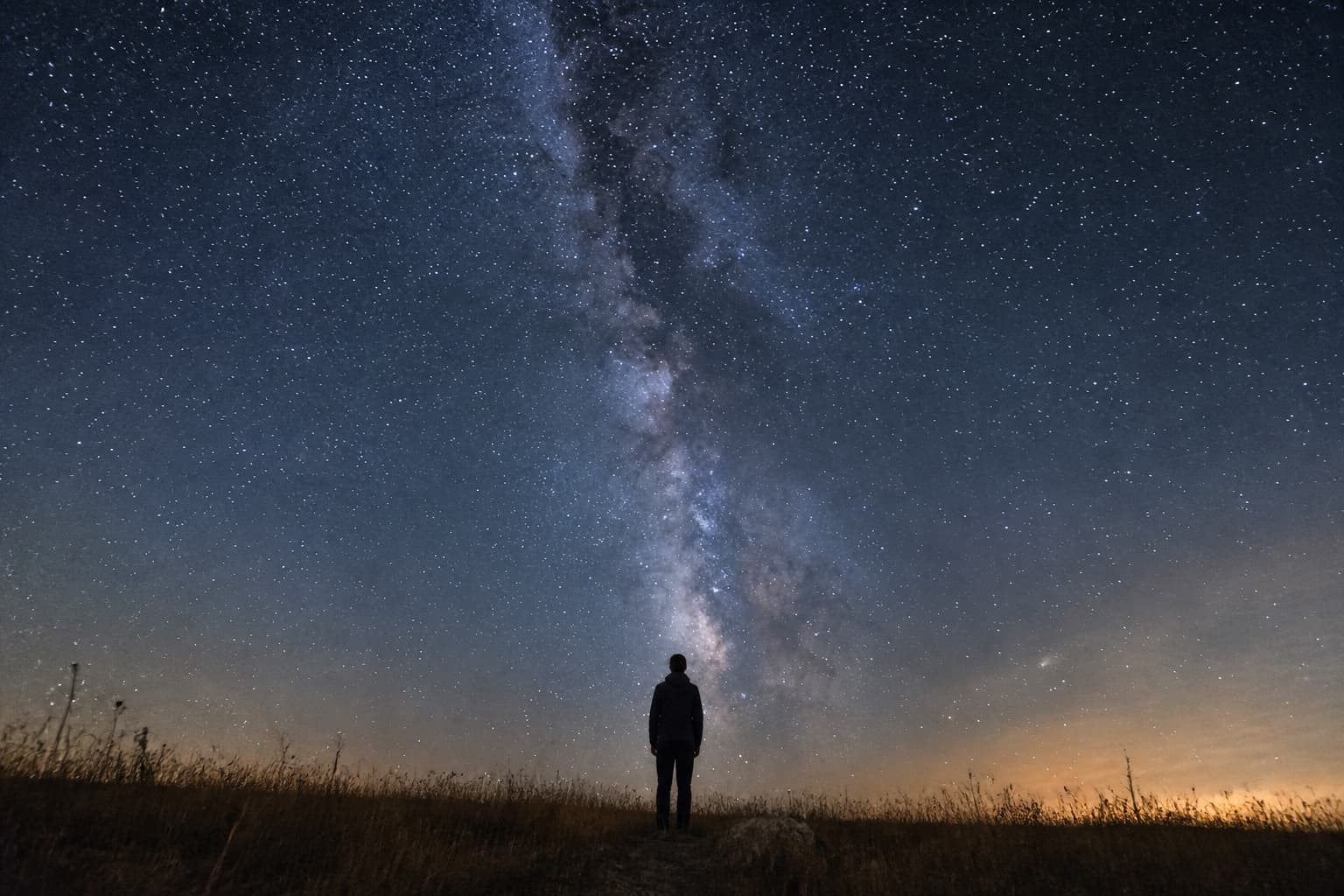
The Milky Way and the Andromeda Galaxy are falling toward each other at about 110 kilometers per second. In about 4.5 billion years, they’ll collide.
It won’t be a Hollywood-style collision — galaxies are mostly empty space, and individual stars almost never actually hit each other. But the two galaxies’ gravity will tear each other’s shapes apart over a couple of billion years and eventually merge into a single elliptical galaxy that astronomers have already nicknamed “Milkomeda.”
That’s in the future of about the same magnitude as Earth’s remaining lifespan — the sun will be approaching the end of its main-sequence life around the same time. Earth probably won’t be inhabitable by then.
The Greek myth
Andromeda was a princess of Aethiopia. Her mother Cassiopeia boasted that Andromeda and herself were more beautiful than the sea nymphs — the Nereids, daughters of Poseidon — and Poseidon sent the sea monster Cetus to ravage the coast as punishment.
The only way to placate Poseidon was to sacrifice Andromeda. So Cassiopeia chained her to a rock by the sea and waited for the monster.
Perseus, flying back from killing Medusa, saw Andromeda chained to the rock, killed the sea monster, freed her, and married her. The whole family ended up in the sky: Andromeda chained as a constellation, with Perseus, Cassiopeia, Cepheus (her father), and Cetus all around her.
The chain in the stars is the chain that bound her to the rock.
The constellation-vs-galaxy confusion
Astronomy and the public say “Andromeda” to mean different things:
- The constellation: a star pattern about 200 light-years across, made of stars in our own galaxy.
- The galaxy: a separate galaxy 2.5 million light-years away, made of a trillion stars of its own.
They appear in the same direction of the sky.
From our point of view, the galaxy sits “inside” the constellation. They share a name because the galaxy was named after the constellation it appears within, not because they have anything to do with each other physically.
When astronomers talk about M31 or NGC 224 (the galaxy’s catalog numbers), they’re unambiguously talking about the galaxy. When they say “Andromeda the constellation” they’re talking about the star chain.
When and where to look
Northern Hemisphere
Best viewing: September through January, high in the evening sky. October and November are peak — Andromeda is nearly overhead at 10 PM, and dark country skies will show M31 plainly to the naked eye.
From light-polluted cities, the galaxy is invisible to the naked eye, but binoculars will pull it out easily.
Southern Hemisphere
More difficult from southern latitudes. Andromeda is low in the northern sky from the tropics and southern hemisphere mid-latitudes, and from below about 45° south, it doesn’t rise high enough to see well.
Other things inside Andromeda
- M32 and M110 — two small satellite galaxies orbiting M31. Visible in binoculars under dark skies, as faint smudges near M31.
- NGC 752 — a wide-spread open star cluster.
- Almach (Gamma Andromedae) — a beautiful color-contrast double star, gold and blue, visible in a small telescope.
The bridge: a sky deep enough to see another galaxy
On most personalized star maps from the Northern Hemisphere autumn or winter, the Andromeda constellation will appear in the print — and if the rendering includes deep-sky details, M31 itself can show as a small smudge inside it.
Plug a meaningful autumn or winter date into the SkyWhen customizer and the preview will show where Andromeda was that evening. The preview is free.
For Andromeda’s neighbors, see Cassiopeia (the mother) and The Milky Way (our own galaxy — the one M31 is on a collision course with).
FAQ
Is the Andromeda Galaxy inside the Andromeda constellation?
From our point of view, yes — the galaxy sits inside the constellation’s patch of sky. Physically they’re unrelated: the constellation is stars in our own galaxy, and the Andromeda Galaxy is a separate galaxy 2.5 million light-years beyond.
Can you see the Andromeda Galaxy with the naked eye?
Yes, under a dark sky. It looks like a faint, slightly elongated smudge about the size of the full moon. From light-polluted cities, binoculars are needed.
How far away is the Andromeda Galaxy?
About 2.5 million light-years. That makes it the farthest single object the average human eye can see without optical aid.
Is Andromeda going to collide with the Milky Way?
Yes, in about 4.5 billion years. The two galaxies will eventually merge into a single elliptical galaxy. Individual stars won’t actually collide — galaxies are mostly empty space.
When can I see Andromeda the constellation?
September through January from the Northern Hemisphere, high overhead in autumn evenings. October and November are peak viewing months.