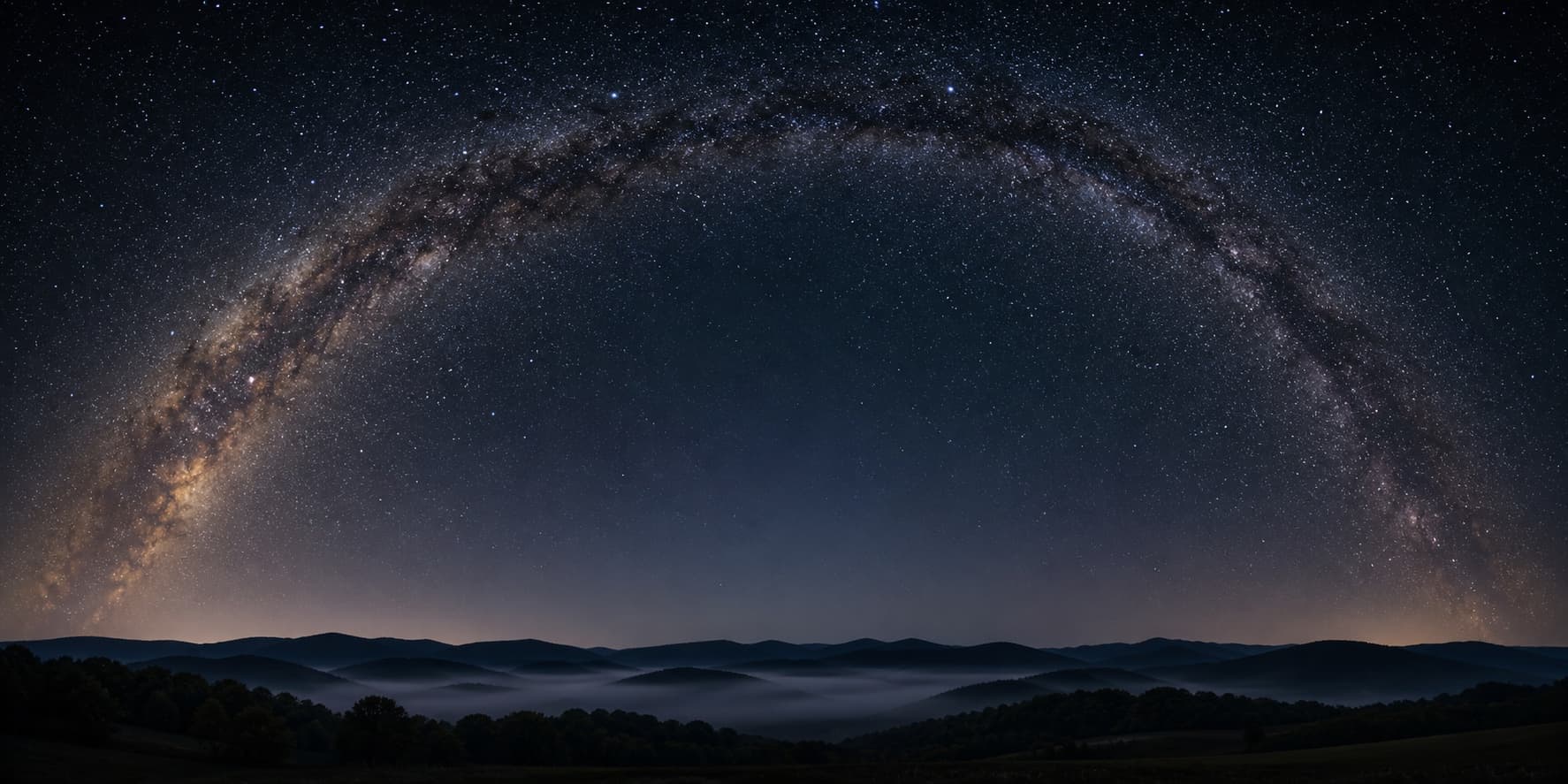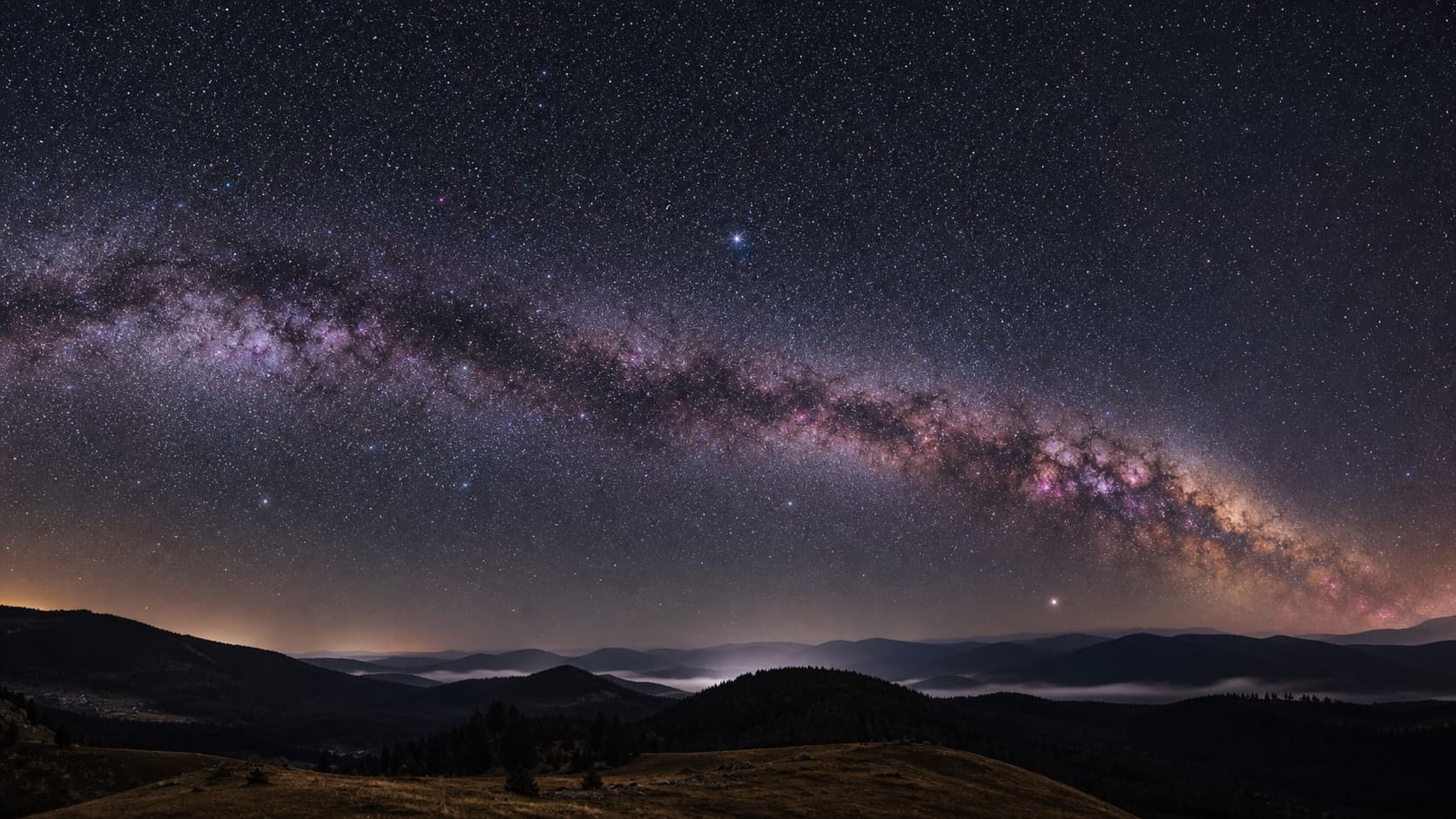
The Milky Way is the galaxy we live in. It’s a flat disk of about 100–400 billion stars, roughly 100,000 light years across, with a thick bulge in the middle and spiral arms wrapping outward.
We’re inside it, about two-thirds of the way out from the center. The hazy band of light you can sometimes see arcing across a dark sky is the disk seen edge-on — billions of stars too faint to make out individually, blending into a single glow.
What the Milky Way actually is
A galaxy is a gravitationally bound collection of stars, gas, dust, and dark matter — usually flattened into a disk by spinning.
The Milky Way is one of an estimated two trillion galaxies in the observable universe. It’s on the larger end of the spectrum, but not the largest.
Structurally, the Milky Way has four main parts: the central bulge (a dense spherical cluster of older stars around the center), the disk (where almost all the young stars and gas live, including us), the halo (a sparser cloud of very old stars and globular clusters surrounding the disk), and the dark matter halo (extending much further out, only detectable from how it pulls on the visible matter).
Where we sit inside it
Our solar system orbits in a relatively quiet part of the disk, about 26,000 light years from the center. We’re inside what astronomers call the Orion Spur — a minor spiral feature between two of the major spiral arms (the Sagittarius arm inside us and the Perseus arm outside us).
One full orbit around the galactic center takes us about 230 million years.
The last time the sun was in this position, dinosaurs hadn’t evolved yet. We’re moving at roughly 220 kilometers per second relative to the galactic center, and the entire galaxy is rotating with us — like passengers on a slow cosmic carousel.
What’s at the center
Sagittarius A*, a supermassive black hole with the mass of about 4 million suns.
Despite the mass, it’s a relatively quiet black hole — it’s not actively eating much gas, so it doesn’t produce much radiation. Astronomers confirmed its existence by tracking the orbits of stars near the center for decades; in 2022, the Event Horizon Telescope produced the first direct image of its shadow.
The Sagittarius A* region is dramatically crowded — dense star fields, intense magnetic fields, the occasional flare as gas falls in.
From our distance, it’s invisible to optical telescopes because dust along the line of sight blocks the visible light. Radio, infrared, and X-ray telescopes can see through it.
How many stars (and planets) are in the Milky Way
Star estimates range from 100 to 400 billion, with the standard textbook number being about 200 billion. The wide range is because most stars are smaller and fainter than our sun, hard to count even with the best instruments — we have to infer them statistically.
Planet estimates are even larger. Based on Kepler mission data, astronomers estimate that nearly every star has at least one planet.
That puts the planet count somewhere in the hundreds of billions to over a trillion. Of those, somewhere between several billion and 60 billion are in the “habitable zone” of their stars — at distances where liquid water could exist on the surface.
Why it’s called the Milky Way
The name is ancient and comes from the milky appearance of the dim galactic band in a dark sky. The Greek myth attributes it to milk spilled from Hera while she nursed Heracles — the word “galaxy” itself comes from the Greek gala (milk).
Most cultures across history have similar names — the Cherokee called it “Where the Dog Ran,” the Chinese the “Silver River,” the Quechua “Mayu” (the heavenly river).
Until 1610, when Galileo pointed his telescope at it, no one knew what the band actually was. He resolved it into individual stars and confirmed that the milky glow was made of countless distant suns — one of the most consequential observations in the history of science.
How to see the Milky Way
Three things need to be true at once: a dark sky, a clear sky, and the right time of year.
Dark
Even moderate light pollution wipes out the Milky Way. You need a sky rated Bortle 4 or better (a darkness classification scale astronomers use) — usually meaning at least an hour’s drive from a major city.
A useful test: if you can see eight or more stars in the bowl of the Little Dipper with the naked eye, your sky is dark enough.
Clear
Obvious, but worth saying. Even thin high cirrus will erase the faint Milky Way glow.
The right time of year
From the Northern Hemisphere, the brightest part of the Milky Way — the bulge around the galactic center, in the constellation Sagittarius — is visible from roughly March through September, with peak visibility in June, July, and August.
From the Southern Hemisphere, the galactic core passes much higher overhead, and the visible Milky Way is correspondingly brighter and more dramatic. Australia, New Zealand, southern Africa, and southern South America have some of the best Milky Way viewing on the planet.
The other critical factor is the moon. New moon, or close to it, is essential — even a half moon is bright enough to wash out the band.
How the Milky Way appears on a star map
On a SkyWhen poster, the Milky Way shows up as a soft luminous band threading through the constellations. It’s rendered with the same astronomical data we use for stars — its position on the page is the actual edge-on disk of our galaxy as it appeared from your latitude and longitude at the moment you chose.
On a midsummer Northern Hemisphere date, the band arcs from the northeast through Cygnus and down to the bright bulge in the southern sky, exactly where it would appear in a dark-sky photograph. On a Southern Hemisphere date, the bulge sits higher overhead and the band is more pronounced.
Our neighbors and our fate
The Milky Way isn’t alone. We belong to the Local Group — a small cluster of galaxies including the Andromeda Galaxy (the largest), the Triangulum Galaxy, and roughly 50 smaller dwarf galaxies.
In about 4.5 billion years, the Andromeda Galaxy will merge with the Milky Way to form a new, larger galaxy.
Our solar system probably won’t be disrupted by the merger — galaxies are mostly empty space, and stellar collisions are essentially zero — but the night sky from Earth in the distant future will be dramatically different. The merger will be slow on human time scales (taking a billion years to complete) and won’t finish before our sun expands into a red giant and consumes Earth.
The bridge: the night you stood under it
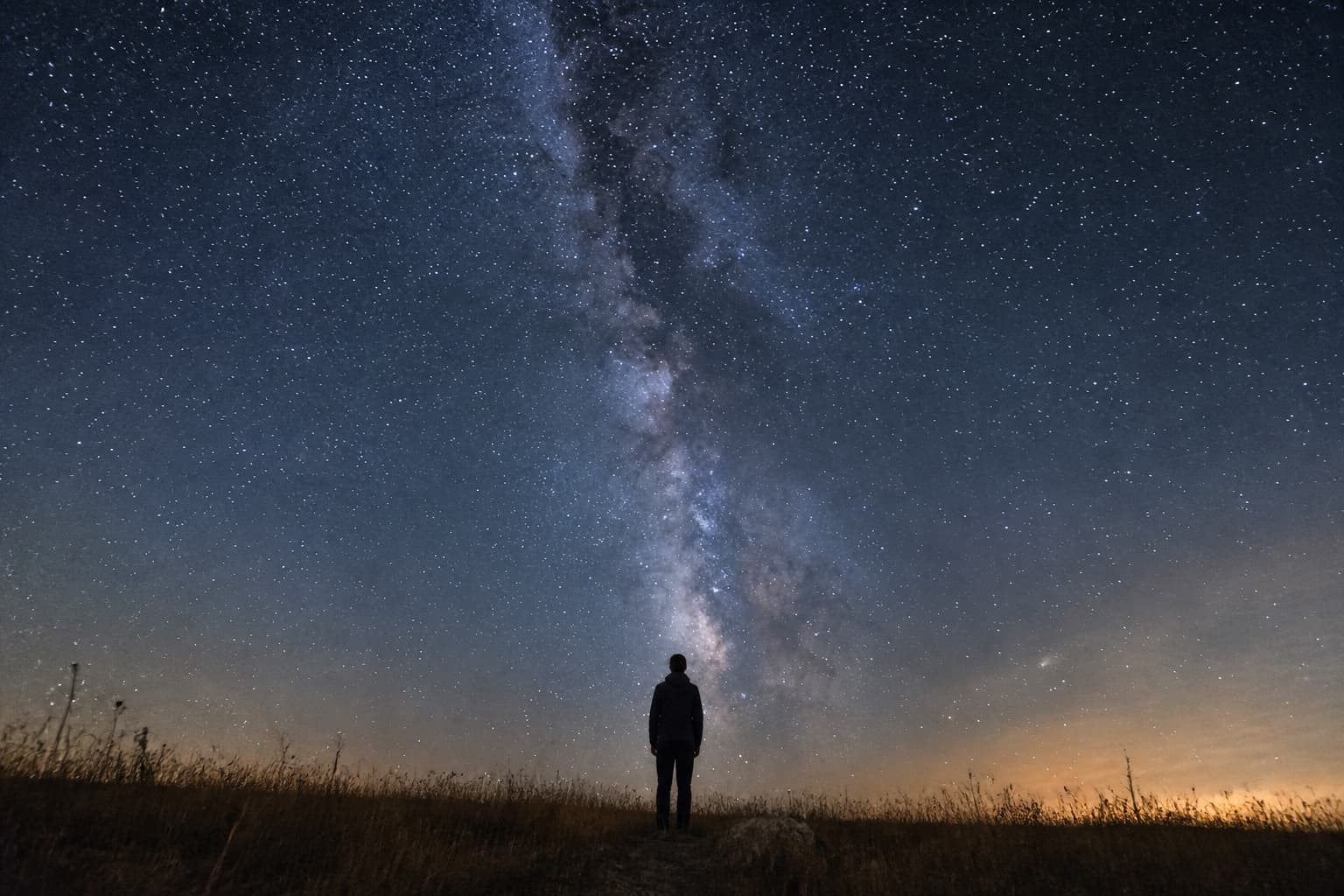
Seeing the Milky Way clearly for the first time is one of those nights people remember for years. The galaxy stops being an abstract concept and becomes a visible thing — a structure you live inside.
A custom star map of that night renders the Milky Way exactly where it sat in your sky, anchored to your latitude and date. The poster is the literal galactic disk in the same arc you saw with your eyes.
Try a date and place you remember at the SkyWhen customizer — the preview is free, and the Milky Way is rendered from real data.
For practical viewing tips, see What’s in the Sky Tonight. For how the math behind any rendered sky works, see How Star Maps Work.
FAQ
How big is the Milky Way?
About 100,000 light years across, with a disk roughly 1,000 light years thick at our position. Recent observations suggest the disk may extend to nearly 200,000 light years if you include the diffuse outer regions.
How many stars are in the Milky Way?
Somewhere between 100 billion and 400 billion. The textbook estimate is about 200 billion. The wide range exists because most stars are dim red dwarfs that are hard to count even with the best instruments.
What's at the center of the Milky Way?
Sagittarius A*, a supermassive black hole with the mass of about 4 million suns. It’s a relatively quiet black hole — not actively consuming much gas — and its existence has been confirmed by tracking the orbits of nearby stars and by direct imaging in 2022.
Can I see the Milky Way with the naked eye?
Yes, from a dark site with a clear sky and no moon. Roughly two-thirds of the world’s population currently lives under skies too light-polluted to see it — getting to truly dark sky usually means an hour or more outside a major city.
When is the best time of year to see the Milky Way?
From the Northern Hemisphere: late spring through summer (April through September), with the core highest in July and August. From the Southern Hemisphere: the core is high in winter (May through September), and visibility is dramatic year-round.