About half of the brightest “stars” in the night sky aren’t stars at all. They’re planets — Venus, Jupiter, Mars, Saturn, occasionally Mercury — and they each have a different look once you know what to spot.
Knowing how to tell them apart is the single biggest jump in casual stargazing skill. You go from “look at all the stars” to “that’s Jupiter, that’s Mars, that’s Vega” in about one good evening.
Here’s the field guide, in plain language.
That’s the live version — share your location and you’ll see which planets are above the horizon right now, with the direction to face. Standalone page at skywhen.com/tools/sky-tonight.
Star or planet? The basic tests
Three quick checks tell you whether the bright dot you’re looking at is a planet or a star. They’re not foolproof — nothing in casual stargazing is — but they’re right ninety-five percent of the time.
The twinkle test
Stars are true point sources of light, so the air’s small movements scatter their light unevenly. The result is the famous twinkle.
Planets are technically small disks, because they’re much closer.
The light arriving from their surface is averaged across that disk, and the twinkle gets smoothed out. They look steady.
On any given night, the brightest steady points are almost always planets, and the brightest twinkling points are almost always stars.
The brightness test
Venus, Jupiter, and Mars (when at peak brightness) outshine every star. If something is overwhelmingly bright — brighter than anything else, by a clear margin — it’s probably a planet.
Sirius, the brightest actual star, is roughly half as bright as Jupiter at its brightest, and a fraction of the brightness of Venus.
The color test
Most stars look white or very-faintly-blue or very-faintly-yellow. A few of the very biggest stars look noticeably orange (Arcturus, Betelgeuse, Antares).
Mars is the only object in the sky that looks obviously red-orange. If you’re looking at an unambiguously reddish bright dot, it’s Mars almost certainly.
The five visible planets, ranked by brightness
Venus — the easiest one
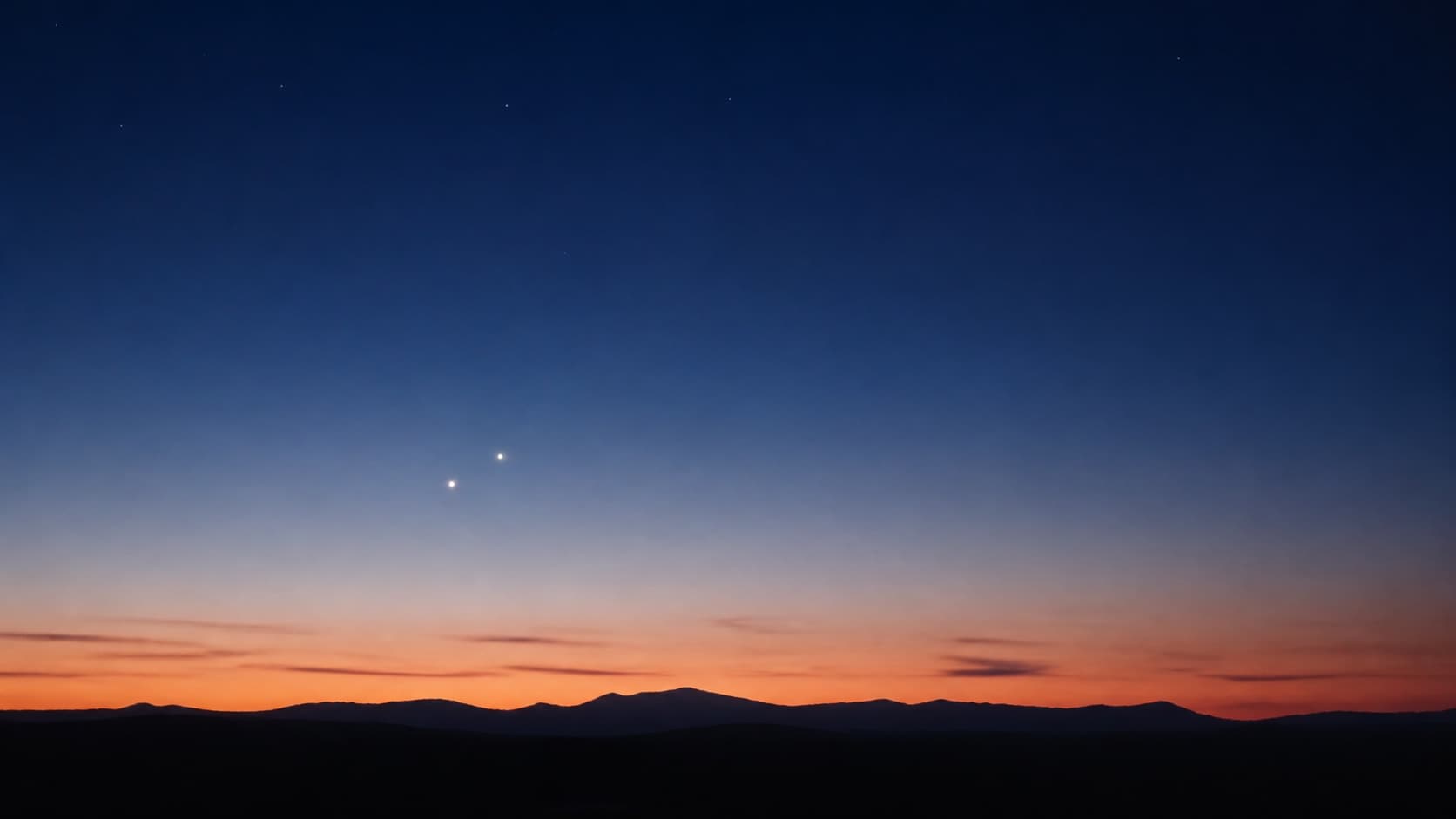
Venus is by far the brightest planet, and the brightest object in the night sky after the sun and the moon. There’s essentially no mistaking it.
Venus only ever appears as either the evening star (in the west, after sunset) or the morning star (in the east, before sunrise). It never sits high in the middle of the night.
If you see something overwhelmingly bright in the western sky just after sunset, or in the eastern sky just before dawn, that’s Venus.
Jupiter — the steady king of the night
Jupiter is the second-brightest planet and is usually visible for most of every year. It’s bright, steady, and white-to-very-slightly-yellow.
Unlike Venus, Jupiter can sit high overhead in the middle of the night. If you’re outside at midnight and there’s a particularly bright, steady point in the sky, and it’s not low to the horizon, it’s probably Jupiter.
With binoculars, you can see Jupiter’s four largest moons as small points on either side of the planet. Galileo first spotted them in 1610.
Mars — the orange one
Mars varies enormously in brightness depending on how close it is to Earth. At its best, it rivals Jupiter; at its worst, it’s a dim orange-red dot barely noticeable.
The thing that gives Mars away is the color.
Orange-red, the only object in the sky that looks unambiguously that color. If you spot what looks like a deep amber star, it’s Mars.
Saturn — the slow, steady, yellow one
Saturn is bright but not as bright as Jupiter. It has a steady, slightly yellowish tint, and it moves through the sky much more slowly than the inner planets.
To the naked eye, Saturn just looks like a bright star. With even a cheap telescope, the rings become visible — it’s one of the most rewarding small-telescope targets in the sky.
Mercury — the hard one
Mercury is the closest planet to the sun, which means it never strays far from the sun in our sky. It’s only visible briefly — during short windows around sunrise or sunset.
When Mercury is at its best, it’s a bright steady dot low in the twilight, either just before sunrise or just after sunset.
You usually need to know exactly when to look. Stellarium or an app will tell you when Mercury is currently visible from your location.
The brightest actual stars
Several stars are bright enough to compete with the planets, and learning their names covers most of the sky’s genuinely bright lights. After this list, almost everything else fades into the “dimmer star” category.
Sirius — the brightest star anywhere
Sirius is in Canis Major, the constellation that follows Orion across the winter sky in the Northern Hemisphere. It’s brilliant blue-white and twinkles intensely when low to the horizon.
From the Northern Hemisphere it’s the most prominent star of winter evenings. From the Southern Hemisphere it’s a summer-evening landmark.
Canopus — the southern showstopper
Canopus is the second-brightest star in the entire sky, but it’s hard to see from much of the Northern Hemisphere.
From south of about 37 degrees north latitude, it climbs high enough to be seen; from farther north (the U.S. Northeast, the U.K., Northern Europe), it never rises.
From the Southern Hemisphere, Canopus is brilliant white and high.
Arcturus — the orange anchor of spring
Arcturus is the fourth-brightest star in the sky and the brightest in the Northern celestial hemisphere. It’s noticeably orange, which makes it easy to identify.
From the Northern Hemisphere, Arcturus dominates the late-spring and summer evening sky.
Vega — the bright blue-white star of summer
Vega is high overhead from the Northern Hemisphere on summer evenings, brilliant blue-white, and unmissable. It’s one of the three corners of the Summer Triangle (with Deneb and Altair).
Capella — the brilliant golden winter star
Capella sits high in the northern winter sky, distinctly golden, and outshines almost everything around it. It’s the sixth-brightest star in the entire sky.
Finding north (or south) from the stars
One classic stargazing trick: the brightest stars also point you to true north or true south, depending on the hemisphere.
Polaris — the North Star
Polaris is not particularly bright.
It’s the fiftieth-brightest star or thereabouts. But it sits almost exactly above the Earth’s North Pole, which makes it the natural anchor for the Northern sky.
Find it by following the two outer stars of the Big Dipper’s bowl.
They point roughly five times their own distance toward Polaris. This trick has guided travelers for thousands of years.
The Southern Cross — pointing south
From the Southern Hemisphere, there’s no bright pole star. Instead, the Southern Cross (Crux) and the two bright Pointer stars from Centaurus combine to indicate where south is.
Draw a line through the long axis of the Cross and extend it four-and-a-half times its own length. The end of that line is roughly above the South Pole.
The bridge: what was overhead on a date you remember
The brightness ranking of the night is in constant flux — Jupiter takes over, Venus disappears for a few months, Mars cycles through dim and brilliant. The bright stars stay put, but the planets keep rearranging.
That means every date in your life had a specific arrangement of bright objects overhead. The night you proposed might have had Jupiter rising; the night your daughter was born might have had Venus low in the west.
A personalized star map captures exactly that lineup. The planets that were up, the phase the moon was in, the constellations sitting where they sat — all of it, on one print, for one specific night.
See it for yourself in the SkyWhen customizer. Pick any date and place; the preview shows you the real sky for that moment.
For the bigger picture — what star maps are and why people make them — What Is a Star Map? is the broader intro. For tonight’s sky specifically, What’s in the Sky Tonight? walks through what to expect from your back yard.
FAQ
How do I know if a bright dot is a star or a planet?
The fastest test is twinkle: stars twinkle clearly, planets mostly don’t. Brightness is the second tell — the brightest non-flashing points in the sky are almost always planets.
Color helps too. Mars is unmistakably orange-red. Venus is brilliantly white. Stars are mostly white with a couple of orange exceptions (Arcturus, Betelgeuse, Antares).
What is the brightest star in the sky?
Sirius is the brightest actual star, in the constellation Canis Major. From the Northern Hemisphere, it’s a winter-evening landmark.
Several planets (Venus, Jupiter, Mars at peak) outshine Sirius regularly, but they aren’t stars.
Which planet is up tonight?
Usually at least one of Venus, Jupiter, Mars, or Saturn is up on any given clear night. The exact lineup changes month by month.
Free apps like Stellarium Mobile, Sky Tonight, or Time and Date will tell you exactly which planets are visible from your location tonight.
Which star points north?
Polaris — the North Star. It’s not particularly bright, but it sits almost exactly above the Earth’s North Pole.
Find it by following the two outer stars of the Big Dipper’s bowl about five times their distance. That trick has guided people for several thousand years.
Why does Mars sometimes look much brighter than other times?
Because Earth and Mars are both orbiting the sun at different speeds, their distance from each other changes a lot over months. Sometimes Mars is on the other side of the sun (far, dim); sometimes it’s on the near side (close, very bright).
The brightest-Mars events happen every 26 months and are called Mars opposition.