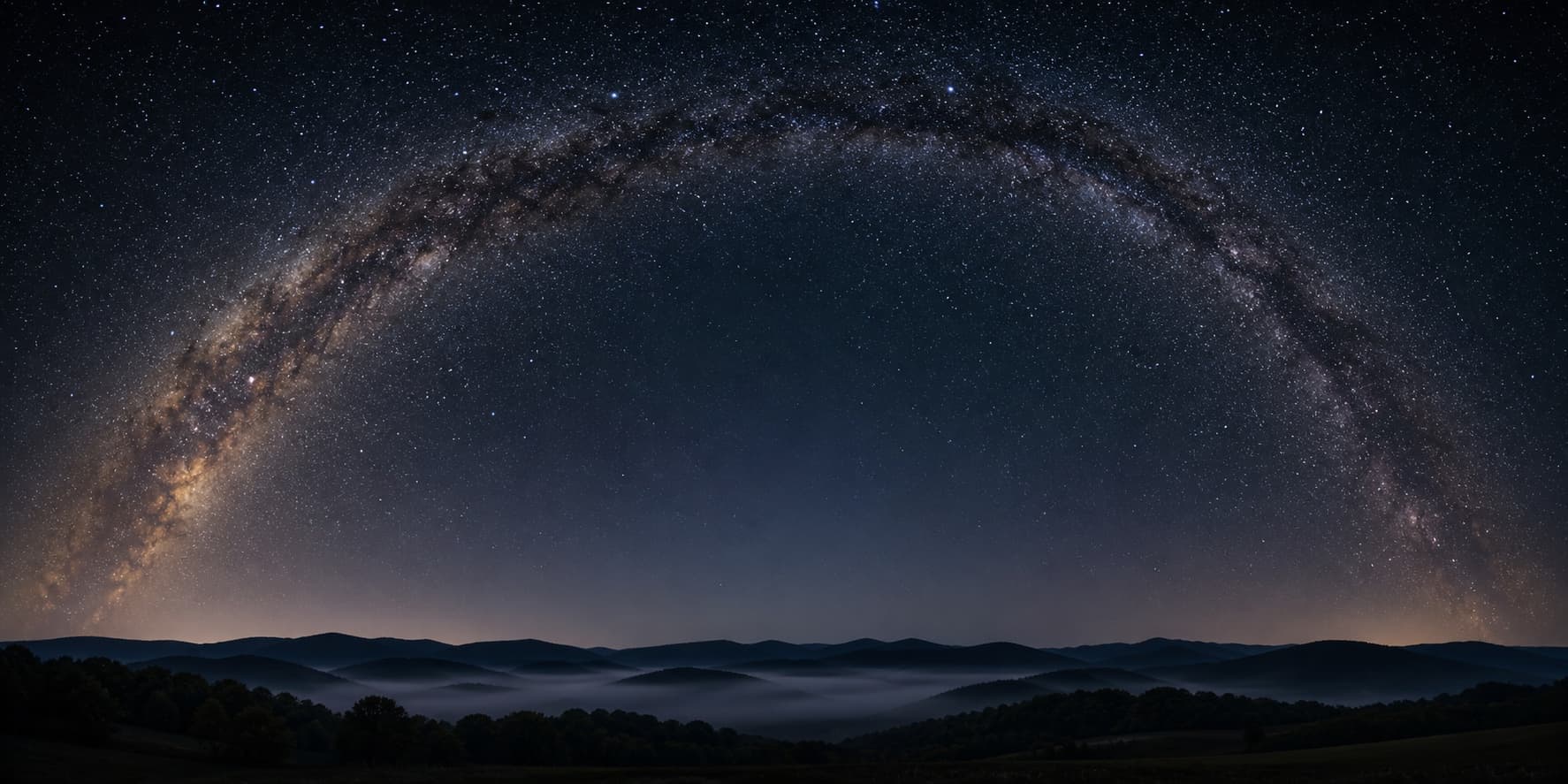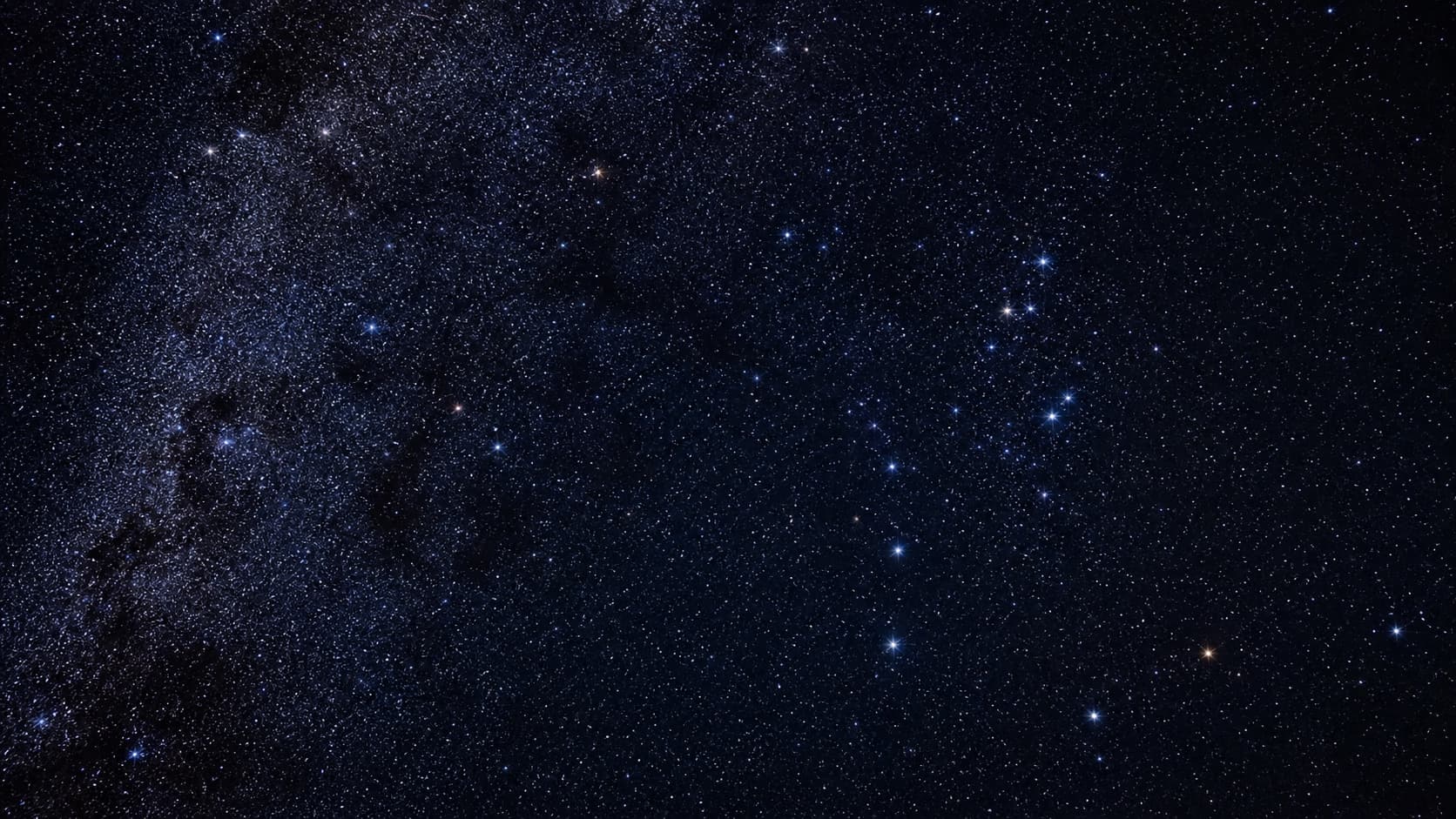
The 12 zodiac signs everyone knows from astrology are named after 12 real constellations — actual patterns of stars that have been catalogued for thousands of years. Aries, Taurus, Gemini, and the rest are visible in the night sky, each one with its own shape, brightest star, and best month to spot it.
This post is the astronomy half of the conversation. Where to find each constellation, what it looks like, how bright it is, and when it climbs highest in your sky.
What the “zodiac” actually is
The zodiac is a band of sky about 16 degrees wide that runs all the way around the celestial sphere. The sun, the moon, and all the major planets stay inside this band as they move across our sky — because the solar system is roughly flat, and we’re looking out from inside that flat disk.
Twelve constellations sit along this band.
Ancient sky-watchers picked these 12 to divide the path of the sun across the year — one constellation per roughly one month of the sun’s journey. That’s where the astrology signs come from: which constellation the sun was “in” on a given date, two thousand years ago.
The astronomy is unchanged. The constellations are still there.
The signs just don’t line up with the real sun anymore — we cover that in Why Your Star Sign Doesn’t Match the Sun’s Actual Position Anymore .
Aries — the Ram
A small, faint constellation. Just three main stars in a flattened triangle, with Hamal as the brightest (magnitude 2.0).
Best seen: October through January from the Northern Hemisphere, looking high in the southern sky. Located between Taurus and Pisces.
Taurus — the Bull
One of the most recognizable winter constellations. The V-shape of the bull’s face is unmistakable, marked by the bright orange star Aldebaran (the bull’s eye).
Bonus: Taurus contains two of the most famous star clusters in the sky — the Pleiades (M45, the Seven Sisters, naked-eye visible) and the Hyades (the V-shape itself is a star cluster).
Best seen: November through March, high overhead in winter from the Northern Hemisphere.
Gemini — the Twins
Two bright stars side by side — Castor and Pollux — mark the heads of the twin brothers. Below them, two parallel lines of fainter stars trace their bodies down toward Orion.
Best seen: December through April, in the northern winter sky east of Orion. Pollux (magnitude 1.1) is one of the brightest stars in the whole sky.
Cancer — the Crab
The faintest of the zodiac constellations. No bright stars at all — you’ll need dark skies and patience.
The redemption is the Beehive Cluster (M44, also called Praesepe), a beautiful open cluster of about 1,000 stars visible to the naked eye on a dark night as a fuzzy patch right in the middle of Cancer.
Best seen: February through May, between Gemini and Leo.

Leo — the Lion
A genuinely lion-shaped constellation.
The front of the lion is a backward question-mark of bright stars called “the Sickle” — that’s the head and mane. Behind it, a triangle of stars marks the hindquarters.
Regulus, at the base of the Sickle, is the brightest star in Leo (magnitude 1.4). The whole shape is one of the easiest to actually recognize as the animal it’s named after.
Best seen: February through June, high in the southern sky after sunset.
Virgo — the Maiden
A large constellation but not particularly bright. Spica, the brightest star (magnitude 1.0), is easy to find by following the curve of the Big Dipper’s handle: “arc to Arcturus, speed on to Spica.”
Best seen: March through July, in the southern sky from the Northern Hemisphere.
Libra — the Scales
Faint and oddly shaped — a rough quadrilateral with no especially bright stars. Historically, the stars of Libra were considered part of Scorpius (the scorpion’s claws), which is why Libra has unusual star names like Zubenelgenubi (the southern claw) and Zubeneschamali (the northern claw).
Best seen: April through August.
Scorpius — the Scorpion
Possibly the most beautifully shaped constellation in the entire zodiac. A long J-curve of bright stars that genuinely looks like a scorpion, complete with a curved tail and stinger.
Antares, the heart of the scorpion, is a red supergiant about 700 times the diameter of our sun. The name means “rival of Mars” — it’s distinctly red-orange to the naked eye.
Best seen: May through August, low in the southern sky from the Northern Hemisphere (and high overhead in the Southern Hemisphere).
Sagittarius — the Archer
Sagittarius is the constellation most stargazers spot as “the teapot” — the eight brightest stars form a kettle shape complete with handle, spout, and lid. The mythological archer is in there, but the teapot is what your eyes actually see.
Looking toward Sagittarius is looking toward the center of our galaxy — this is the densest, brightest part of the Milky Way as seen from Earth. Dark-sky views of Sagittarius are extraordinary.
Best seen: June through September.
Capricornus — the Sea-Goat
A bowtie-shaped constellation of medium-bright stars. Not flashy, but the shape is identifiable.
Best seen: July through October, low in the southern sky from the Northern Hemisphere.
Aquarius — the Water Bearer
Large but faint — spread across a wide area of sky with no especially bright stars. The Y-shaped “water jar” at the head is the easiest piece to recognize.
Best seen: August through November.
Pisces — the Fish
Two long lines of stars connected at one end by a faint loop — the two fish tied together by their tails. Faint overall.
Best seen: September through December.
Best seasons at a glance
A rough Northern Hemisphere lookup. From the Southern Hemisphere, swap the seasons (a winter constellation in New York is a summer constellation in Sydney).
- Winter: Taurus, Gemini, Cancer
- Spring: Leo, Virgo, Libra
- Summer: Scorpius, Sagittarius, Capricornus
- Autumn: Aquarius, Pisces, Aries
For a practical “tonight” lookup by your sign, see How to Find Your Zodiac Constellation in the Sky Tonight.
The bridge: your sign as it actually looked overhead
One of the more thoughtful uses of a star map is to render the constellation of someone’s sign as it actually appeared on their birthday — the real stars of Leo, or Aries, or Pisces, in their real positions above their real city.
Plug a birth date and place into the SkyWhen customizer and the preview will show you exactly that. The preview is free.
For the trust-bridge to astronomy, see Astrology vs. Astronomy. For why the signs no longer match the literal sun, see Why Your Star Sign Doesn’t Match.
FAQ
Are the zodiac constellations real?
Yes — they’re all real, scientifically catalogued constellations recognized by the International Astronomical Union. They’re patterns of stars that have been tracked since at least Babylonian times.
Why are there 12 zodiac constellations?
Twelve was a convenient division of the sun’s yearly path — one constellation per roughly one month. The number ties to the 12 lunar cycles in a year, which is where many ancient calendars come from.
Is Ophiuchus a 13th zodiac constellation?
The sun does pass through a 13th constellation, Ophiuchus, between Scorpius and Sagittarius — this is astronomically true. But the zodiac is a 12-sign cultural system, not a 13-constellation list, so Ophiuchus is usually left out of the zodiac itself.
Which zodiac constellation is the brightest?
Scorpius is the brightest and most visually striking overall, thanks to Antares and its long curved shape. Leo, Taurus, and Gemini are close behind.
When can I see my zodiac sign in the sky?
Roughly six months opposite to when the sun is “in” that sign. If your sign is Leo (sun in Leo late July to mid-August), Leo is high overhead at midnight in February or March.