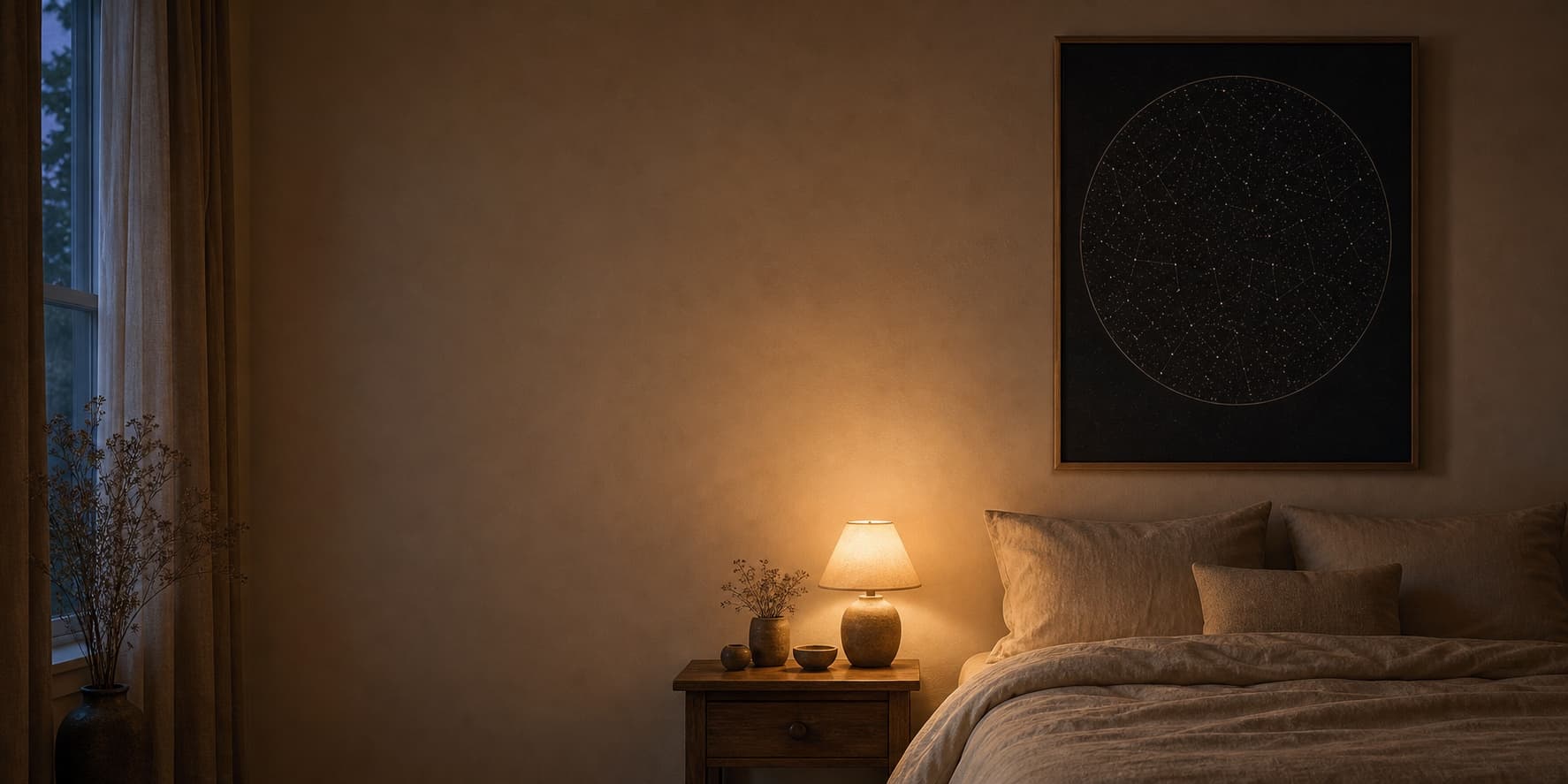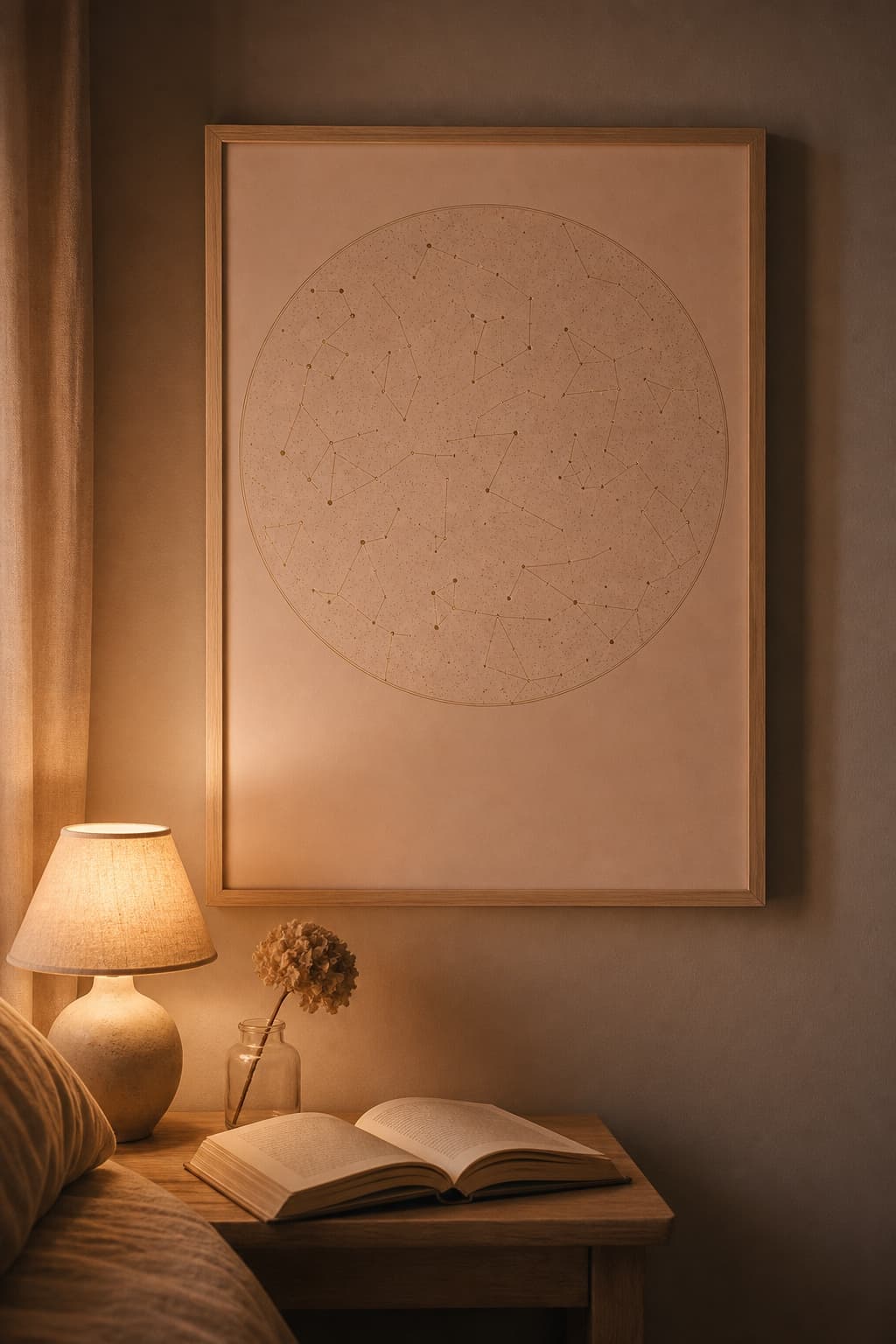
There is one version of the night sky that belongs to a person more than anyone else, and most people go their whole life without seeing it.
A birthday star map is that sky. The actual stars, planets and moon phase overhead on the day they were born, above the place it happened.
Why birth-day skies make good gifts
Most other dates on someone’s life calendar are shared — weddings, anniversaries, holidays. The birthday is one of the few that’s unambiguously theirs alone.
A star map of the birth night is the rare gift that connects them specifically and only to a single moment in the universe’s history. No one else shares that exact sky at that exact place on that exact day — even people born the same day in a different city see a slightly different print.
Why milestone birthdays specifically
Two reasons.
First, the further back the date, the more pronounced the difference between the birth sky and any contemporary sky. Constellations drift slowly.
Planets cycle through different positions.
The moon phase from May 1965 is different from the moon phase from May 2026. The print feels measurably more like a record from another era.
Second, milestone birthdays carry more weight as gift occasions. The expectation of a meaningful gift is higher at 50 than at 27, and a personalized star map answers that expectation more naturally than a generic gift would.
Worth separating from a similar-sounding thing: your birthday star is a single star whose light left the year you were born. This page is about the whole sky of that night, printed.
By milestone
21st and 30th
The youngest milestones where a birth-night star map starts to feel meaningfully distant. The sky from 21 or 30 years ago has visibly different planet positions from the current sky — a recognizable difference rather than a trivial one.
Common gift direction: from parents to a child reaching adulthood. The print lives in the new adult’s first place.
40th and 50th
The strongest gift occasions for a birthday star map.
The sky from 40 or 50 years ago feels distinctly historical. Often given by a spouse, by adult children, or by the recipient to themselves.
Format-wise, this is where the format expands. Larger print sizes, more elaborate framing, fuller text underneath (often including the birth city, the parents’ names, or the hospital).
60th, 70th, and 80th
The sky from 60+ years ago is genuinely a record of a different era. The print tends to become a family-history piece — given by adult children or grandchildren, framed to last, kept in a prominent place.
At these milestones, the star map is often paired with an old photograph of the recipient as a child or with their parents. The two artifacts together — a face from the past and a sky from the same week — create a personal-history exhibit in one frame.
What the print typically looks like
Shape
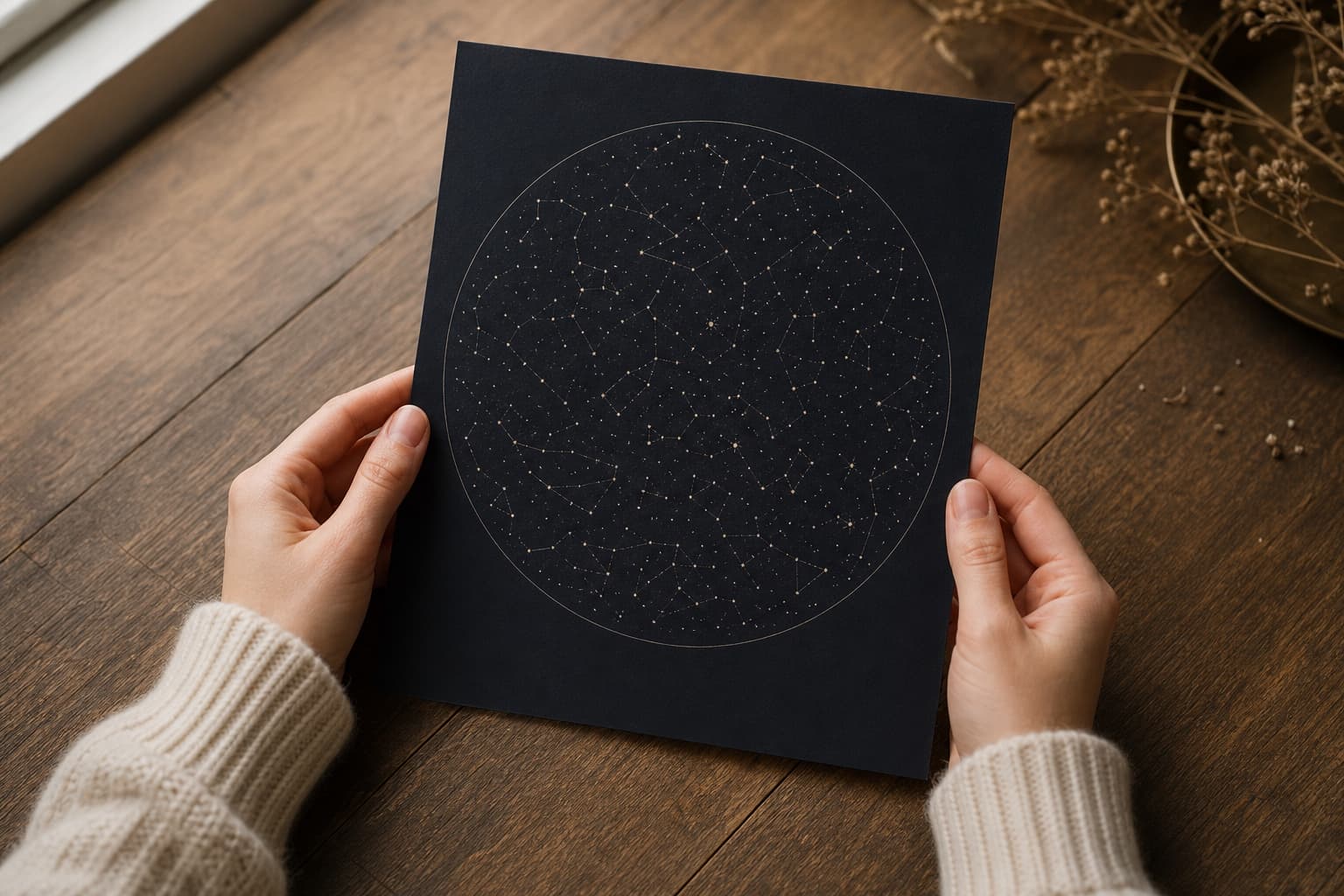
Circles dominate the birthday category. Less ceremonial than the hearts, less architectural than the edge-to-edge designs, and they sit well on a personal wall in a bedroom or office.
Palette
Choices skew toward what the recipient’s home already looks like. Older recipients often get one of the dark designs (Midnight or Nebula); younger recipients, and lighter rooms, more often get Porcelain.
Text under the sky
Most birthday prints carry three lines: the recipient’s name, the date, and the birth city. Some add a fourth line — a short phrase like “the night you arrived” or a single significant word.
For 60+ milestones, some families add the parents’ names in a small line at the bottom. The print becomes both a record of the birth night and a quiet reference to the people who made it happen.
What about birth times you don’t know exactly?
Common situation. Many people don’t know the exact hour they were born, and older birth certificates often only list the date.
For the visible constellations and the moon phase, the exact time barely matters. “Evening” or “9 p.m.” for any date works fine — the constellations overhead are the same across the entire evening of a given date.
The only inputs that change appreciably with time-of-day are the precise position of the moon (which moves about 0.5 degrees per hour) and the location of fast-moving planets like Mercury. Neither affects the visual character of the print in any way most viewers would notice.
How birthday star maps differ from birth star maps
Some overlap, but the gift direction is different.
A “birth star map” is usually a gift from parents (or grandparents) commemorating a baby’s arrival, hung in the nursery. A “birthday star map” is usually a gift for the now-grown person celebrating their own birth night, typically at a milestone year.
Same input, different output context. We covered the parent-to-baby angle in Birth Star Maps and Nursery Wall Art.
The bridge: the universe you started under
Your birth night is one of the few cosmic moments of your life that you have no memory of, no photographs of, and no first-hand experience of — but it’s also the most personally yours.
Every other date in your life happened with your knowledge. That one didn’t.
A star map of that night fills in something quietly missing from most people’s personal archive. Plug a birth date into the SkyWhen customizer and the preview will show the actual sky from that night — including the moon phase, the planet positions, and the constellations overhead while the world was getting a new person.
For sky-on-any-date capability in general, see The Night Sky on Any Date in History. For accuracy details, see Are Star Maps Accurate?
FAQ
Is a star map a good 50th birthday gift?
It’s among the most popular milestone-birthday gifts in the category. The sky from 50 years ago feels distinctly historical, and the print becomes a personal-history piece for the recipient’s wall.
What if I don't know the exact time of birth?
Use “evening” or 9 p.m. The visible constellations don’t change appreciably across an evening, so the print will look essentially identical regardless of the exact hour.
Can I make a star map for a date in the 1950s or 1940s?
Yes. The software handles any date in human history without trouble — 1950s, 1900s, or even the 1700s and 1500s. The math doesn’t care how old the date is.
What's the difference between a birthday star map and a birth star map?
The inputs are the same. The gift context differs: a birth star map is usually given by parents commemorating a baby’s arrival and hung in the nursery. A birthday star map is usually given to the grown adult on a milestone birthday for their own home.
What's the best size for a milestone-birthday star map gift?
12×16 inches is the most common size for 30–50 birthdays — fits well above a desk or in a bedroom. 18×24 inches works for 50+ and is often picked for living-room or hallway hanging, and there’s a 24×36 for anyone with a big empty wall to fill.