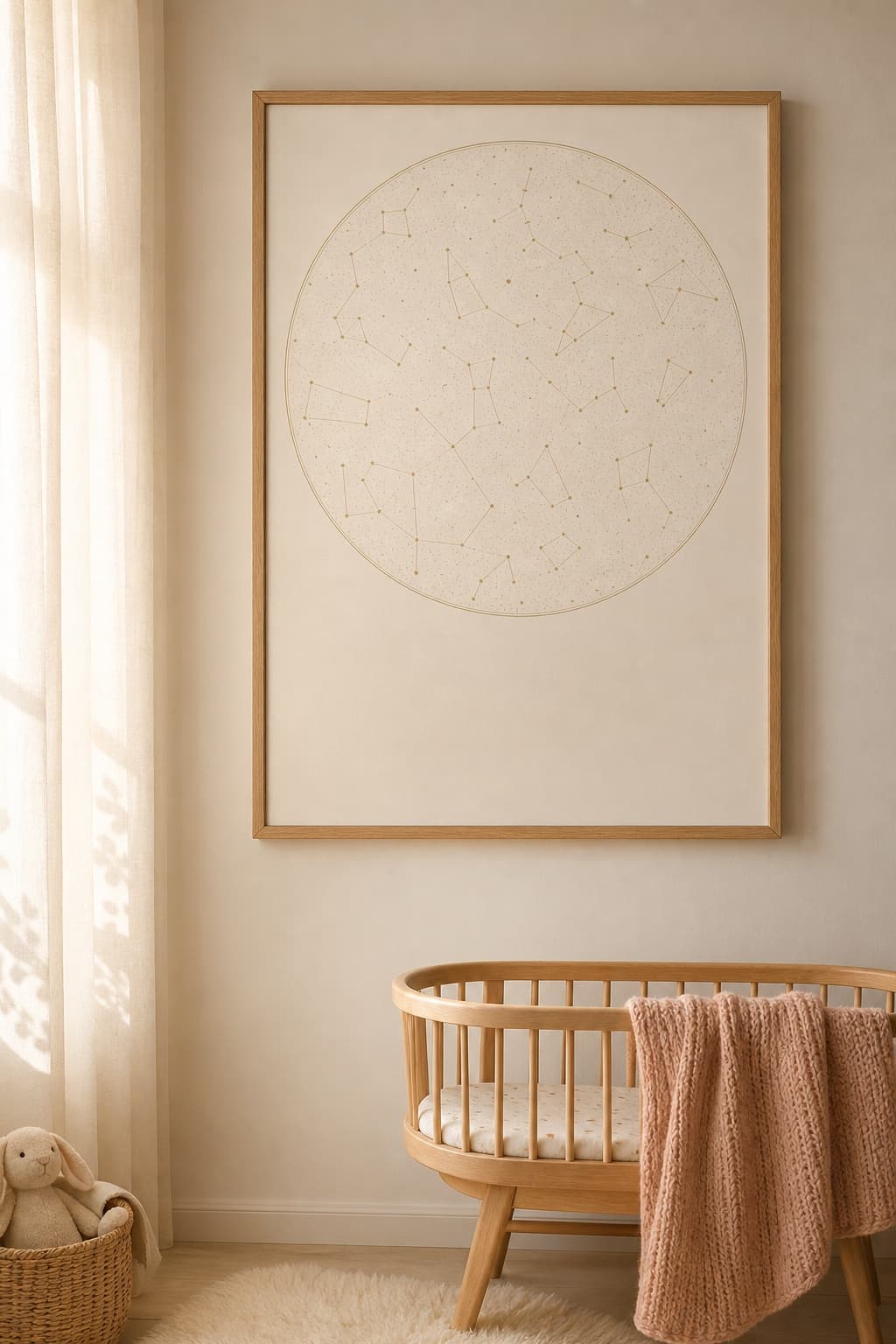
Almost everything you hang in a nursery gets grown out of. That is the quiet problem with decorating one.
A birth star map is the exception, because it is the real sky above the hospital — or wherever the baby arrived — at the moment they did.
It reads as art when they are four, and as a record when they are twenty-four.
Why the birth night works as a star-map date
Most pieces of nursery wall art get aged out. Cute animal prints, alphabet posters, soft pastel watercolors — they belong to a few-year window of the child’s life, and then they come off the wall.
A birth-night star map doesn’t age out.
It’s not childish, it’s not a cliché, and it’s anchored to a date that will matter for the entire life of the child. The same print fits a nursery, then a kid’s bedroom, then a young adult’s first apartment.
Who gives them
Grandparents
The most common direction. Grandparents-to-be often commission a birth-night star map before the baby is born and present it after the arrival — or pre-order it with the place left blank and fill in the city once the baby is born.
It works as a counter-gift to the cute-onesie-and-rattle tradition: thoughtful, adult-aesthetic, hangable in the home rather than being a temporary object.
Godparents and close friends
The other common direction. A baby-shower-period gift that’s personalized enough to feel distinctly thoughtful, but doesn’t require knowing the family’s nursery color scheme in advance — the palette can be picked to suit the room once you see it, or stay neutral cream-on-navy.
Parents to themselves
Many new parents commission a birth-night star map for their own home in the weeks after the birth — sometimes in the nursery, sometimes in the living room or the parent’s bedroom.
Variation: two prints in different sizes — the larger in the nursery, the smaller on a parent’s desk or nightstand.
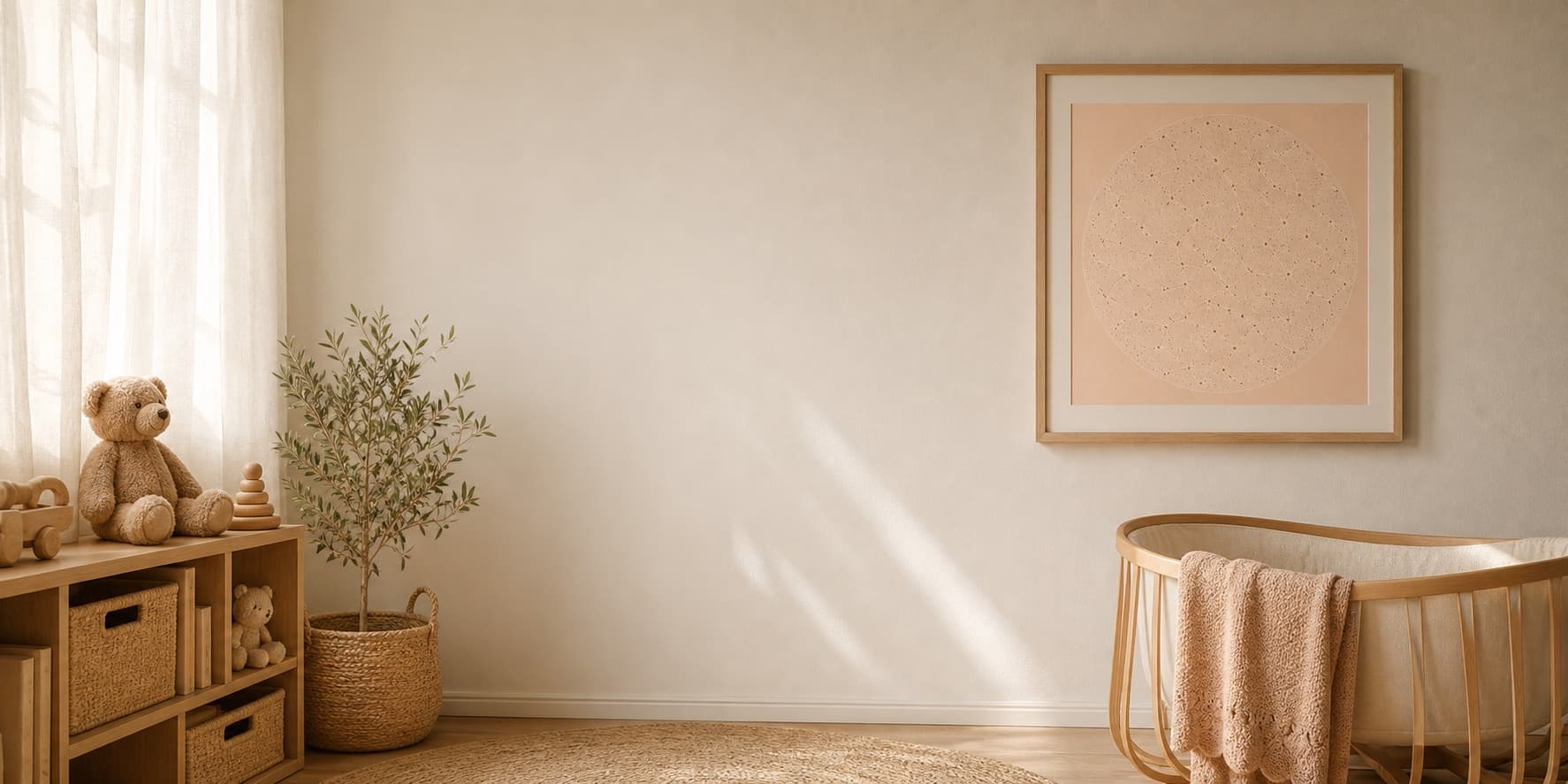
What the print typically looks like
Shape
Circles dominate the nursery category. Soft, balanced, and free of any angular edges — they sit well on a wall above a crib or changing table.
The heart shape - Heart, or its warm white twin Keepsake - is the second-most-common choice, though some parents find it too sentimental for a nursery. The edge-to-edge designs are rare for a nursery.
Palette
Porcelain — warm white paper with the night sky kept black — is the easiest nursery choice. It feels quiet enough to live above a crib without being visually loud.
Midnight (near-black with cream stars) is the other common pick. More dramatic, and often chosen for older children’s rooms rather than newborn nurseries.
Text
Most birth-night prints carry three lines under the sky: the baby’s name, the date and time of birth, and the city. Some add a fourth line — “the night you arrived” or “welcome to the world.”
For multi-child families, some parents commission matching prints for each child — the same format, the same palette, the same frame style. The set sits together as a small wall of birth nights, one print per kid.
What about babies born during the day?
The star map will still render the sky as it was at the moment of birth — the stars and planets that would have been overhead if the sun hadn’t blocked the view. The math doesn’t care if the sky was technically “night” at the time; we’re showing what was up there at that moment.
For very early-morning births, the print might show the same constellations as a print of the previous evening (since the sky doesn’t shift dramatically across a single night). For midday births, the print shows the daytime sky’s stars — which are real, just invisible until evening.
Combining birth date with other family dates
Some families build a small “family wall” over the years — one print per birth, hung together. Each child gets a print of their own birth night, and the set sits together as a small archive of the family’s arrivals.
Variation: the wedding-night sky next to each child’s birth night. Three or four prints together — the parents’ wedding, the first kid’s birth, the second kid’s birth — and you have a wall of cosmic family history.
How long the print can last
On standard inkjet paper, prints last about 30–50 years before significant fading with normal indoor lighting. On archival paper, with proper UV-filtering glass, a print can last 100+ years.
For a piece that’s meant to follow the child through their life, archival paper is worth the small upgrade. It’s the difference between “wall art for the next 30 years” and “keepsake to be handed down after the child has their own children.”
The bridge: the night you arrived
A birth-night star map is one of the only gifts you can give someone that records a moment from before they had any awareness of being alive.
Most personal-history artifacts (photos, voice notes, journals) start later — when the kid is months old, or years old. The sky from the actual moment of birth is something the kid will only ever see through their parents’ effort to capture it.
Plug the birth date and the hospital city into the SkyWhen customizer and the preview will show you the exact sky from that night. The preview is free.
For gift framing once the kid grows up, see Birthday Star Map. For confidence on accuracy, see Are Star Maps Accurate?
FAQ
What's a good gift for a baby shower?
A birth-night star map (ordered after the baby arrives) is one of the most-given personalized gifts in the category. For a baby-shower-period gift, some buyers pre-order a print with the date and city left blank, to be filled in once the baby arrives.
What city should I use if the baby was born during a trip?
Use the actual location where the birth happened. The star map renders the sky over that exact latitude and longitude — so the print will show the sky from the city the baby was actually born in, not the family’s home city.
What if I don't know the exact time of birth?
The visible constellations don’t change much across a single evening, so picking the closest time you remember (or just “9 p.m.”) will produce essentially the same print.
Is a birth star map appropriate for nursery wall art?
Yes — and unusually well. Most nursery wall art ages out after a few years. A birth-night star map is anchored to a date that matters for the child’s entire life, so the print can stay on the wall through childhood and beyond.
What's the best palette for nursery art?
Porcelain — warm white paper, with the sky still black — is the most popular nursery choice. Midnight (near-black) is sometimes chosen for older children’s rooms but is less common above a crib.