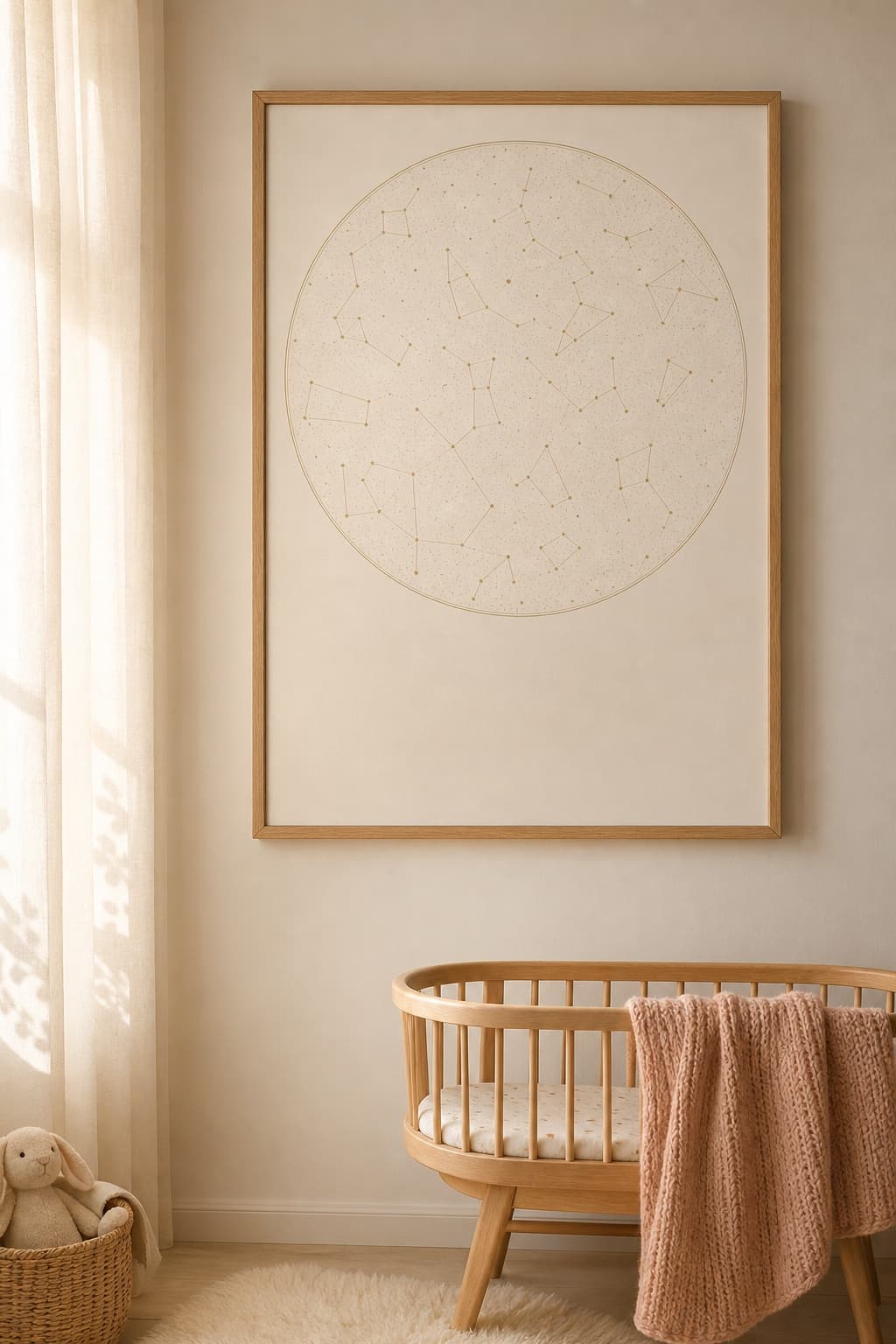
Why your birth sky is worth a look
Almost nothing survives from the day you were born. The weather is gone, the room is gone, the people in it have all changed.
The sky is the exception. Those same stars are still up there in almost exactly the same arrangement, and they come back around to that arrangement every year on your birthday.
That’s the whole appeal, and it’s why a birth sky ends up framed more often than any other date we see.
The four things this tells you
A star map on its own is beautiful and slightly unreadable if you have never used one. So this page says the useful parts out loud.
- The map — every dot is a real star, in the position it held above your birth city that night. The lines are constellations, and the soft band is the Milky Way.
- The moon phase — full, new, or somewhere in between, with how much of it was lit. A full moon on your birth night means the sky was bright and the faint stars were washed out; a new moon means they had it to themselves.
- The planets that were up — only the ones actually above the horizon while it was dark. A planet that rose at eleven in the morning was technically “up” and practically invisible, so it doesn’t count here.
- The sun’s real constellation — which is the honest answer to “what was my star when I was born”, and frequently not the star sign you grew up with.
Your star sign is probably wrong
This is the part that surprises people, so it’s worth saying plainly.
The zodiac dates in a magazine were set around two thousand years ago. Since then the Earth’s axis has wobbled far enough that the sun no longer sits where those dates say it does.
The practical result: most people were born with the sun in the constellation before the sign they were told. A late-August Virgo is usually a Leo, astronomically speaking.
Neither answer is a lie — they’re measuring different things. The full explanation of the drift is here, and the star sign tool puts both side by side for your date.
If you don’t know your birth time
Use the tool anyway. The default of 9 PM is a good one — it lands after full dark almost everywhere, in almost every season.
Here’s what the time actually changes. The sky turns about fifteen degrees an hour, so a few hours’ difference rotates the whole map without changing which stars are in it.
If you were born at 3 AM, the same constellations are there — they’ve just swung west. The character of the sky is set by the date and the place far more than by the hour.
And if you want the exact one, it’s on your birth certificate.
Other dates worth trying
Birthdays are the common one, but the same idea works for any night that mattered.
- Your parents’ birthdays, which almost nobody has seen rendered.
- The night your own child was born.
- A wedding night, or the night you met.
- The last night of someone you miss.
For anything that isn’t a birthday, the sky on any date tool is the more direct route — same engine, no birthday framing.
Looking for NASA’s birthday picture?
A lot of people arrive here after searching for NASA’s photo from the day they were born, and find it isn’t quite what they wanted.
NASA’s Astronomy Picture of the Day gives you a photograph that was published on your date — usually a galaxy or nebula thousands of light-years away, with no connection to you or your city. It’s a lovely archive and a poor birthday gift.
We wrote the full comparison here — what APOD actually is, why it only goes back to 1995, and how to get the thing most people were really after.
The tool above is free and always will be. If your birth sky turns out to be one worth keeping, the customizer opens with the date and place already filled in.
FAQ
What if I don't know what time I was born?
Most people don’t, and it matters less than you’d think. The tool uses 9 PM unless you tell it otherwise, which puts you in proper darkness in almost any place and season.
Your birth certificate has the time if you ever want the exact one. Hospitals record it, and a parent usually remembers it to the nearest hour.
What was my star when I was born?
There isn’t one star assigned to a person — but there is a constellation the Sun was sitting in on your birthday, and that’s what the question usually means.
It’s often not your star sign. The zodiac dates were fixed about two thousand years ago and the sky has drifted since, so a lot of people were born under the constellation before the one they were told. The star sign tool shows both side by side.
Which planets were up on the night I was born?
The tool lists them. It checks all five naked-eye planets — Mercury, Venus, Mars, Jupiter, Saturn — and reports the ones that were above the horizon between dusk and dawn.
A planet that technically rose at 11 AM doesn’t count, because nobody could see it. Only the dark-sky window is used.
Does it work for old birthdays?
Yes. Grandparents, great-grandparents, and dates well before photography all work — the math is reliable across all of recorded history.
Older dates are often the most interesting ones, because nobody has ever seen that sky rendered before.
Is this free?
The tool is free with no login and no email, and it stays that way.
If you want the sky as something you can hang, the customizer turns it into print files, wallpapers, and social images for $29 as a one-time download.