See the picture from your birthday
NASA has published one space photo every day since 16 June 1995. Enter a date to see that day’s picture and the story behind it.
If you just looked one up, you have probably spotted the problem already: the picture is often spectacular, and it has nothing whatsoever to do with you.
NASA’s Astronomy Picture of the Day gives you the photo they published on your date — usually a galaxy or nebula thousands of light-years away, chosen by two astronomers with an archive and a deadline. It has nothing to do with you, your city, or the sky you were actually born under.
Here’s what APOD actually is, why it isn’t your birthday sky, and how to get the thing most people meant to search for — which works for every year, including the ones before NASA started.
What APOD actually is
The Astronomy Picture of the Day has been running since 16 June 1995, which makes it one of the oldest continuously updated pages on the internet.
The format has never changed. One image a day, plus a paragraph of explanation written by an actual astronomer, on a page that still looks like 1995 and is all the better for it.
It’s run by Robert Nemiroff and Jerry Bonnell, and the writing is excellent. If you have never fallen into the archive, set aside an evening.
Why it isn’t your birthday sky
Three reasons, and they compound.
The photo wasn’t taken on your date
APOD picks a picture to publish each day. The image itself might be from a telescope run six months earlier, or from a mission that ended in the 1980s.
The date on the page is a publication date, the way a newspaper’s date doesn’t tell you when the photographs inside it were taken.
It isn’t the sky over anywhere you have been
Most APOD images are deep-sky objects — nebulae, galaxies, star nurseries — captured by observatories or space telescopes pointed at one tiny patch of sky.
A picture of the Eagle Nebula is a picture of something forty-two thousand trillion kilometres away. It was above your birth city only in the sense that everything is above everything, eventually.
Before 16 June 1995, there is nothing
This is the one that stops most people. APOD started in 1995, so if you were born in 1987 or 1962 or 1949, your birthday has no entry.
You can look up the anniversary — the 12th of August in some later year — but that’s a different date wearing your birthday’s clothes.
Hubble’s version answers a slightly different question
NASA built a separate thing for Hubble’s thirtieth anniversary in 2020, and it is worth ten minutes of anyone’s time.
You give it your month and day, and it returns an image Hubble actually captured on that calendar date — in some year of its operation, not necessarily yours.
That’s a real connection to the date, and it works no matter when you were born, because it’s matching the day of the year rather than the exact year.
It still isn’t your sky. It’s a beautiful object, photographed by a telescope in orbit, that happens to share a calendar square with you.
What people usually mean by the question
When someone searches for a NASA photo from the day they were born, they are almost never asking a NASA-archive question.
They want the sky that was over the hospital. The stars that were up while their parents were awake and their name was still being argued about.
That’s a solvable problem, and it doesn’t need a photograph. It needs the positions of the stars and planets at one moment, above one point on Earth — which is arithmetic, and arithmetic goes backwards happily.
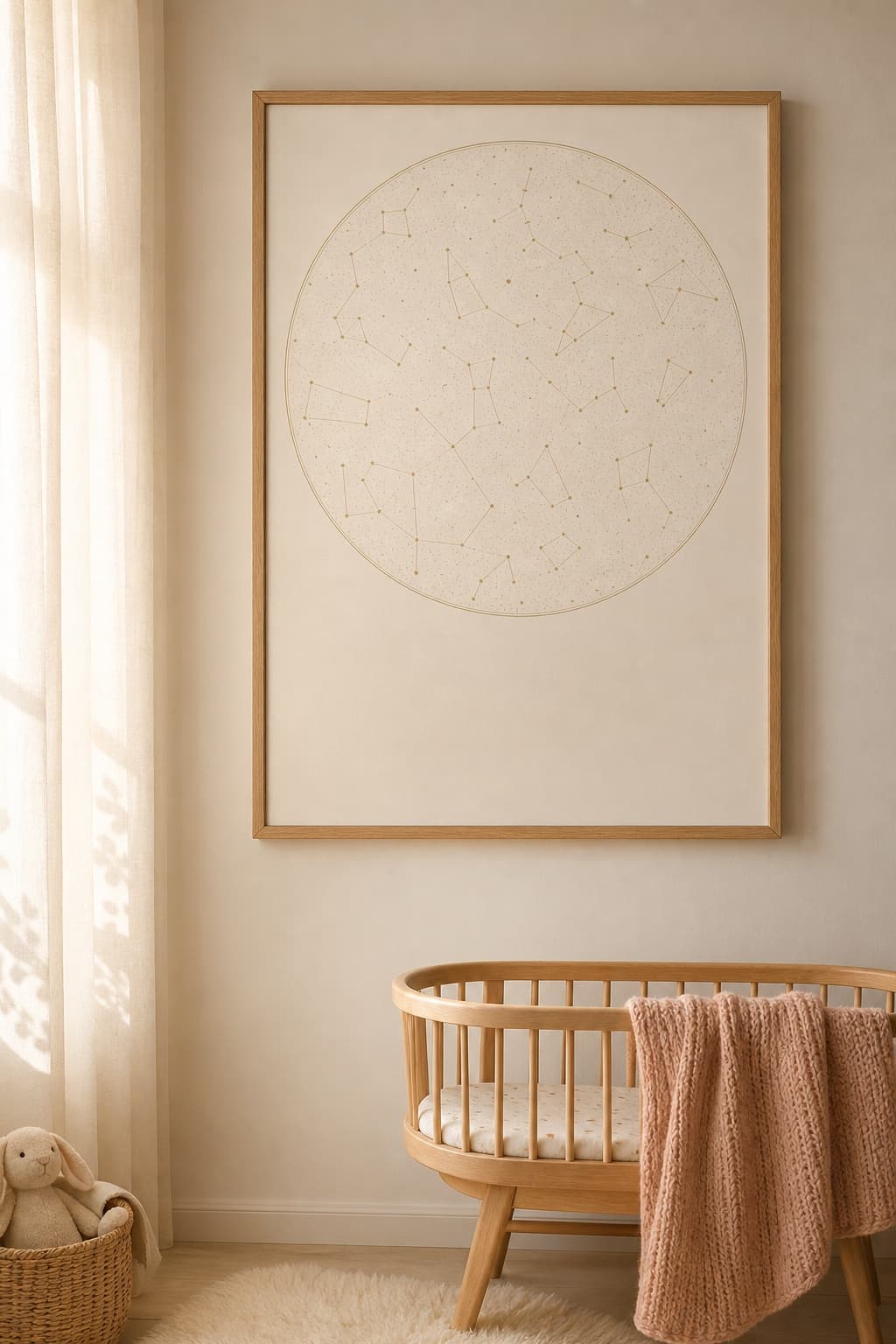
Our birthday sky tool does exactly that. Birth date, birth city, and it draws the real sky above that place that night — plus the moon phase, the planets that were up, and the constellation the sun was actually sitting in.
No 1995 cutoff.
Your grandmother’s birthday works. So does 1804.
How the two compare
- Coverage — APOD starts in June 1995. A calculated sky covers all of recorded history and a few thousand years either side.
- Connection to you — APOD’s link to your birthday is the calendar square. A star map’s link is that this is the light that was genuinely arriving above your birth city at that hour.
- Place — APOD has no concept of where you are. A star map is built from a latitude and longitude, and the sky over Oslo looks nothing like the sky over Nairobi on the same night.
- What it looks like — APOD gives you a photograph, often a spectacular one. A star map gives you a diagram of a real moment, which is a different kind of thing to look at.
Neither is better. They answer different questions, and it’s worth knowing which one you were asking.
Look up both — they take about a minute each
The box at the top of this page has already done the APOD half. Read the astronomer’s paragraph properly; it is the best part, and almost nobody does.
Then do your own sky, because it’s the one nobody has ever shown you. Put your birth date and birth city into the birthday tool .
If you don’t know the hour you were born, skip it — nine in the evening is a good stand-in and the constellations barely care.
One of those tells you what humanity was looking at.
The other tells you what was looking back at you. They’re both worth ten minutes.
A few other dates that reward the trip
Once you have the tool open, the birthday is rarely where people stop.
- Your parents’ birth dates, which almost nobody has ever seen drawn.
- 20 July 1969 over Houston — the sky above Mission Control while Apollo 11 was landing.
- The night you met someone, if you can pin it down to the week.
- 21 December 2020 anywhere clear, when Jupiter and Saturn came closer together than they had since 1623.
If you want the mechanics of why a rewound sky is trustworthy, the piece on how accurate star maps are covers it, and the sky on any date walks through how far back the math holds up.
The reason we built the tool is that this calculation works for every date anyone could ask about, which is a strange and slightly wonderful fact. Any night, any place on Earth, free and instantly — and if the sky you find turns out to be one worth keeping, the customizer will render it at print resolution.
FAQ
What did NASA see on my birthday?
Two different things, depending on which NASA page you mean. The Astronomy Picture of the Day shows the one image NASA published on your exact date — the lookup at the top of this page finds it, for any birthday from 16 June 1995 on.
Hubble’s birthday page shows something the telescope photographed on your month and day, in some year since 1990. Neither is the sky over your birthplace — for that, the sky on any date tool draws the real one.
Does NASA have a picture of the sky on the day I was born?
Not of your sky, no. NASA’s Astronomy Picture of the Day publishes one image per day, usually a deep-space object photographed by an observatory somewhere — not a view of the sky above your city.
For the actual sky over your birthplace that night, you need it calculated rather than photographed. That’s what the birthday sky tool does.
How far back does NASA's Picture of the Day go?
To 16 June 1995, its first entry. There is nothing before that date.
If you were born earlier, the usual workaround is to look up your birthday in a later year — which is a different date that happens to share the calendar square.
What about the Hubble birthday image?
That one is better. NASA released it for Hubble’s thirtieth anniversary, and it returns an image the telescope genuinely captured on your month and day.
The year won’t match yours, and it still isn’t a view of your sky, but the date connection is real.
Do I need to know what time I was born?
No. Nine in the evening works as a default, and it’s what our tool uses if you leave the time blank.
The hour rotates the sky but doesn’t change which constellations were up, so the character of the night is set mostly by the date and the place.
Is any of this free?
APOD, Hubble’s tool, and our birthday sky tool are all free, with no account needed for any of them.
The only paid part on our side is if you want print files of the sky you find, which is a one-time $29 download.