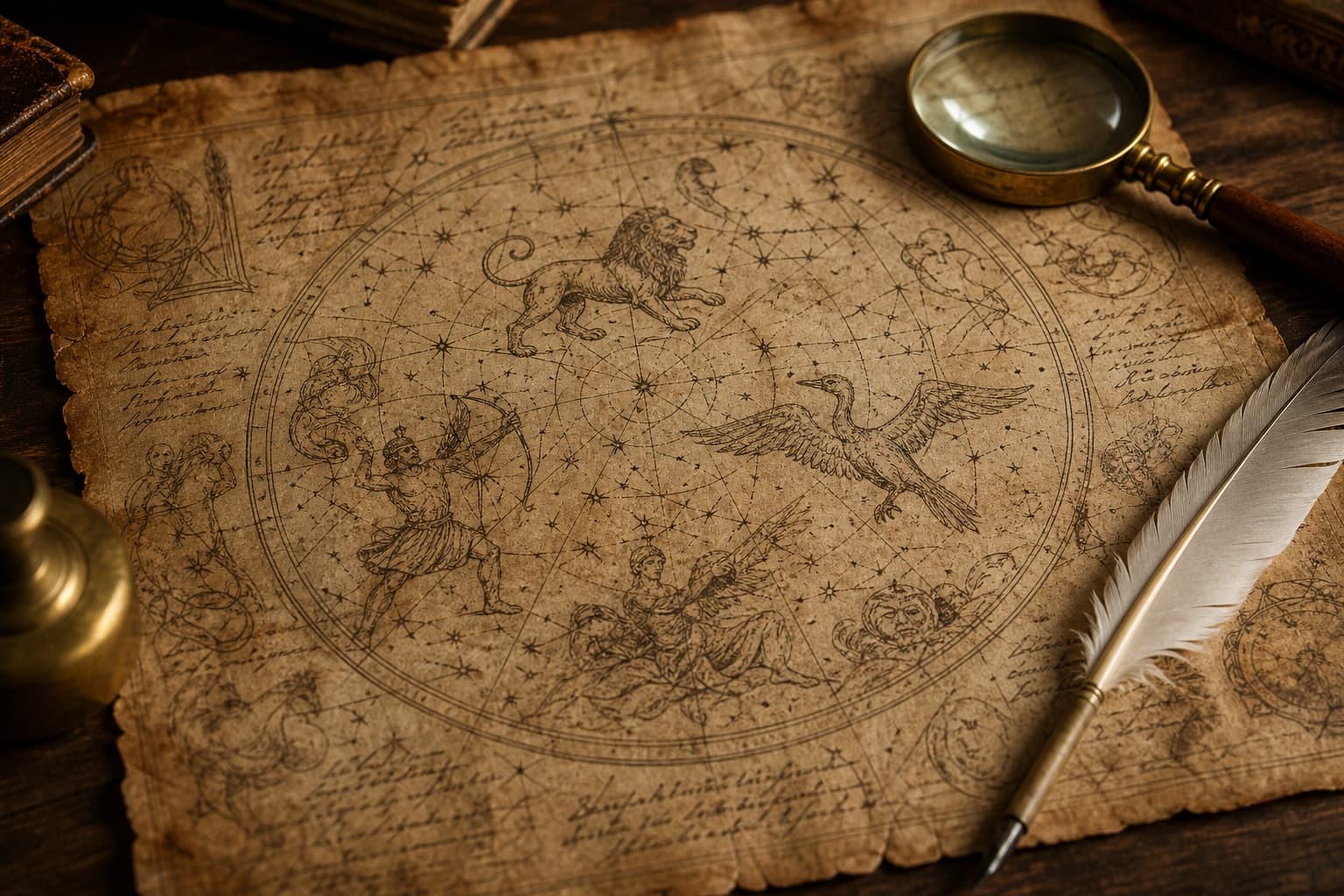
People have been mapping the sky for as long as we’ve been making art. The oldest known map of any kind is, by some readings, a star chart — carved into a piece of mammoth ivory more than thirty thousand years ago.
Modern personalized posters are the most recent chapter of that very long story. The impulse hasn’t changed; the precision has changed enormously.
Here’s the short version of how the sky-mapping tradition went from cave walls to your living room wall.
32,000 BC: cave walls and carved bones
The earliest evidence of humans recording the night sky comes from the deep Stone Age. Carvings found in caves in France, dated to around 32,000 BC, contain dot patterns that some archaeologists interpret as the Pleiades cluster — a famous group of seven bright stars visible to the naked eye.
Whether those exact carvings are star maps or coincidental decoration is debated. What isn’t debated is that early humans were paying close attention to the sky for practical reasons: tracking seasons, navigating, marking ritual dates.
Around 17,000 years ago, the famous cave paintings at Lascaux include what looks convincingly like a map of the Pleiades, the bull of Taurus, and the Summer Triangle — constellations that still appear in modern celestial maps.
3,000 BC: Mesopotamia and the first written sky
The Sumerians and Babylonians in modern-day Iraq were the first to write down the sky systematically. Clay tablets from around 1800 BC list the rising and setting times of bright stars, lunar phase observations, and the earliest recognizable zodiac (later inherited by the Greeks).
Babylonian astronomers tracked Venus’s appearances and disappearances over decades, recording them on cuneiform tablets. Their data is still good enough that modern researchers use it to refine our understanding of how the Earth’s rotation has slowly changed over millennia.
Around the same time, ancient Egyptian, Chinese, and Mesoamerican cultures were building their own sky-mapping traditions independently — the impulse to record the night sky seems to be roughly universal.
150 AD: Ptolemy and the canon of constellations
The single most influential book in the history of Western celestial mapping is the Almagest, written around 150 AD by the Greek-Egyptian astronomer Claudius Ptolemy in Alexandria.
In it, Ptolemy listed forty-eight constellations and gave the positions and brightnesses of more than a thousand stars. He drew from older Greek work (especially Hipparchus, around 130 BC) and from Babylonian records.
Ptolemy’s constellation list became the canonical set for the next 1,500 years. When the International Astronomical Union finalized the modern eighty-eight constellations in the 1920s, the Ptolemaic forty-eight were all still on the list.
Many of the names we still use — Orion, Andromeda, Cassiopeia, Cygnus, Pegasus — were already canonical when Ptolemy wrote them down.
800 AD: the Islamic golden age of astronomy
From the eighth to the thirteenth century, astronomy in the Islamic world reached a level of precision Europe wouldn’t catch up with for another four hundred years. Centers in Baghdad, Damascus, and (later) Samarkand and Cairo systematically improved on Ptolemy’s data.
Around 964 AD, the Persian astronomer Al-Sufi published the Book of Fixed Stars, a beautifully illustrated star catalog that corrected many of Ptolemy’s measurements. Al-Sufi was the first known person to describe the Andromeda Galaxy (which he called “a little cloud”) and the Large Magellanic Cloud.
The naming of many bright stars in modern use comes from this period: Aldebaran, Algol, Betelgeuse, Deneb, Rigel, and Vega are all Arabic-origin names that survived into European astronomy.
The Renaissance: printed star atlases
The invention of the printing press in the mid-1400s made beautiful, mass-produced star atlases possible for the first time. Three works dominated:
Bayer’s Uranometria (1603)
Johann Bayer’s Uranometria was the first star atlas to cover the entire celestial sphere, including the Southern Hemisphere stars that Europeans had only recently mapped during their voyages south.
Bayer introduced the system of labeling stars within a constellation by Greek letters — Alpha for the brightest, Beta for the second-brightest, and so on. That system is still used today.
Hevelius’s Firmamentum Sobiescianum (1690)
Johannes Hevelius’s atlas added several new constellations that have stuck around (Sextans, Vulpecula, Lynx) and was famous for its gorgeous engravings of the mythological figures associated with each constellation.
Flamsteed’s Atlas Coelestis (1729)
John Flamsteed, the first Astronomer Royal of England, produced the most accurate star atlas of its time, based on telescopic measurements taken at the Greenwich Observatory. His system of numbering stars within each constellation is also still in use.
Renaissance and Baroque celestial atlases blurred the line between scientific record and art — the constellation figures were elaborate hand illustrations, often colored, with the actual star positions threaded through the artwork.
The age of accuracy: telescopes, photography, satellites
The telescope changed celestial mapping forever. Galileo’s observations starting in 1610 revealed Jupiter’s moons, Saturn’s rings, sunspots, and the cratered face of our own moon — suddenly there were far more objects to map than anyone had imagined.
By the mid-1800s, astronomers were photographing the sky systematically. Photographic plates could record fainter stars than any human eye could see, and could compare sky positions across decades to track stellar motion.
In the twentieth century, dedicated star-mapping satellites took over.
The Hipparcos mission, launched in 1989, mapped over a hundred thousand stars to unprecedented precision. The Gaia mission, currently still gathering data, is mapping over a billion.
The HYG Database used by modern personalized map software is, ultimately, a consolidated public-domain version of the data these satellite missions produced.
Late 20th century: planetarium software
The first publicly accessible software that could simulate the sky for any date and place arrived in the 1990s. Programs like RedShift, Starry Night, and (later) the free open-source Stellarium turned the desktop computer into a personal planetarium.
For the first time, anyone could rewind or fast-forward the sky from any spot on Earth with a few clicks. Astronomy historians used it to verify ancient records; teachers used it in classrooms; amateur stargazers used it to plan observing nights.
The same software made the personalized poster business possible. If you can compute the sky for any date and place in a few milliseconds, you can let a customer pick a date and city and render a print-ready file in seconds.
Today: the personalized poster
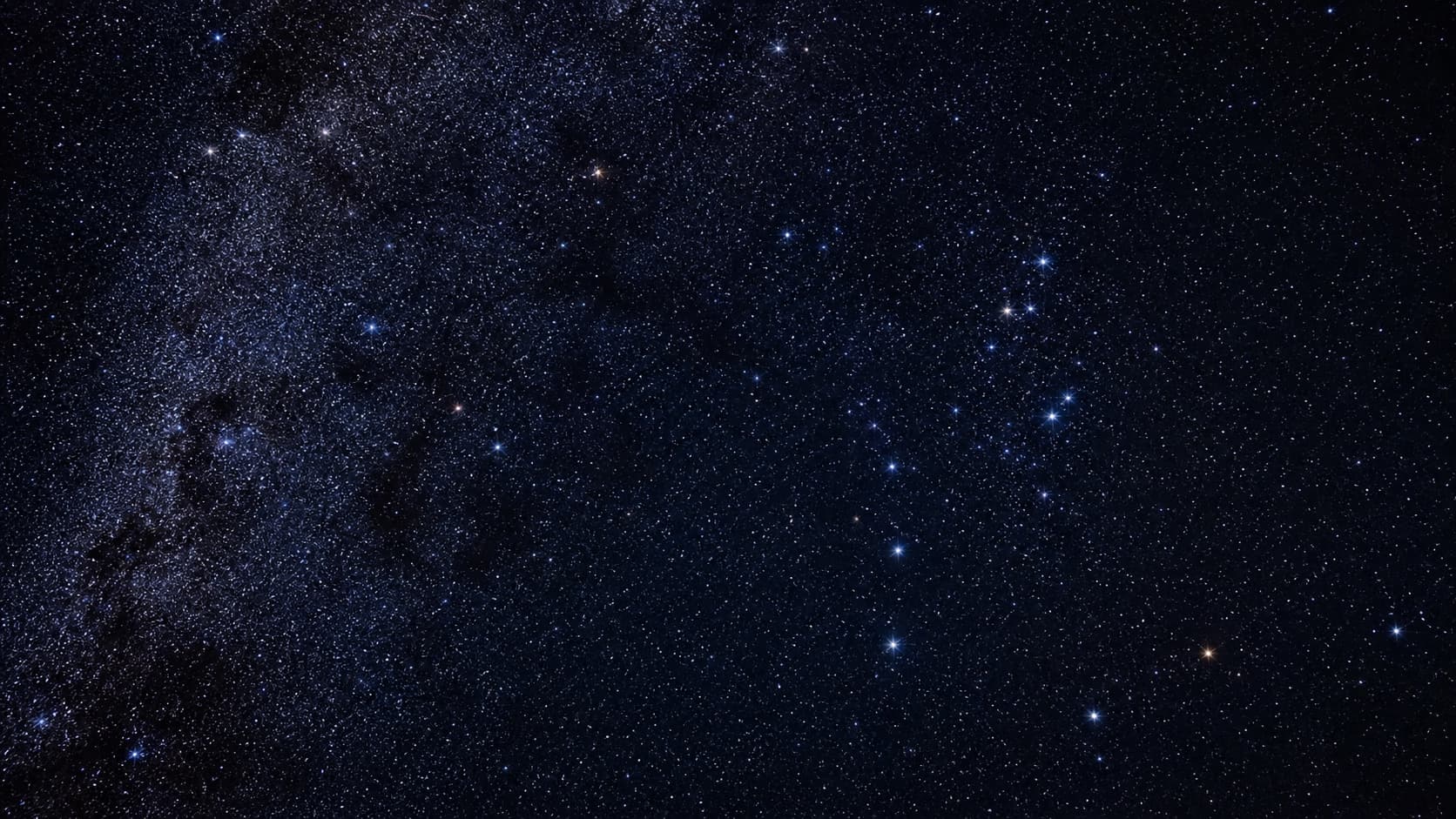
Personalized star map posters are roughly a 2010s invention. A handful of companies built customer-facing products on top of free astronomy data and the then-new ability to do print-on-demand fulfillment at low cost.
What’s genuinely novel in this chapter of celestial mapping is the orientation — the print isn’t for navigation, isn’t for science, isn’t for astrology. It’s a record of a specific moment in a specific person’s life.
The closest historical analog is medieval and early-modern personal manuscripts that included natal-chart pages — a single sheet recording the sky on the day someone was born, kept as a family document. The new poster format is a return to that sentimental use, with vastly more accurate underlying data.
What hasn’t changed in 32,000 years
Across cave walls, clay tablets, hand-drawn atlases, photographic plates, satellite data files, and Etsy posters — the underlying urge to record the sky is the same.
People have always wanted to mark certain nights as different from other nights, and the sky overhead is a natural backdrop for that marking.
The earliest known records mark agricultural cycles, ritual dates, and military events. Modern personalized maps mark weddings, births, and personal milestones.
Different motivations, same impulse: this night was different, and the sky was doing this on that night.
The bridge: a chapter in a very long story
A personalized star map is a small thing — a printed piece of paper, a frame, a wall. But it’s the latest example of something humans have been doing since before the invention of writing.
The technology has come a long way. The data is accurate to a fraction of a degree.
The print quality is gallery-grade. The math is descended from Ptolemy and Al-Sufi and Flamsteed, all polished to spacecraft-navigation precision.
And the impulse is the one that drove someone, 32,000 years ago, to carve dots into a mammoth bone in a cave in France.
Try a date that matters in the SkyWhen customizer. The sky shows up in a few seconds — on the same screen, drawn from the same tradition.
If you want the broader context for what star maps are now, the entry point is What Is a Star Map? For the math underneath modern maps, see How Star Maps Work.
FAQ
What was the earliest star map?
The oldest possible star map is a 32,000-year-old carved piece of mammoth ivory from France that some archaeologists interpret as showing the Pleiades star cluster.
The interpretation isn’t universally accepted. The earliest unambiguous written star maps come from Babylonian clay tablets around 1800 BC.
Who made the first map of the stars?
No single person did. The earliest sky-recording efforts were spread across several ancient cultures — Babylonian, Egyptian, Chinese, Mesoamerican — working independently.
The first comprehensive star catalog that influenced Western astronomy was compiled by Ptolemy around 150 AD, drawing on earlier Greek and Babylonian work.
What is the most famous antique celestial map?
Johann Bayer’s Uranometria (1603) is probably the most-cited Renaissance star atlas. Andreas Cellarius’s Harmonia Macrocosmica (1660) is the most famous for its lavishly illustrated plates.
Both are still reproduced and sold as decorative prints today.
How accurate were ancient star maps?
Surprisingly accurate, given the lack of telescopes. Ptolemy’s catalog placed stars to within roughly half a degree of their actual positions, which is about the limit of naked-eye precision.
Modern personalized star maps are accurate to a fraction of an arc-minute — about sixty times more precise than Ptolemy’s best work.
Are modern personalized star maps part of the same tradition?
Yes, in the sense that the underlying impulse — recording the sky on a date that mattered — is what people have been doing all along.
The closest historical analog to today’s gift-oriented personalized maps is medieval and early-modern natal-chart pages, which recorded the sky on a person’s birth night as a family document.