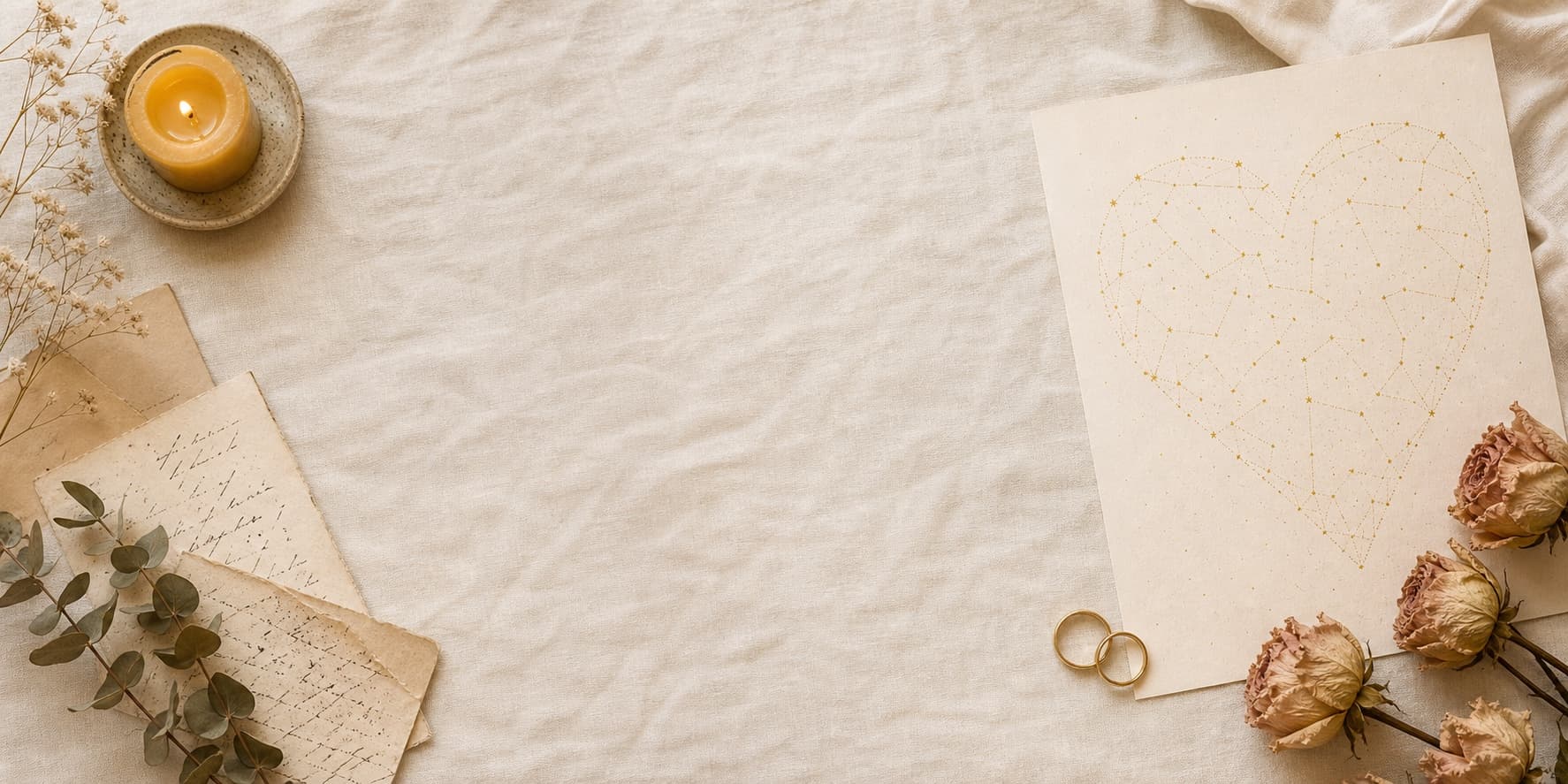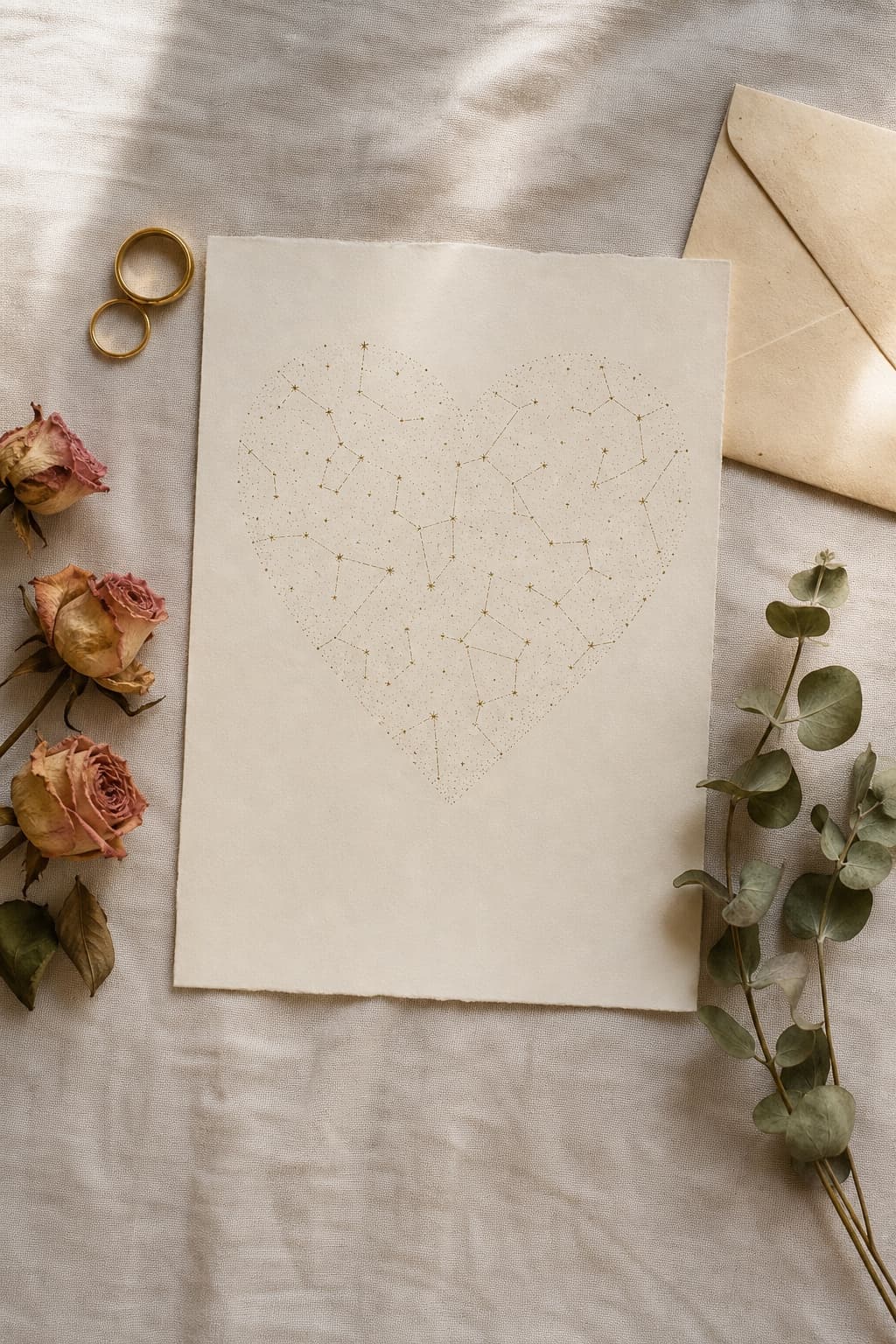
The photographs will cover the faces, the dress, the cake and the dancing. Nothing in the album records the evening itself.
A wedding star map does that job: the night sky above the venue, at the time of the ceremony, printed and framed.
It marks the date the way a photo marks the faces — by recording what was actually there, rather than decorating around it.
What it actually captures
Three inputs go in: the wedding date, the time of the ceremony (close enough is fine — within an hour matters very little for the visible constellations), and the location of the venue.
What comes out is the sky as it actually appeared from that spot. Real stars, mapped from their cataloged positions.
Real planets, calculated from their ephemerides. The actual moon phase from that night.
If a Venus–Jupiter pairing happened to be in the sky that evening, it shows up. If the Milky Way arched overhead, the band is there too.
The accuracy is at the level of a real astronomy chart — not a stylized decorative sky. We covered exactly what data goes into a real star map in Are Star Maps Accurate?
Why it works as a wedding gift
A wedding photo records the faces.
A wedding video records the moment. A star map records the universe overhead that day — a piece of context the couple themselves didn’t see, because they were busy getting married.
That’s what makes it land.
The poster isn’t a substitute for any of the other artifacts; it’s a new one. It says: the planet was here, in this orientation, with these constellations overhead, and this is what the universe was doing while you were saying yes.
Who gives them, and to whom
Guest to couple
The most common direction.
A wedding gift from family, close friends, or members of the wedding party. Often given alongside or in place of a traditional registry-list gift.
The print is a graceful alternative to a generic gift because it’s unmistakably specific — there’s no version of it that’s right for anyone else.
Couple to themselves
A first-anniversary tradition for many couples.
The wedding-day star map ordered a year after the wedding, hung in the new shared home. Variation: ordering it as a paper anniversary gift (paper being the traditional first-anniversary gift in Western tradition).
Couple to parents
Less common but particularly thoughtful. A copy of the couple’s wedding-day star map, given to each set of parents — the same sky that they stood under, in their own homes.
Bridal party gift
Some couples gift each bridesmaid or groomsman a smaller version of the wedding-day sky. The same date, the same place, but a smaller print that lives in the wedding party member’s home.
What the print typically looks like
Shape
The heart shape is overwhelmingly popular for wedding prints.
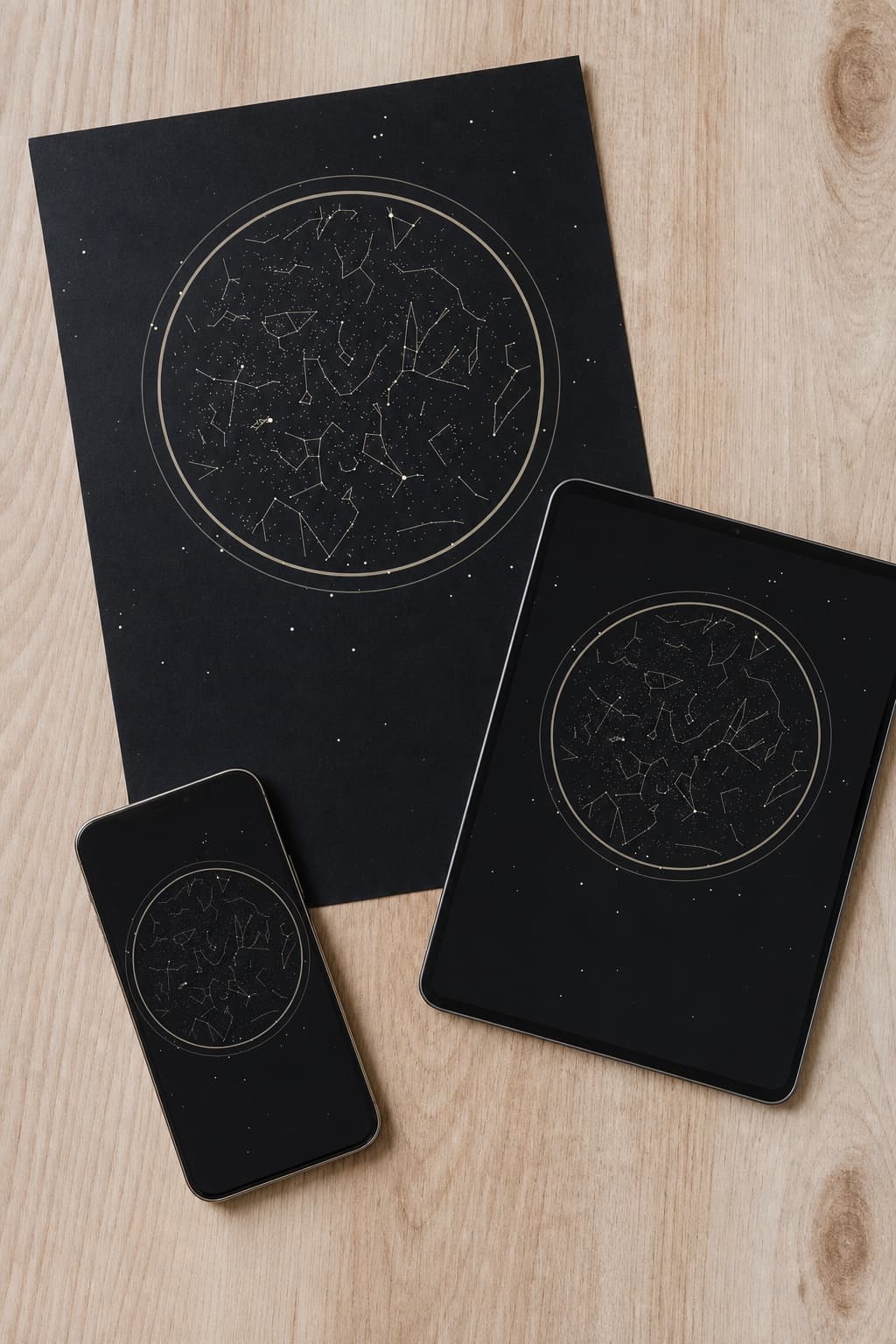
Soft, romantic, unambiguously personal. The circle is the second-most common — slightly more formal, very symmetrical, suits gallery walls.
The edge-to-edge designs are the third option. Cleaner and more architectural, often chosen by couples who want the print to look like a piece of wall art rather than a sentimental object.
Palette
Near-black (the design is called Midnight) is the most common wedding choice — dramatic, a little astrophotographic. A quiet violet (Nebula) is the softer, more romantic version of the same idea.
If the print is going somewhere bright, “Porcelain” puts that same sky on warm white paper. Couples tend to pick based on the room they’ll hang it in.
Text
Typically three lines under the sky: a name line (the couple’s names or “The Hartmans” or “Sarah & Daniel”), the date, and the location (city or venue). Some couples add a short message line — “the day we said yes” or a meaningful line from their vows.
Size and finish
Most wedding orders come in 12×16 inches (medium frame, fits above a couch or sideboard) or 18×24 inches (large statement piece). There’s also a 24×36 for couples who want the sky to own the wall, and the 8×10 size is more often chosen for bridal-party gifts.
What about destination weddings and outdoor ceremonies?
Both work fine.
The location input takes any place on Earth, so a beachside Tulum ceremony or a hilltop Tuscany venue is no different from a hometown church. The star map will render the sky from whichever spot you specify.
For destinations where the ceremony happened in daylight, the print still works.
The map shows the night sky from that date and place — the stars and planets that would have been overhead if the sun hadn’t blocked the view. The math doesn’t need the sky to actually be dark for the rendering to be correct; we’re just showing what was up there at that moment.
What about the “wedding guest book” star map?
A creative variation some couples have started doing: order a large wedding-day star map a few weeks before the wedding, frame it without glass, and pass it around at the reception with a pen. Guests sign their names around the edges, the way they’d sign a traditional guest book.
The result is a wedding artifact that combines the date sky with the actual attendees as signatures. It hangs in the new home as both an astronomical map and a record of who was there.
How to choose the time of day
The wedding ceremony itself is the natural choice. But if the ceremony was in daylight, you’re free to pick the time the reception kicked off, the time the first dance happened, or just “9 p.m.” — the visible constellations won’t change dramatically across the evening.
For midday outdoor ceremonies, many couples pick the time the reception ended.
That tends to be late evening — the “real” sky for that day, with the actual stars overhead. The choice is yours; the math is unaffected.
The bridge: keeping the date
A wedding day is, by design, dense with artifacts — photos, video, rings, the dress, the cake topper.
Most of them record the people. A star map records something almost no one else thinks to record: the world above the people.
It gives the date a kind of weight that “another framed wedding photo” doesn’t quite reach. Plug the date and venue into the SkyWhen customizer and the preview will show you the exact sky from your wedding evening.
The preview is free.
For more on choosing the right date when you’re unsure, see Personalized Star Map Gift Ideas. For anniversary-specific options once the wedding is past, see Anniversary Star Map Ideas.
FAQ
Is a wedding star map a good wedding gift?
It’s one of the most-requested gifts in the category. Universally recognized as thoughtful, doesn’t require knowing the couple’s specific tastes, and naturally personal because it’s anchored to their date.
What date should I pick for a wedding star map?
The wedding day itself. If you have the time of the ceremony, use that; otherwise “evening” or 9 p.m. works fine. The stars don’t change much across a single evening.
Can I make a star map for a destination wedding?
Yes — the location input takes any place on Earth. A Tulum beach ceremony or a Tuscany hillside wedding will render the sky as it appeared from that exact latitude and longitude.
What's the most popular shape for wedding star maps?
Heart, by a wide margin. Circular is second, and the edge-to-edge designs are third. The choice usually depends on whether the print is meant as a sentimental object or as a more architectural piece of wall art.
How long do these prints last?
The digital files are yours forever once delivered. Printed on archival paper with proper inks, the physical print is rated to last decades without fading. Frame behind UV-filtering glass for the longest life.