Most housewarming gifts are things the new owners will use up, or things they already own two of. Candles, a bottle, a plant, a chopping board.
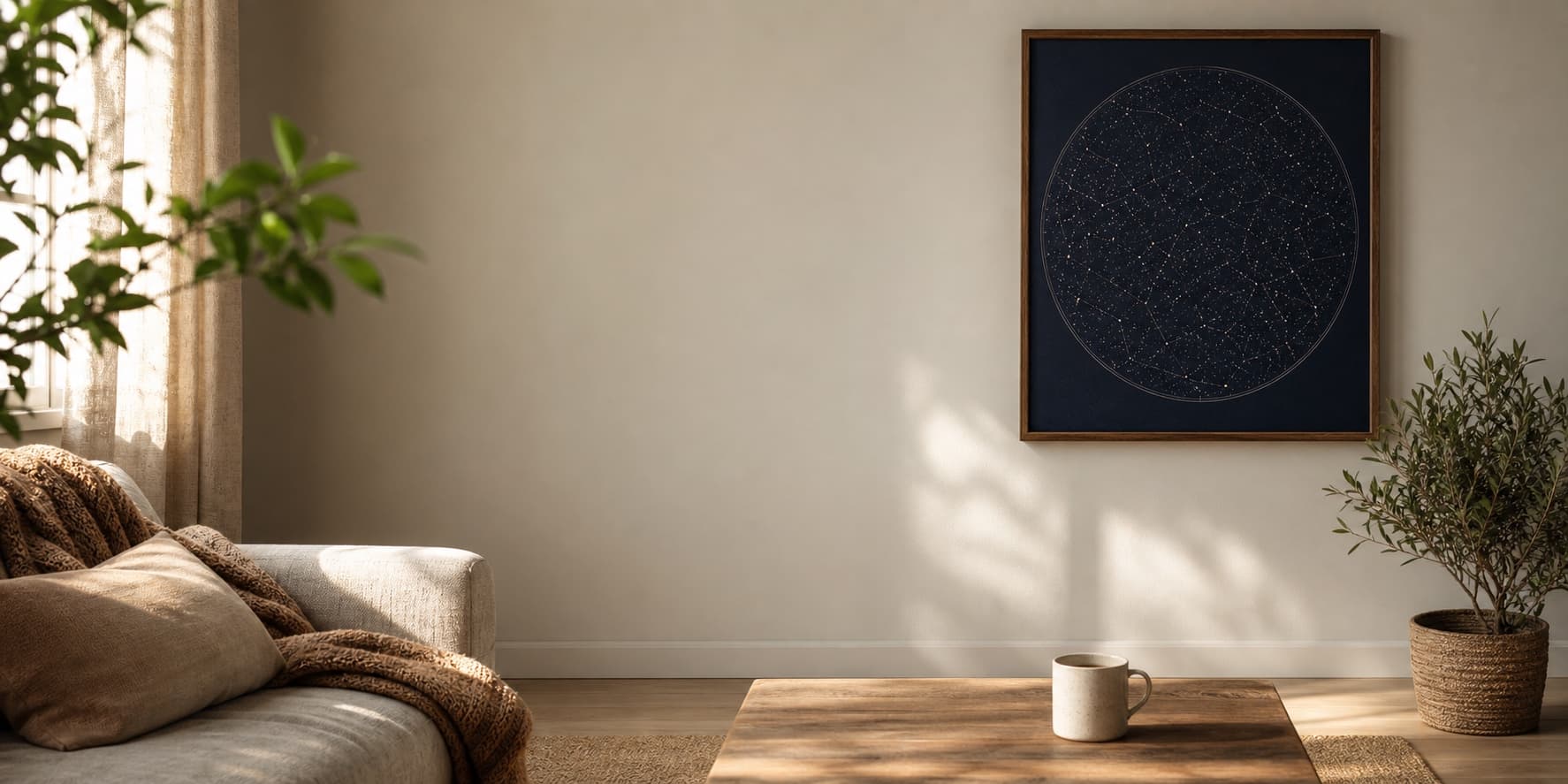
A star map is one of the few housewarming gift ideas that is actually about the house. It’s the night sky over that exact address, on the night it became theirs.
Here’s how to pick the night, what to do when you have never seen the place, and where the thing should actually hang.
Why a star map suits a new home
A house move is one of the few life events that has a precise date and a precise place attached to it. That is exactly what a star map needs.
A wedding gets photographed from every angle. A new house rarely gets marked at all, beyond a few phone pictures of empty rooms.
There is also a practical reason it works. A new home has bare walls and no art yet, which is the one moment in someone’s life when a poster is genuinely useful rather than one more object.
You are giving them something to hang on the day they most need something to hang.
Which night to choose
The location is obvious here, which is unusual. It is the new address, and that part writes itself.
The date takes slightly more thought, and there are four reasonable answers.
The night they got the keys
The default, and the strongest for most people. It is the moment the place legally became theirs, and almost everyone remembers it.
If you are not sure of the exact day, completion day is usually close enough that nobody will ever know the difference.
The first night they slept there
Often a different date to the keys, and often the more emotional one. It is the night the house stopped being a purchase and started being home.
This one tends to suit people who moved in gradually rather than all at once.
Moving day itself
Chaotic, exhausting, and for that reason memorable. Plenty of people would rather remember the day of the van than the day of the paperwork.
It also works well when a couple moved in together for the first time, because that date belongs to both of them equally.
For a first home
If this is their first place, the date matters less than the fact of it. Any of the three above will land.
What changes is the wording underneath, which is worth making explicit here. “Our first home” will still mean something in thirty years and two houses.
Who you’re buying for
The same map, framed differently depending on who is opening it.
A couple moving in together
Use the first night, not the keys. Moving in together is the milestone, and the paperwork is incidental to it.
This is also the version most likely to end up in the living room rather than the hallway.
Someone buying their first place alone
Buying alone is a genuine achievement and almost nobody marks it, because there is no ceremony attached.
A dated print is a quiet way of saying it counted. Keep the wording plain and avoid anything that reads as a consolation for being single.
Someone who moved far away
A map of the new city’s sky is a warmer gift than it sounds, especially if they moved somewhere they don’t know anyone.
The stronger version is two prints, the same night from the old city and the new one, which is the same idea behind long-distance star maps.
Family moving to a forever home, or downsizing
For a family home, the keys date and a large print in the hallway is the safe, strong choice.
For downsizing, consider using the sky over the house they left rather than the one they moved to. That is often the harder goodbye, and the more welcome gift.
The practical bits
Buying for a house you have never seen
This is the real housewarming problem, and it has a simple answer. You are not picking art for their taste, you are picking something that will not clash with it.
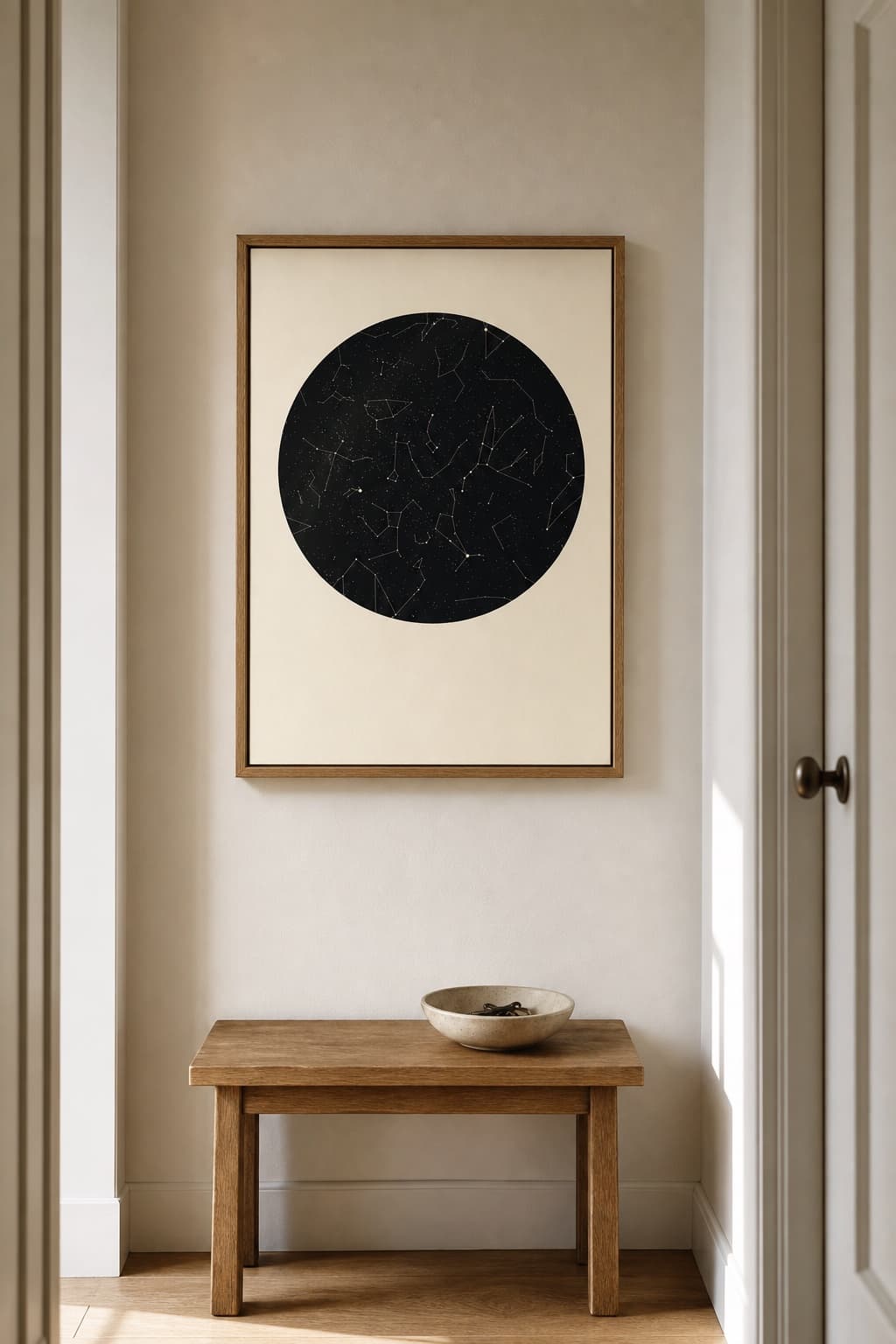
Go neutral. A dark sky on a dark background, or a warm off-white version, both sit quietly next to almost any wall colour and any furniture.
Avoid the bolder palettes unless you have actually seen the room. A violet poster is wonderful in the right house and awkward in the wrong one.
On size, a mid-size print is the safe bet. Something around 12×16 or 18×24 has presence without demanding a specific wall.
Where it actually hangs
Entryways and hallways are the natural home for this one, because those walls stay empty longest and guests see them first.
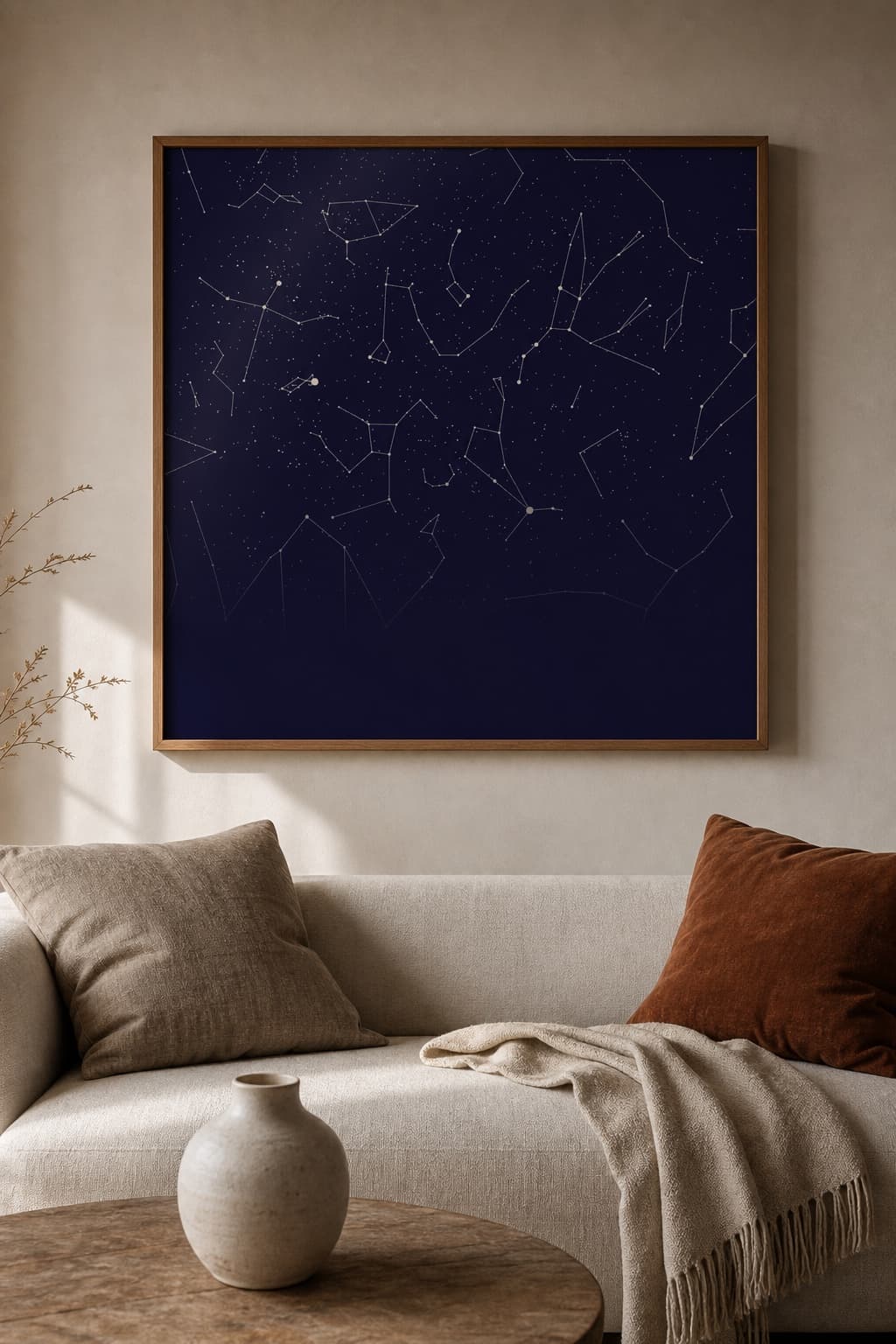
A stairwell works well for a larger print. If you want it in the living room, it usually needs to be bigger than you think to hold its own.
There is more on building around a piece like this in our guide to celestial wall art ideas.
What you actually get
One purchase gives you twelve files, so the recipient can print whatever size suits the wall they end up choosing.
- Four print files, from 8×10 up to 24×36, at full print quality
- Six phone, tablet and desktop wallpapers of the same sky
- Two square and story-shaped versions for sharing
That flexibility is genuinely handy when you are buying blind. If the hallway turns out to be smaller than you imagined, they have the smaller file already.
You can put in the address and see the real sky before you decide anything, which is the fastest way to know whether the date you picked looks any good.
When to give it, and what to hand over
There is one small awkwardness worth planning around. The gift needs the address, and you usually only get the address with the invitation.
In practice that is fine. An invite normally arrives a week or two ahead, which is far more time than you need.
The files arrive by email in about ten minutes, so even an invitation on the day leaves you enough room.
The bigger question is what you physically hand over, because a file is a poor thing to give someone at a door. Print it and put it in an inexpensive frame, and it stops being a file and starts being a present.
If you are short on time, a rolled print tied with string is genuinely good. Most high-street print shops will turn a poster around the same day.
Going in with other people
Housewarming gifts are often pooled, and this one scales better than most. Four people together can comfortably cover a large framed print.
A 24×36 in a proper frame is a different category of gift to a 12×16 in a clip frame, and the jump costs less than you would expect once it is split.
One person should still choose the date. Gifts designed by committee tend to end up with the safest possible answer, which here is usually the dullest one.
The address, not the artwork
It is tempting to treat this as buying a nice poster for someone’s new hallway. It is closer to marking a date on a building.
The stars in it are where they genuinely were above that address on that evening, worked out from real astronomical data rather than drawn to look pretty. We explain how that works in are star maps accurate and cover the basics in what is a star map.
Which is why it outlives the candles. In ten years it is still the sky over the night they got the keys.
One more idea: a new home is a place first, so it pairs naturally with a map. Acity map postershows the real streets around the new address, with a heart on the house and the move-in date underneath.
FAQ
What is a good housewarming gift that isn't a candle or a plant?
Anything tied to the house itself rather than to general homeware. A star map of the new address on the night they moved in is one option, as are framed prints of the street or the town.
The test is whether they could already own it. If they could, it will probably end up in a cupboard.
How much should I spend on a housewarming gift?
For a close friend or family, most people land somewhere between twenty and fifty. For a colleague or a casual friend, less.
A dated, personal gift tends to read as more generous than its price, because the thought is visible in it.
I haven't seen their new place. What size and colour should I pick?
Choose a neutral palette, either a dark sky or a warm off-white, and a mid-size print around 12×16 or 18×24.
That combination sits comfortably in almost any room. The bolder colours are better saved for a wall you have actually stood in front of.
Do I need the exact date they moved in?
Close is fine. The sky changes slowly enough over a few days that being slightly out is not noticeable.
If you can find out the completion date or the day of the move, either works well.
Can I give a star map for a rented flat, not a purchase?
Yes, and a first rented flat is often the more meaningful move. The map records where someone lived and when, which has nothing to do with who owned it.