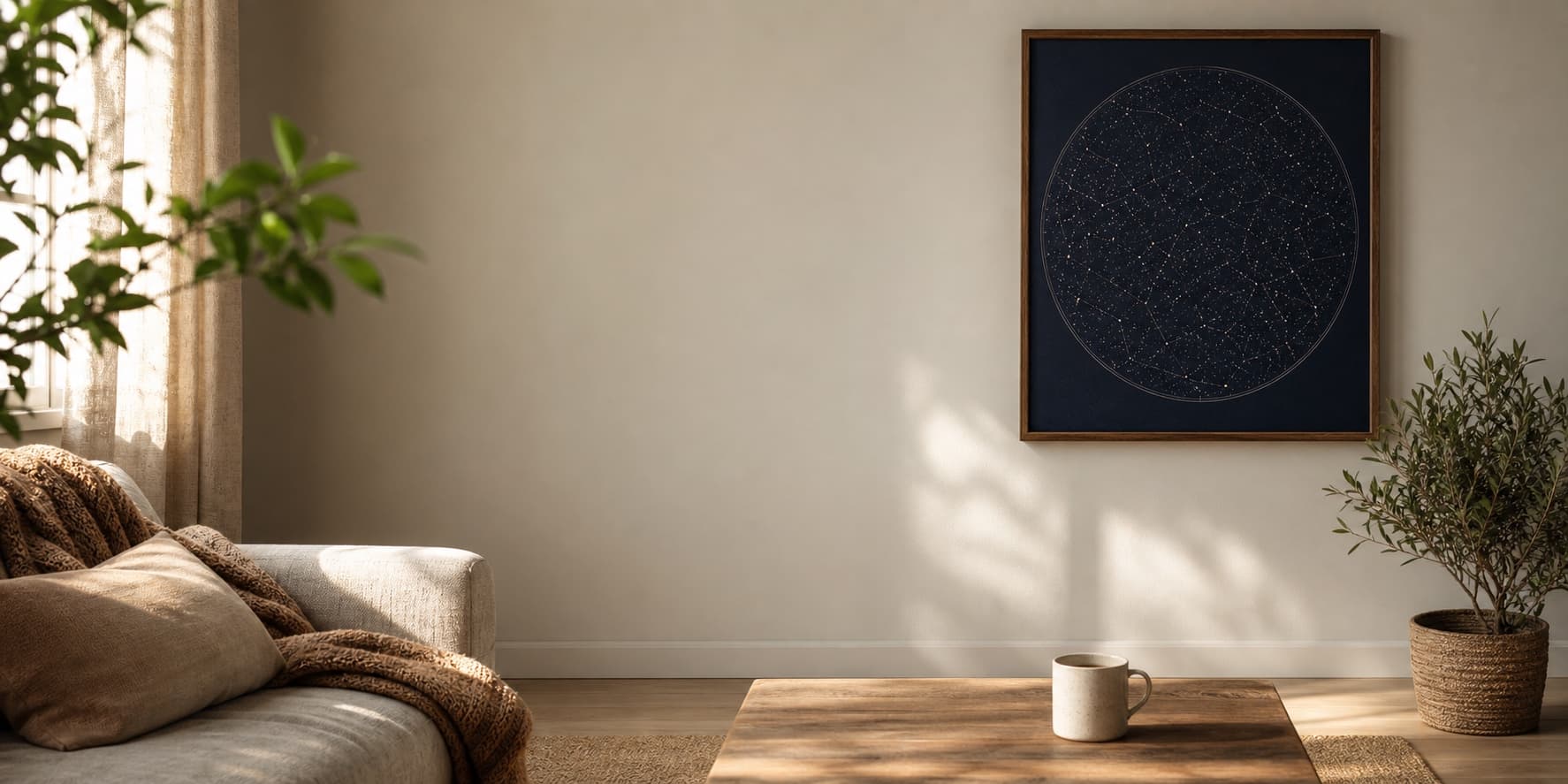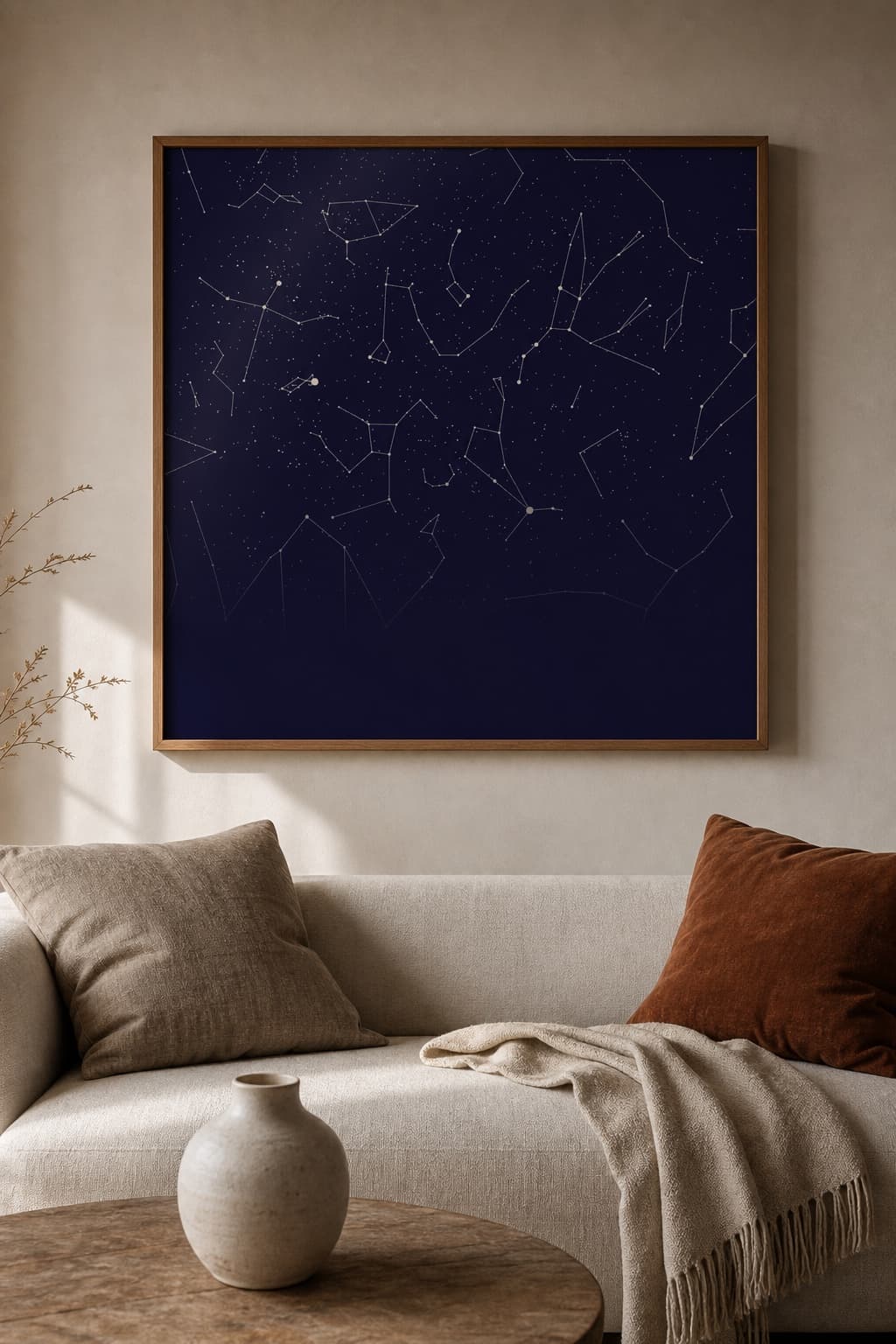
Star and moon imagery never quite goes out of style, probably because it was never really in one.
Celestial wall art works in almost any room — bedroom, nursery, living room, hallway, study — without tipping into juvenile or trendy.
This is a style guide: how to build a celestial wall that suits your home, what works where, and how a custom star map fits inside each look.
The boho celestial look
Warm tones, mixed textures, lived-in feel.
Cream backgrounds with gold or terracotta accents. Natural materials — rattan, wood, linen, dried flowers.
What works on the wall: a peach or cream-toned circular star map, a horizontal moon-phase strip in wood or brass, a constellation print with hand-drawn line work, woven star-shaped wall hangings. Mix two or three of these into a small gallery cluster.
What to avoid: anything too sharp-edged, too monochrome black, or too technical-looking. Boho is soft.
The vintage celestial look
Reproduction antique star charts and lunar maps.
Aged paper textures, sepia and bronze tones, ornate frames. Looks like something you’d find in an old observatory or a library.
What works on the wall: antique celestial chart reproductions (the ones with ornate Latin constellation labels and decorative borders), vintage moon-phase engravings, brass instruments mounted as objet. A modern star map in a warm-cream palette inside a dark wood frame also fits.
What to avoid: glossy finishes, neon colors, anything that reads as digital or contemporary. Vintage means it should look like it’s been on the wall for fifty years.
The modern minimalist look
Clean lines, lots of negative space, monochrome palettes — usually deep navy on white, or charcoal on cream.
Thin frames or no frames. Very little ornament.
What works on the wall: a single large star map (one big piece, not a cluster), a clean moon-phase strip with no labels, a single constellation print in line work. Lots of whitespace around the piece.
What to avoid: clutter, gallery walls of small pieces, ornate framing. Modern minimalist celestial is about one strong piece doing the work.
The moody dark look
Deep blacks and rich navies, surrounded by saturated jewel tones.
Dramatic lighting. Often paired with dark walls (a deep green or charcoal feature wall behind the art).
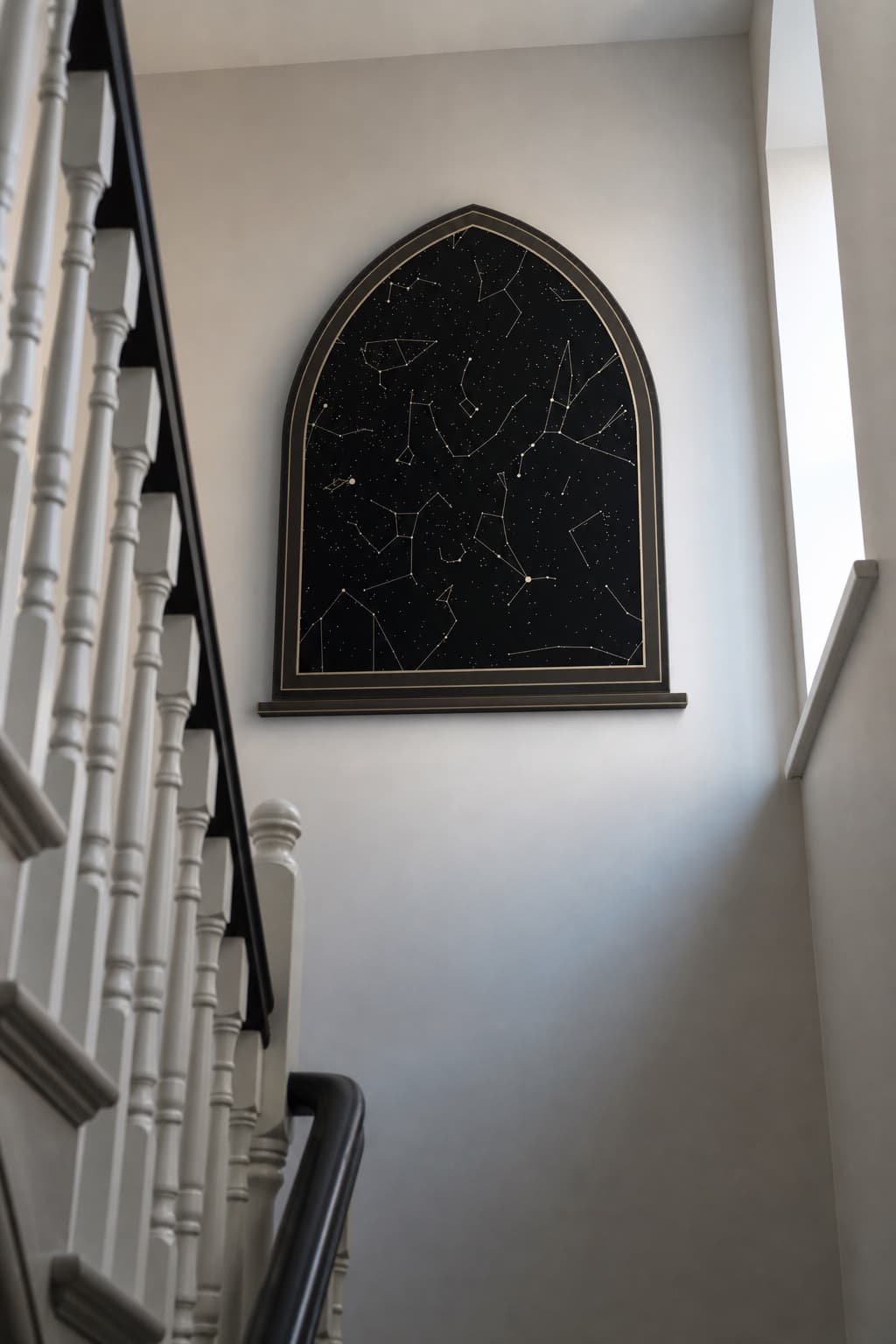
What works on the wall: a black edge-to-edge star map such as Overhead (stars running to the paper's edge, no disc), a moon-phase strip in pure white-on-black, a single constellation line drawing in metallic ink against a black background. Heavy dark wood or matte black frames.
What to avoid: bright pastels, anything pale or washed out. Moody is intense.
The brass-and-gold look
Warm metallics as the dominant accent.
Gold-foil prints, brass frames, mixed with deep blues and creams. Reads slightly Art Deco; works beautifully in entryways and living rooms.
What works on the wall: a navy or deep-blue star map in a brass frame, a gold-foil constellation print, a moon-phase strip in brushed brass, a celestial map with gold ink. Often paired with brass-base table lamps to echo the metal tone.
What to avoid: clashing metals (mixing brass with silver/chrome rarely works). Pick one warm metal and stick with it.
What goes in which room
Bedroom
Over the bed is the canonical spot.
A single horizontal piece (a moon phase strip works perfectly here) or one large circular star map centered above the headboard. Frame should match the bed’s wood tone.
Smaller bedside accent pieces (an 8×10 star map of a meaningful date) also work on the wall flanking the bed.
Nursery
Warm white paper (Porcelain or Keepsake), a circle or a heart, calm sans-serif text. A birth-night star map is the typical centerpiece.
See Celestial Nursery Decor for the full nursery guide.
Living room
Larger pieces work best — an 18×24 or 24×36 inch print as a focal point above the sofa or a console. Often a gallery wall with the star map as the anchor piece plus 2–3 supporting celestial prints (moon phase, constellation, vintage map).
Hallway
A horizontal moon-phase strip is the ideal hallway piece — long, narrow, commands attention without crowding. Vintage star charts in a row work too, framed consistently.
Study or library
Vintage celestial charts, antique-style lunar engravings, brass-framed star maps. The room that handles ornate framing the best.
Building a celestial gallery wall
A celestial gallery wall is usually 3–7 pieces in a cluster, with a single anchor piece and supporting pieces around it.
The anchor should be the largest and the most personal — a custom star map of a meaningful date is the classic anchor choice, because it’s the piece your eye lands on and the one with the story attached.
Supporting pieces typically include: a moon-phase strip, one or two constellation prints, a vintage map reproduction, occasionally a metal star or sun shape. Frame all pieces in the same finish (or two complementary finishes max) to keep the wall feeling coherent.
Budget by piece type
- Mass-market printable downloads: $5–$20 each. Quick, decorative, no story.
- Etsy generic prints (boho, constellation): $25–$75 each. Wide range of quality.
- Antique reproductions in good frames: $80–$250 each.
- Custom personalized star map (digital download): $20–$50.
- Custom personalized star map (printed and framed): $80–$200.
- Original art and limited prints: $200–$1,000+.
Sub-styles inside boho celestial
Two niches worth naming.
Witchy celestial — same boho base, but darker, with moon symbolism, tarot motifs, and crystal accents.
Cottagecore celestial — soft pastels, dried botanicals, hand-painted star charts; the most rural and grandma’s-attic of the sub-styles.
The bridge: a real sky as the centerpiece
The piece of celestial wall art that does the most work is a personalized one. Generic constellation prints are pretty; a star map of the actual sky from a specific date — a wedding night, a birth night, the day you moved into the house — is the piece that makes a celestial gallery feel intentional rather than decorative.
Plug a meaningful date into the SkyWhen customizer and the preview will show what the sky actually looked like. The preview is free.
For specific sub-categories, see Moon Phase Wall Art, Constellation Wall Art, and Celestial Nursery Decor.
FAQ
What is celestial wall art?
Wall decor with night-sky imagery — stars, moons, constellations, galaxies, lunar phases, or full sky maps. The category covers everything from generic boho moon prints to scientifically accurate custom sky maps.
Where does celestial wall art look best?
Bedrooms (over the bed), nurseries, hallways, and living rooms over a sofa or console are the most common spots. The deep blues and warm metallics that dominate the category complement most palettes, so it works almost anywhere.
What palette goes best with celestial wall art?
Deep navy plus warm cream is the most versatile combination. Brass or gold accents push it toward elegant; warm peach or terracotta accents push it toward boho.
How big should a celestial wall print be?
For a focal point over a sofa or bed, 18×24 inches minimum (24×36 if the wall is large). For a gallery wall, mix sizes — one or two larger anchor pieces plus a few 8×10 to 12×16 supporting pieces.
Is celestial wall art still trendy in 2026?
Yes — and it’s one of the rare Pinterest decor categories with real staying power. The imagery is centuries-old, the palettes are timeless, and it doesn’t age out the way themed prints from a specific year often do.