You have almost certainly seen the eight-moon strip: a long row running new to waning crescent, hung in a clean line above a bed or a sofa.
Moon-phase wall art is popular for good reason. It’s calm, graphic and readable at a glance.
It is also the same eight moons in every house that owns it, which is where a personalized version starts to look interesting.
The eight phases, in order
The lunar cycle takes about 29.5 days — just shy of a calendar month. In that time the moon goes through eight named phases, in this order:
- New moon — invisible (the sun-side of the moon faces away from us)
- Waxing crescent — a thin sliver on the right side (Northern Hemisphere)
- First quarter — half-moon, right side lit
- Waxing gibbous — mostly full, sliver of dark on the left
- Full moon — fully lit disk
- Waning gibbous — mostly full, sliver of dark on the right
- Last quarter — half-moon, left side lit
- Waning crescent — a thin sliver on the left side
The strip art usually displays all eight at equal size, in this order, left to right.
Style 1: minimalist line-art
Eight simple circles, each with the lit portion drawn as a clean shape.
White on a black background, or black on a white background. No textures, no shading, no labels.
Works in: modern minimalist rooms, scandi interiors, contemporary bedrooms, any room with a tight color palette.
Frame: thin black or thin white, depending on contrast preference.
Style 2: photo-realistic moons
Each phase rendered as a textured photograph of the actual moon (or a photorealistic illustration), showing the craters and the maria. Looks like a row of small actual moons floating above the wall.
Works in: bedrooms, studies, transitional living rooms, anywhere that handles a touch of dramatic realism.
Frame: matte black or natural wood — the moon’s grayscale needs a simple, neutral surround.
Style 3: gold-on-cream boho
Moon phases as gold-foil or warm-mustard illustrations on a cream or warm beige background. Often hand-illustrated rather than photo-real.
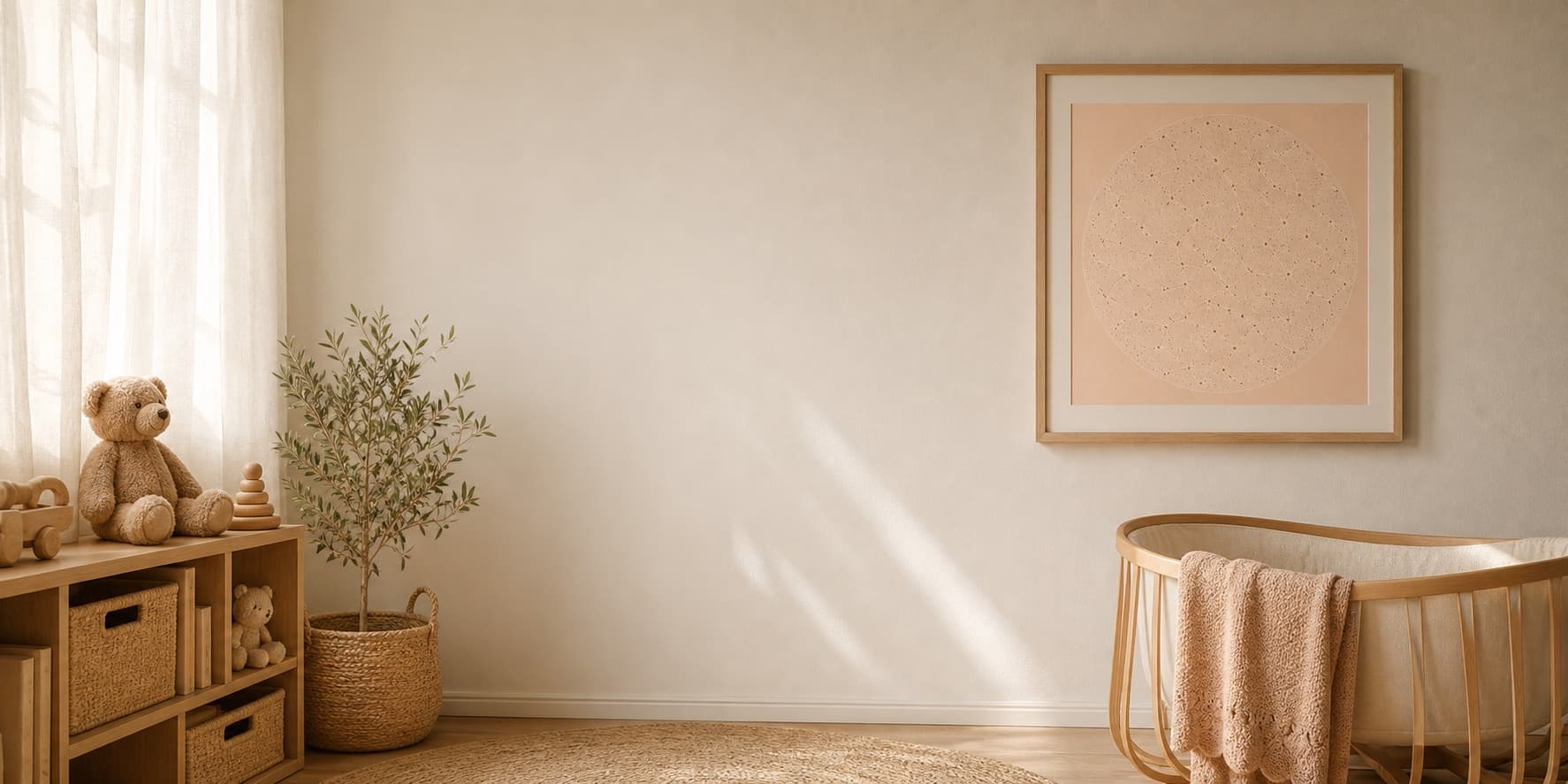
Works in: boho bedrooms, nurseries, warm-palette living rooms, any room with terracotta or rattan accents.
Frame: light wood or brushed brass. Avoid black framing — it fights the warmth of the print.
Where to hang it
Above the headboard
The canonical spot.
A long horizontal moon-phase strip echoes the headboard’s width and pulls the eye horizontally. Three to four feet wide is typical for a queen-size bed.
Above a sofa or console
Same reasoning. The horizontal format does exactly what a long piece of furniture asks for — it elongates the wall and balances the volume of the furniture below.
In a hallway
Moon-phase strips were almost designed for hallways.
Narrow, long, doesn’t crowd you as you walk past. Often mounted at eye level so each phase is visible as you pass.
Above a doorway
Unconventional but striking. The strip sits above a doorframe, framed thin or mounted directly, and acts as a quiet transition piece between rooms.
The personal twist: one moon, one date
An alternative to the eight-phase strip is a single larger print of the moon’s actual phase on a specific date that matters to you. A wedding-night moon.
The moon on the day your child was born. The phase on the night someone proposed.
This swaps the generic eight-phase cycle for one specific moment. The moon phase is rendered accurately from the date, time, and location — same astronomical engine that drives our full star maps.
The result is a single big piece rather than a strip of eight — usually 12×16 or 18×24 inches, with the date and city as small text below the moon.
The trickier version: the lunar month spelled out
A less-common but striking format: 28 to 31 small moon illustrations laid out in a calendar grid, each showing the moon’s phase on each day of a specific month. Like a quiet wallpaper of the lunar cycle over a chosen month.
Most often picked for a wedding month or the month a baby was born. The grid is read as a calendar but reads visually as art — the moon’s progression across the month traces a smooth wave.
Buying considerations
- Matte finish almost always beats glossy — glare on a glossy moon-phase strip is constant.
- If you’re mixing it with other celestial wall art, match the framing finish across pieces.
- Standard 24×8-inch and 36×12-inch ratios are the most common; if you need a custom width, allow extra lead time.
- For nurseries, soft cream or peach palettes age better than stark black-and-white.
The bridge: the moon on the night that mattered
The strongest version of moon-phase wall art for most people isn’t a generic eight-phase strip — it’s the moon as it actually appeared on a specific night that matters to them.
Plug a date and place into the SkyWhen customizer and the preview will show you the moon phase visible on that night (plus the stars surrounding it). The preview is free.
For the broader decor guide, see Celestial Wall Art Ideas. For constellation prints, see Constellation Wall Art.
FAQ
What are the eight phases of the moon?
New moon, waxing crescent, first quarter, waxing gibbous, full moon, waning gibbous, last quarter, and waning crescent — in that order over about 29.5 days.
What's the most popular moon-phase wall art style?
A horizontal strip of eight phases, either in white-on-black minimalist line work or in gold-foil-on-cream boho style. The strip typically goes over a bed or sofa.
Can I get moon-phase wall art for a specific date?
Yes — some services (including SkyWhen) render the moon’s actual phase from a specific date, time, and place. It’s typically a single large print rather than a strip.
How big should moon-phase wall art be?
For a horizontal strip over a queen-size bed or standard sofa, three to four feet wide is typical. For a single large moon print as a focal point, 18×24 or 24×36 inches.
Does moon-phase wall art work in a nursery?
Yes, very well. A soft cream-and-gold horizontal moon-phase strip above the crib (or above a changing table) is calming and ages with the child. Pair with a birth-night star map as the central piece.