The whole difficulty of being far apart is never being in the same place at the same time. In one narrow sense, though, you always are.
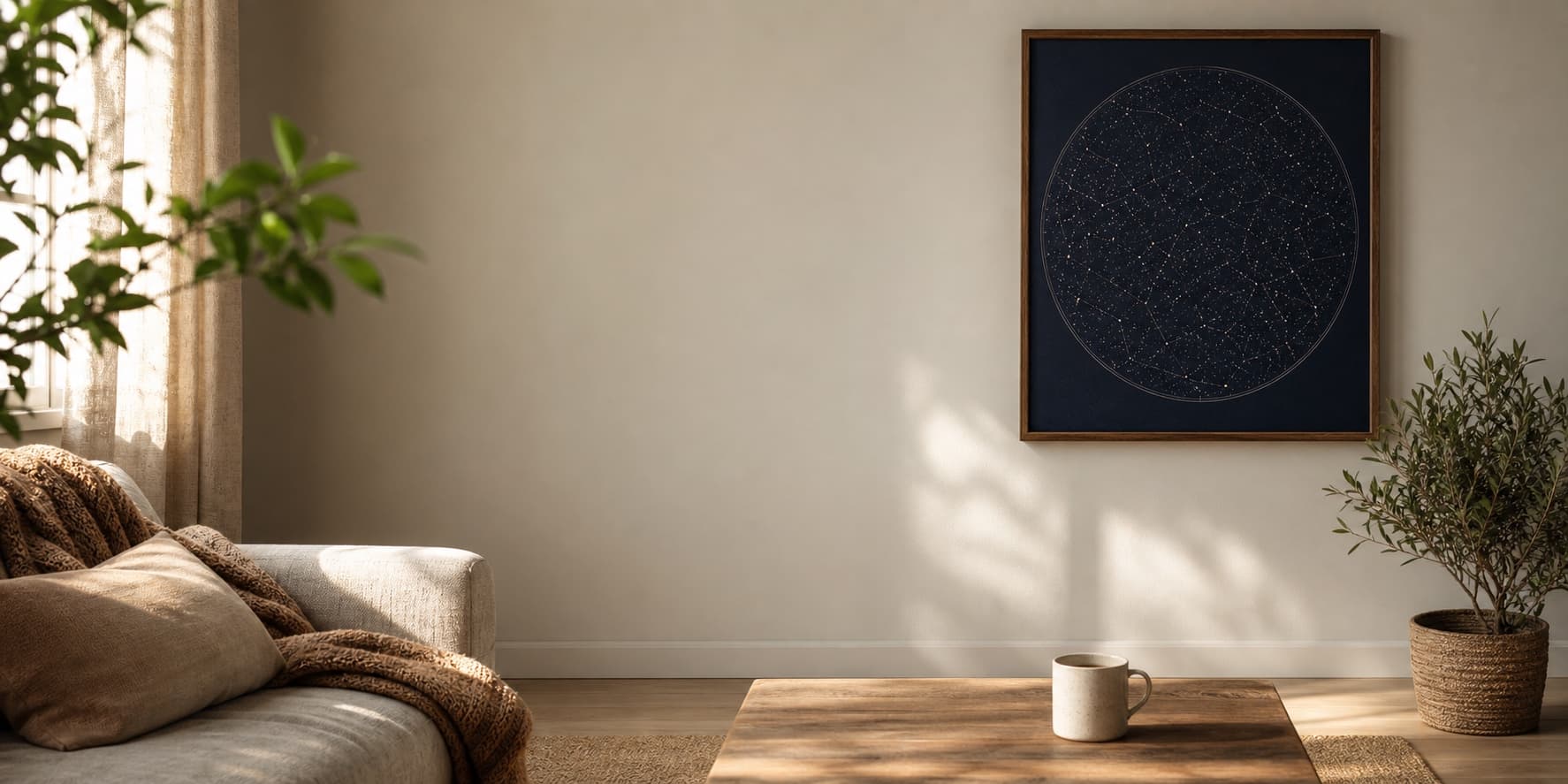
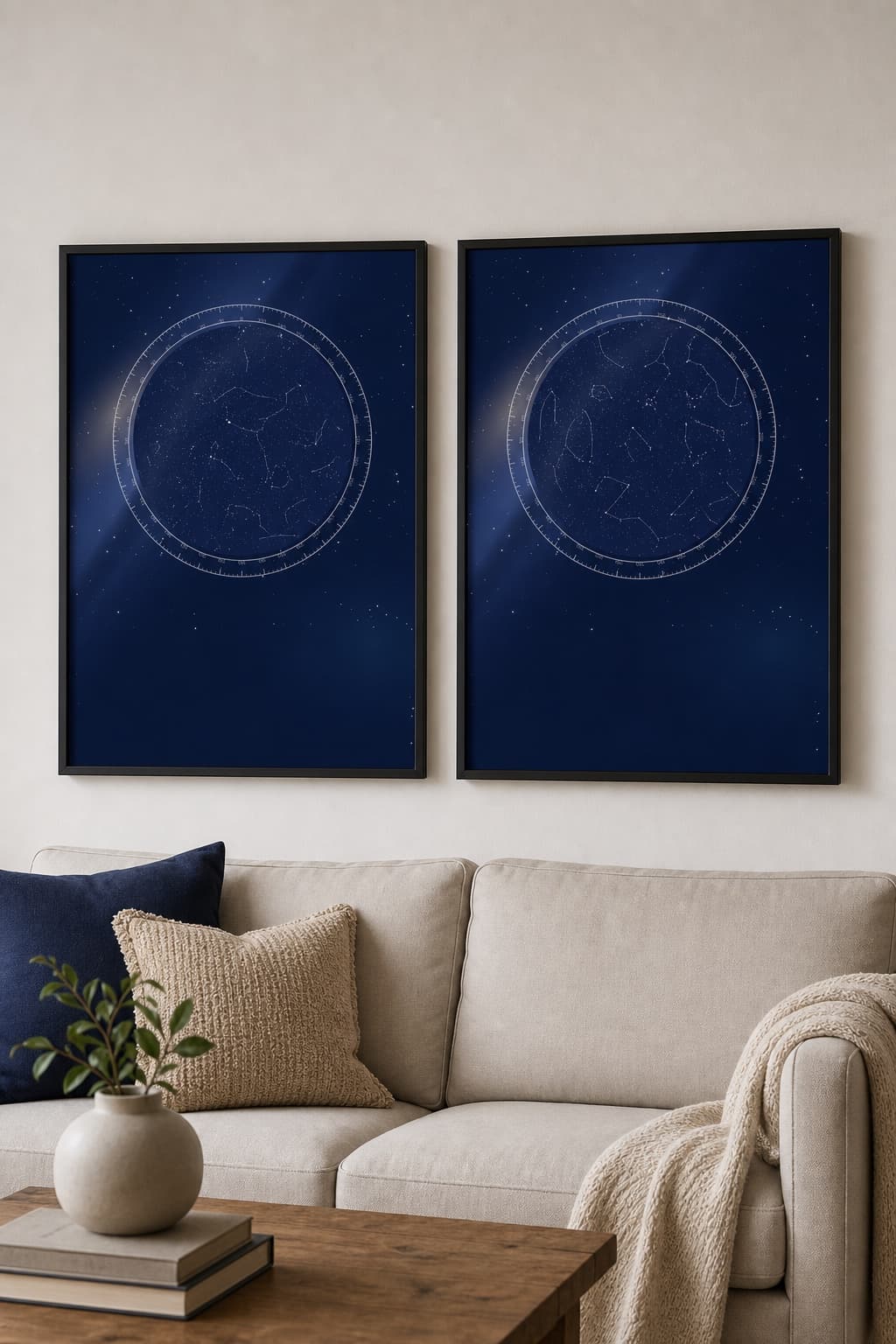
A long-distance star map is a pair rather than a single print. Two maps of the same night, one from each person’s city.
They hang in two different homes, in two different places on the map, and both show the same evening.
The format, exactly
Two orders, same date, two different locations.
The customizer treats each one as its own star map — different city, different sky on the print. The shared element is the date and time you input for both.
Most people pick a date that matters to both people: the night they met, an anniversary date, the day they last saw each other, the day one of them moved away. The pair of prints holds the date that connects them, while the visible difference between the two skies acknowledges the distance.
Why the two skies actually look different
Earth’s spin and tilt mean that the stars overhead at a given moment depend on where you’re standing.
From New York at 9 p.m. on a summer evening, the sky has Vega high overhead and Sagittarius low in the south. From Sydney at the same instant (which is 11 a.m. the next day local time), the sky has the Southern Cross overhead and Sagittarius high in the north.
Even cities only a few hundred kilometers apart show subtle differences — the position of constellations relative to the horizon shifts, the stars closer to the celestial pole appear higher or lower. From two cities on opposite sides of the planet, the prints look meaningfully different from each other while still capturing the same moment.
We covered the science of this in Northern vs. Southern Hemisphere: How the Night Sky Changes.
Who gives them
Long-distance couples
The most common direction.
Couples in different cities, often as a one-year anniversary gift while still long-distance. The pair of prints — one in each apartment — becomes a visual reminder that the relationship is sharing a sky even while not sharing a city.
Parents and adult children
The other strong direction.
Parents living in one country, an adult child living in another. The pair commemorates a shared date — the kid’s birth night, a family milestone, the day they moved.
One print hangs in the parents’ home (the sky over the family home); another in the kid’s apartment in the new city. Same date, two locations.
Siblings, best friends, longtime friends
Less common but very effective. Two friends who’ve lived in different cities for years can commemorate a shared milestone — the date they met, a graduation year, the day one of them moved abroad — with paired prints from their two cities.
The “moving away” gift
A specific subgenre. One person is about to move to a different country, city, or continent.
The pair of prints captures the day of the move — one from the city being left, one from the city being moved to. Each person hangs the one they live in (or sometimes they swap).
Which date to choose
The day you last saw each other
For couples who are temporarily long-distance (work, school, a brief separation), this is a clean anchor date. The pair of prints captures the last time you were in the same room.
The day one of you moved
The opposite framing — the day distance entered the relationship. Useful for parent–child relationships where one moved away.
A shared anniversary
For couples: the day you met, the day you got together. For parents: a kid’s birth date or a family milestone.
A regular “same evening”
Some pairs of friends or couples pick a non-anniversary date that happens to be meaningful in both their lives — the night both watched the same lunar eclipse from different cities, the evening they both watched the same TV show finale, a New Year’s Eve they spent on the phone with each other.
What the print typically looks like
Matched palettes
The two prints are most powerful when they’re visually identical except for the sky itself. Same palette, same shape, same frame style, same text format — so the only difference between them is the actual stars overhead.
Matched text
The two prints often carry the same text under the sky — a single shared message line, the date, and then the city. Common shared text:
- “Same sky, different city”
- “Looking up together”
- “The same night, two windows”
- The date alone, with the city written separately on each print
How to order a pair
Two separate orders in the customizer, with the same date and time but different cities. You can re-use the design choices (palette, shape, text style, size, frame) from the first order on the second, so the pair stays visually consistent.
If you want both prints in your account before shipping, place both orders before checking out — the cart holds multiple maps. If one person is in a hurry, you can also place each order separately and ship them to different addresses.
For very-different-hemisphere pairs (one in Australia and one in Norway), the visual difference between the two prints is dramatic.
For closer pairs (two cities on the same continent), the prints look more similar but still distinct. Both work — what matters is that the prints are anchored to two real places.
The bridge: the sky doesn’t care about borders
Long-distance relationships have to deal with the very real fact of being separated.
The night sky is one of the few things that’s technically shared — both people, in both cities, are looking at the same celestial sphere from different angles. The view is different; the universe is the same.
A pair of prints holds that idea visually. Plug a shared date into the SkyWhen customizer twice — once with each person’s city — and the preview will show the two skies side by side.
The preview is free.
For pre-marriage dating dates that work as the shared anchor, see Star Maps for Couples . For broader gift framing, see Personalized Star Map Gift Ideas .
For accuracy details, see Are Star Maps Accurate?
FAQ
What's a good gift for a long-distance couple?
A paired star map — two prints of the same date, rendered from each person’s city. The pair acknowledges the distance while sharing the date.
How do I order a pair of star maps for two different cities?
Two orders in the customizer, same date and time, different cities. Keep the palette, shape, and text style identical so the pair looks visually consistent.
Will the two prints look different from each other?
Yes. The same instant looks different from two different points on Earth — different constellations are overhead, in different positions. The more different the latitudes, the more different the prints.
What's a good shared message line for the pair?
“Same sky, different city” is the most common. “The same night, two windows” or just the shared date with each city underneath also work well.
Can I get one print in one country and another in a different country?
Yes. The customizer supports any place on Earth as the location input. Shipping is calculated separately for each order, so you can ship one print to one address and the other to a different one.