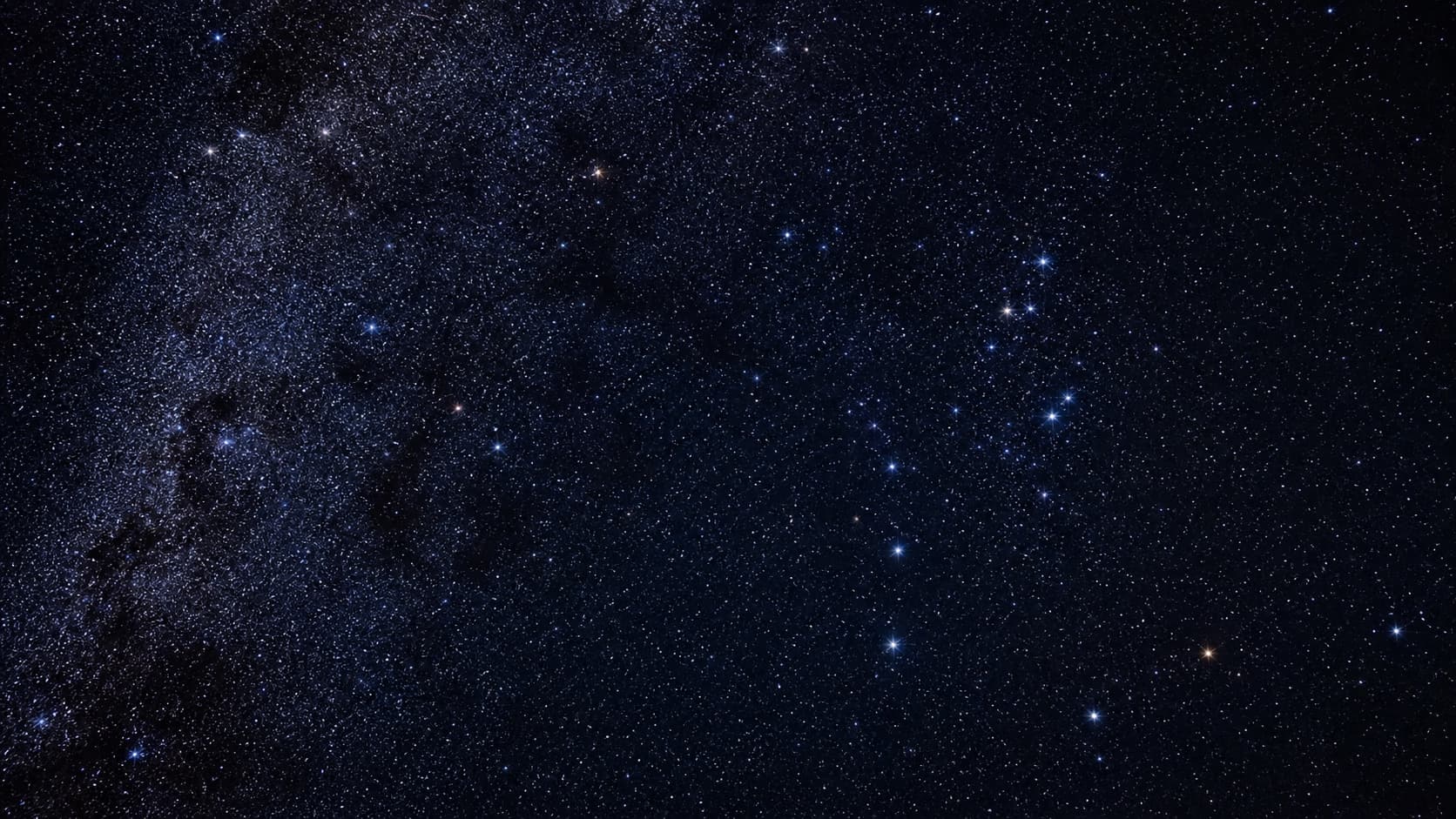
The Southern Cross — formally Crux — is the constellation everyone who’s ever flown over the Equator wants to find next. Four bright stars in a tight, compact cross, hanging high in the southern sky from Australia, New Zealand, South Africa, Brazil, and most of South America.
It’s the southern hemisphere’s answer to the Big Dipper — the easy-to-spot navigation reference, the cultural anchor on flags, the first constellation locals learn. And it’s tiny — the smallest of the 88 officially recognized modern constellations.
The four (or five) stars
The Southern Cross has four main stars forming a clear cross, plus a faint fifth often added to the asterism.
- Acrux (Alpha Crucis) — the bottom of the cross, brightest star in the constellation at magnitude 0.8.
- Mimosa (Beta Crucis) — the left arm, magnitude 1.3, blue-white.
- Gacrux (Gamma Crucis) — the top of the cross, magnitude 1.6, a red giant.
- Imai (Delta Crucis) — the right arm, magnitude 2.8, the faintest of the four mains.
- Ginan (Epsilon Crucis) — the disputed fifth star, much fainter at magnitude 3.6, sitting offset from the main cross.
The question of whether the Southern Cross has four stars or five is a national argument in some places (it appears as five stars on the flag of Australia and four on the flag of New Zealand — the only difference between those otherwise-near-identical flags).
How to find it
From the Southern Hemisphere, the Southern Cross is unmistakable. It’s high in the southern sky, surrounded by the Milky Way, and there’s nothing else nearby that could be confused with it.
Tip: don’t confuse Crux with the “False Cross” — another four-star cross-shape in the same region of sky (made up of stars from Vela and Carina). The False Cross is larger and dimmer; the real Southern Cross is smaller and brighter, with two extremely bright stars nearby (Alpha and Beta Centauri) that the False Cross lacks.
Finding south with the Cross
There’s no bright pole star at the south celestial pole, but the Southern Cross gives you a workable substitute.
Draw a line from Gacrux (top of the cross) through Acrux (bottom of the cross), and extend it about 4.5 times the length of the cross itself. That point is very close to the south celestial pole — due south.
Some navigators also use the line between Alpha and Beta Centauri (the two bright “pointer stars” just east of the Cross) crossed with the long axis of the Cross for a slightly more accurate south reference.

When and where to look
Southern Hemisphere
Visible all year from anywhere in the Southern Hemisphere. The Cross is circumpolar (never sets) from anywhere south of about 35° south — so from Sydney, Auckland, Cape Town, Buenos Aires, or Santiago, it’s in the sky every clear night.
Highest in the autumn evening sky (March through June from southern latitudes).
Northern Hemisphere
Visible from anywhere south of about 25° north. From Hawaii, Florida, the Caribbean, Mexico, India south of Mumbai, Vietnam, and the Philippines, the Cross is visible low on the southern horizon at certain times of year.
From New York, London, Paris, or anywhere comparable, it’s never above the horizon.
The cultural footprint
The Southern Cross appears on the national flags of Australia, New Zealand, Brazil, Papua New Guinea, and Samoa. It also appears on subnational and regional flags (the Eureka Flag, the flag of the U.S. state of Magallanes in Chile, and others).
For most Southern Hemisphere cultures, Crux is the dominant orientation constellation — the way Polaris is for the Northern Hemisphere. Indigenous Australian and Aboriginal astronomical traditions have detailed star lore built around it.
Acrux and the bright neighborhood
Acrux, the brightest star in the Cross, is technically a multiple-star system of at least six stars locked in a complex gravitational dance — the two brightest are visible as a double in a small telescope.
The Cross sits inside one of the richest regions of the Milky Way. To the east are Alpha and Beta Centauri — Alpha Centauri is the closest star system to our sun (4.37 light-years), and it’s the third-brightest star in the entire night sky.
Just below and to the side of Crux is the Coalsack Nebula — a dark nebula that appears as a black patch against the Milky Way’s glow. Naked-eye visible.
Why we can’t see it from up north
The Cross is centered about 60° south of the celestial equator. From any latitude that’s 30° north or higher, that point is always below the horizon — you would have to dig through the Earth to see it.
This is part of why southern hemisphere skies look so different from northern ones. Sydney’s evening sky is full of stars and patterns that don’t exist in New York’s evening sky, and vice versa.
See Northern vs. Southern Hemisphere for the bigger picture of why the two halves of Earth see such different skies.
The bridge: a southern sky, faithfully rendered
A star map of a meaningful date over Sydney, Cape Town, Auckland, or any other southern city will have the Cross visible — high overhead in autumn, high in the south in summer.
Plug a date and a southern city into the SkyWhen customizer and the preview will show the actual Crux from that night, exactly where it was. The preview is free.
For more on southern skies, see Northern vs. Southern Hemisphere .
For the more famous northern counterpart, see The Big Dipper and the North Star .
FAQ
Is the Southern Cross four stars or five?
Four main bright stars in a cross shape, plus a much fainter fifth star (Epsilon Crucis) offset to the side. The Australian flag depicts five, the New Zealand flag depicts four. Both are defensible.
Where can I see the Southern Cross?
From anywhere south of about 25° north latitude. The whole Southern Hemisphere sees it year-round; the tropics see it seasonally; above about 25° north (most of the U.S., Europe, China, Japan), it never rises.
Is there a southern pole star like Polaris?
Not really — there’s no comparably bright star near the south celestial pole. The closest is Sigma Octantis, which is barely naked-eye visible (magnitude 5.5). The Southern Cross is used as a pointer instead.
What's the difference between the Southern Cross and the False Cross?
The False Cross is a larger, dimmer cross-shaped pattern made of stars from Vela and Carina, sitting north-west of the real Southern Cross. The real Cross is smaller, brighter, surrounded by the bright Alpha and Beta Centauri, and embedded in the Milky Way.
Why is the Southern Cross on so many flags?
Because it’s the most recognizable shape in the southern sky and has been a cultural and navigational anchor for southern hemisphere cultures for centuries. Australia, New Zealand, Brazil, Papua New Guinea, and Samoa all feature it on their national flags.