
“Star map,” “star chart,” “celestial map” — most people use all three interchangeably, and most of the time that’s fine. They all describe a representation of the night sky.
But the words have slightly different connotations. If you’re shopping, looking into the hobby, or just curious, here’s how the terms actually break down.
Star map — the modern, gift-oriented term
When most people today say “star map,” they mean a personalized print of the night sky on a specific date and place — a wall poster, usually given as a gift.
The phrase took off in the 2010s alongside the personalized-poster product category. It’s the term you’ll see on most modern e-commerce sites, in Pinterest boards, on Etsy, and in gift-guide articles.
Connotation: sentimental, decorative, designed for the wall. Print-quality, with typography, a place name, and a date.
What people mean when they say “star map”
- Custom star map — same product, with the “custom” prefix making the personalization explicit.
- Personalized star map — identical meaning to “custom star map.”
- Sentimental star map — same again, with a sentiment-forward framing.
- Date star map or star map by date — same product, emphasizing the date input.
- Night sky map — slightly more general, sometimes used by sites that also sell non-personalized prints.
All of these refer, in practical use, to the same kind of product: a printed personalized poster of the real sky at a chosen date and place.
Star chart — the older, technical term
“Star chart” is the older, more technical term. It comes from the navigation and astronomy tradition, where charts were tools for working — actually using to find your way or to identify objects in the sky.
A star chart, strictly speaking, is a reference diagram of the sky designed for practical use. It might be a foldable laminated sheet you take outside while stargazing, a page in a textbook, or a screen in planetarium software.
Connotation: functional, reference-grade, less concerned with aesthetics. Used as a tool, not as art.
Where “star chart” still gets used
- Planispheres — rotating circular star charts you can adjust for the date and time, then take outside to identify constellations.
- Sky atlas books — printed reference books of the entire sky, page by page, used by amateur astronomers planning observing nights.
- Planetarium software — some apps and programs still call the live sky simulation a “star chart.”
- Educational materials — textbooks and astronomy course materials usually use “star chart” over “star map.”
If someone says “I’ll take a star chart outside tonight,” they’re talking about a practical reference tool. If they say “I made a star chart of our wedding,” they probably mean a star map — they’re just using the older word.
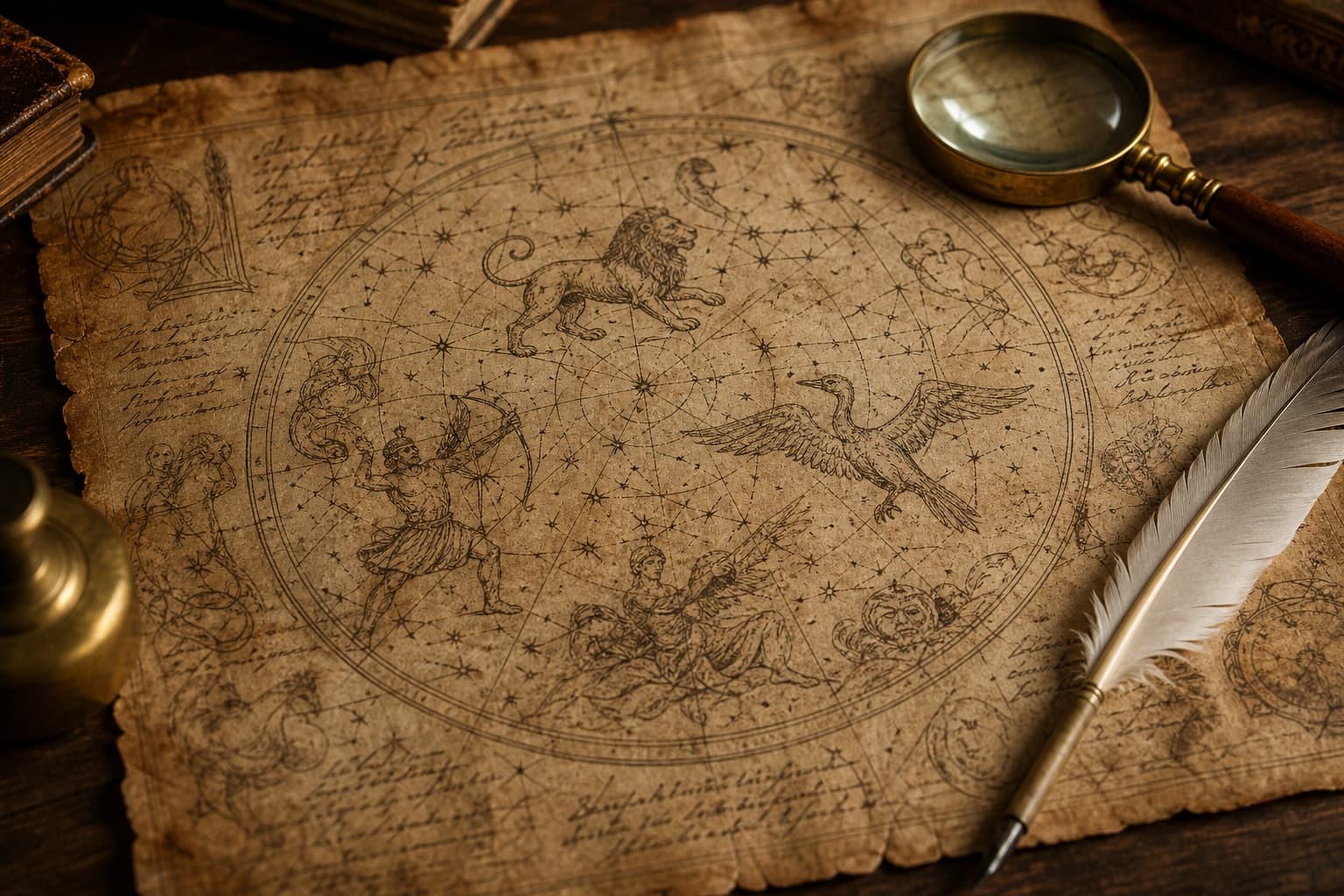
Celestial map — the historical, decorative term
“Celestial map” carries the most historical and aesthetic weight of the three terms. It evokes Renaissance star atlases, hand-drawn zodiac figures, gilded constellations on parchment.
The classic celestial maps — Bayer’s Uranometria (1603), Cellarius’s Harmonia Macrocosmica (1660), Flamsteed’s Atlas Coelestis (1729) — were scientific catalogs first, but their illustrators turned them into beautiful objects in their own right.
That decorative-object meaning is mostly what people invoke today when they use the phrase “celestial map.” You’ll see it most often in:
- Antique and vintage prints — reproductions of Renaissance-era celestial atlases sold as decorative art.
- Museum and gallery contexts — historical sky charts in collections, with their original constellation figures intact.
- Wall art and home decor categories — particularly Pinterest-popular vintage and boho aesthetics.
Connotation: ornate, historical, decorative, often with mythological figures drawn into the sky.
We covered the full history of these in A Brief History of Celestial Maps.
Quick comparison
The three terms, side by side:
- Star map: Modern. Personalized, gift-oriented, designed for the wall. The most common term in current shopping language.
- Star chart: Older and more technical. Reference materials, planispheres, sky atlases, planetarium software. The working tool.
- Celestial map: Historical and decorative. Renaissance atlases, antique reproductions, ornate constellation art. The artifact.
Other terms you’ll see
A few more words show up around this space. Worth a quick gloss:
Sky map / sky chart
Used essentially the same way as “star map” and “star chart” respectively. “Sky map” is slightly less common in personalized-product contexts, but means the same thing.
Planisphere
A specific kind of star chart — a rotating disc with a window that lets you set the date and time and see which stars are above the horizon. Used for practical stargazing.
Astrolabe
A historical instrument (used from antiquity through the Renaissance) that combined a star chart with a calculating tool, used by navigators and astronomers to determine the time, location, and altitude of celestial bodies.
Mechanical, ornate, fascinating. Not really a “chart” in the modern sense.
Birth chart / natal chart
An astrology document — the position of the sun, moon, and planets against the zodiac on someone’s birthday. Not the same as a star map.
A birth chart is an astrology tool used for personality interpretations.
A star map is an astronomy artifact showing the literal sky. They look completely different on paper and are used for completely different things.
Some people confuse the two when shopping for gifts. If you want the literal sky on someone’s birthday, you want a star map.
If you want a horoscope-style chart, you want a birth chart. Different products.
Constellation map
Usually refers to a chart focused specifically on the constellations — their boundaries, names, and patterns — rather than a full sky simulation. Can be decorative or reference-grade, depending on context.
Why the words matter for shopping
Most online shopping for “custom celestial map” or “personalized star chart” will land you in the same product category as “personalized star map.” The search-engine algorithms know they’re synonyms.
But the words you use can affect the aesthetic of what you find:
- Search for “personalized star map” and you’ll get the modern, clean, minimal-design end of the spectrum.
- Search for “custom celestial map” and you’ll skew slightly toward vintage or ornate aesthetics.
- Search for “astronomy star chart” and you’ll probably end up looking at reference materials, not personalized posters.
None of them are wrong; they just steer you to slightly different shelves of the same store.
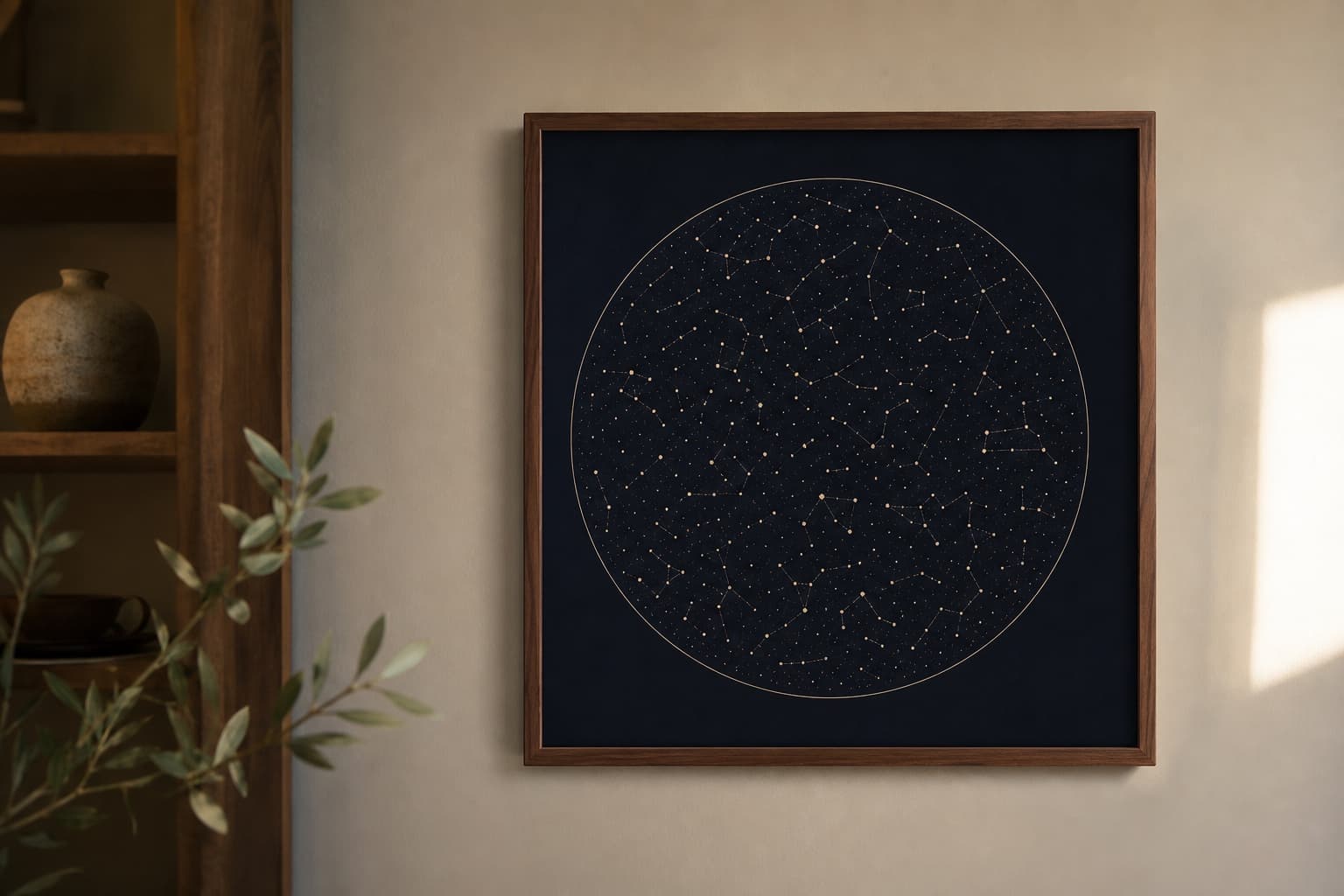
The bridge: the names matter less than the date
The thing that turns a generic sky print into something worth giving isn’t which word you use to describe it. It’s the specific date and place printed below the circle.
Three different terms can all point at the same product: a personalized poster of the real night sky on a date that mattered to you or to the person you’re giving it to.
If that’s what you’re looking for, the customizer at the SkyWhen customizer shows you the real sky for any date and place in seconds, no card required. Whatever you want to call it.
For the beginner explainer of what these even are, start at What Is a Star Map? If you’re trying to decide between formats or shopping for a gift, the occasions people most often pick are in Personalized Star Map Gift Ideas.
FAQ
Is there a real difference between a star map and a star chart?
In careful usage, yes — a “star map” usually means a personalized, decorative poster, while a “star chart” usually means a reference diagram used for navigation or astronomy.
In casual usage, the two terms are interchangeable.
What's a celestial map?
A “celestial map” usually refers to a historical or ornate representation of the sky — Renaissance star atlases, antique constellation prints, that whole aesthetic.
The term is also sometimes used as a synonym for “star map” in modern personalized-product contexts.
Is a star map the same as a birth chart?
No — they’re completely different things. A star map shows the actual night sky as it appeared at a date and place. A birth chart (also called a natal chart) is an astrology document showing planet positions against the zodiac for personality interpretation.
They look completely different on paper and are used for different purposes. Star maps are astronomy; birth charts are astrology.
What's a planisphere?
A planisphere is a kind of star chart — a rotating disc with a window that lets you set a date and time and see which stars are above the horizon from your latitude.
They’re practical tools used by amateur astronomers and educators, rather than decorative prints.
Does the term matter when I'm shopping?
Search engines mostly treat the terms as synonymous, so any of them will surface similar products.
But the word you search with can subtly steer the aesthetic — “personalized star map” tends toward modern minimal, “custom celestial map” tends toward vintage ornate, “astronomy star chart” tends toward reference materials.