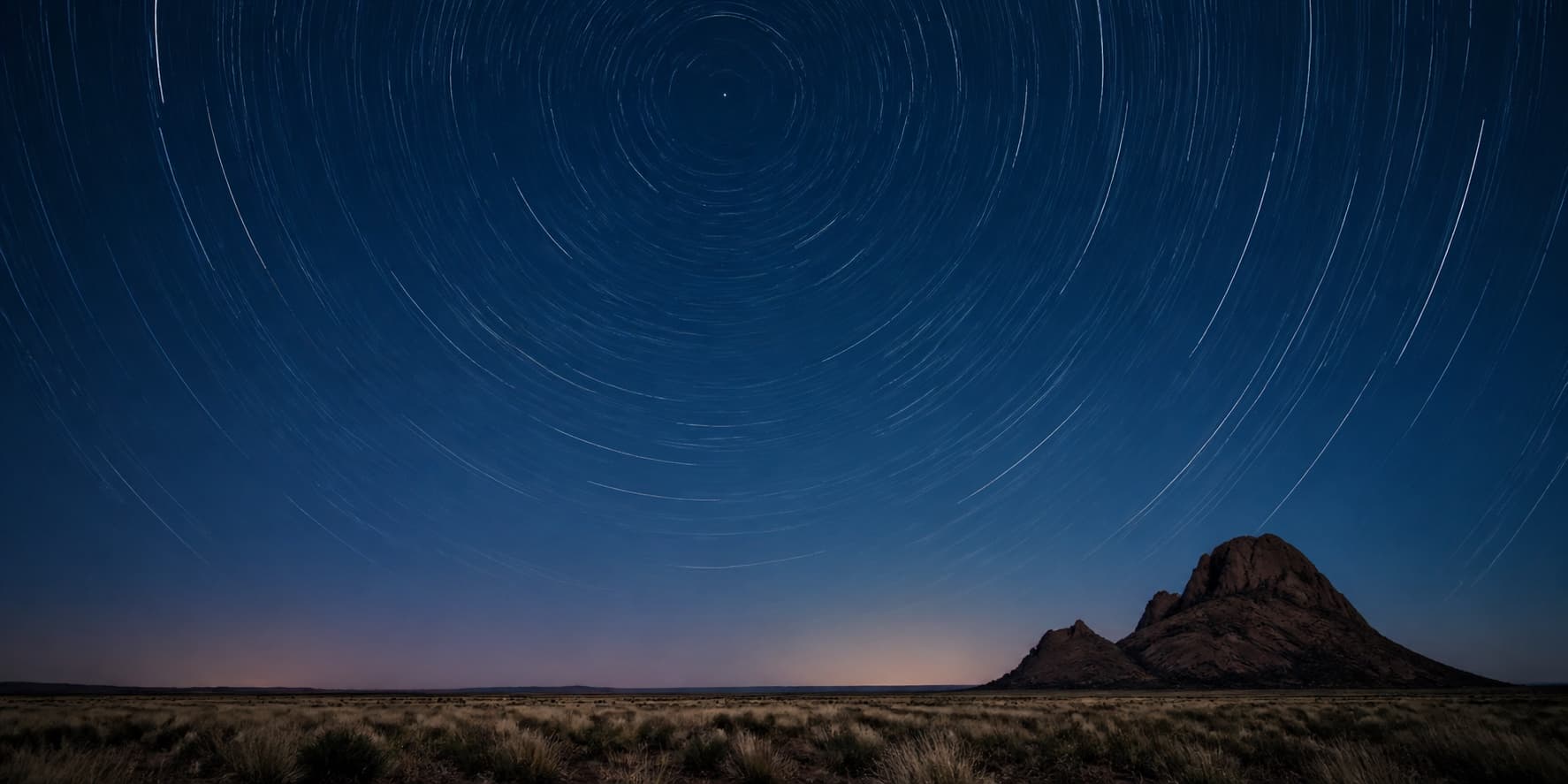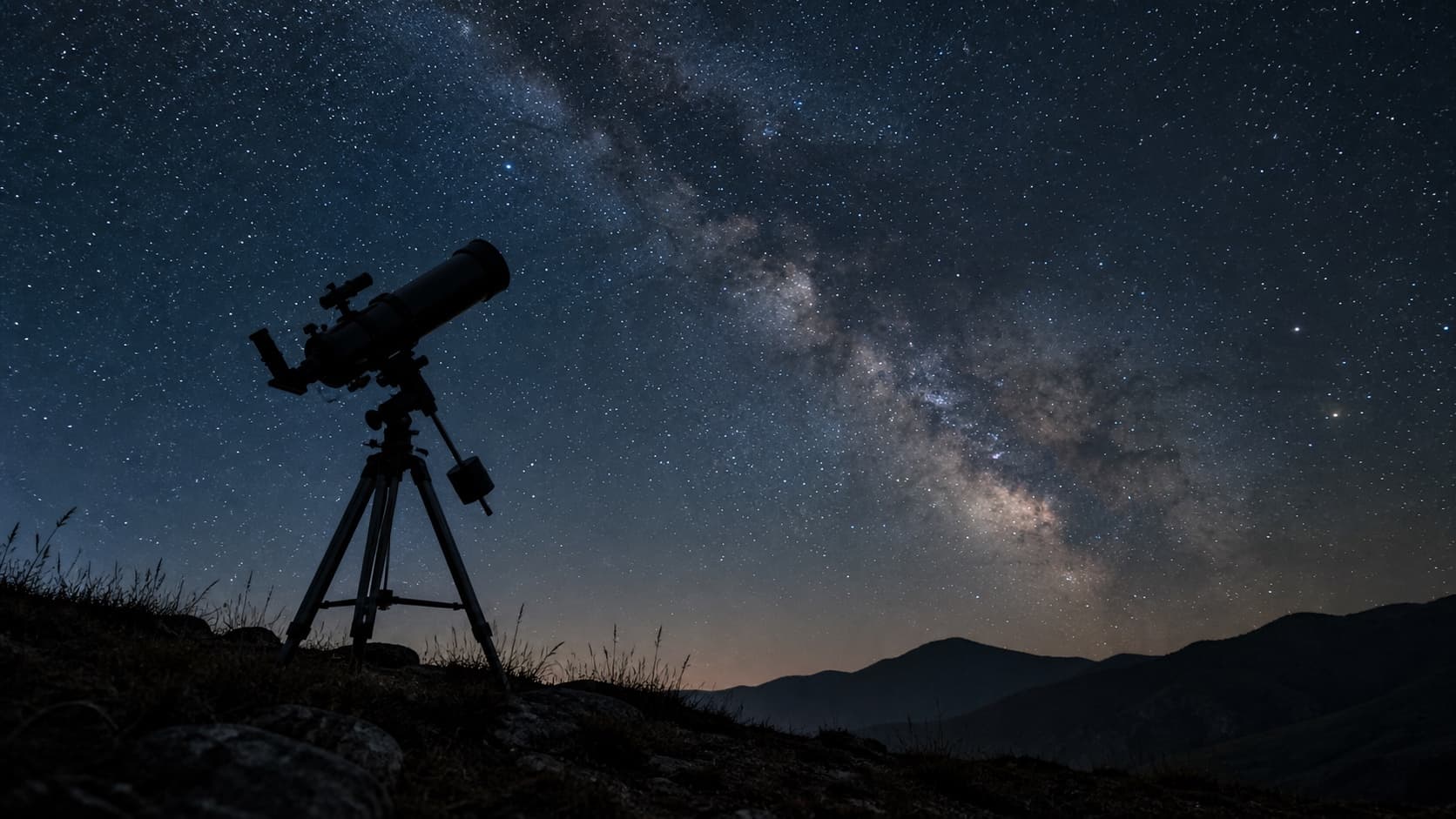
Star photography used to require expensive equipment and serious patience.
As of 2026, you can get a real photograph of the night sky from any modern phone (iPhone 12 or newer, Pixel 6 or newer, Galaxy S22 or newer). With a DSLR or mirrorless camera, you can get a stunning one.
This guide covers both paths — what a phone can do, what a real camera adds, and the specific settings that get you a usable photo on your first night out.
What you can do with just a phone
Phone cameras have improved enough that you can get a real photo of the night sky from any flagship phone made after about 2021. Three steps:
One. Find a dark spot. Cities have too much light pollution for phone cameras to do much.
A backyard in a small town works; a real dark sky park works dramatically better.
Two. Stabilize the phone. Lean it on a fence, set it on a rock, or buy a $10 small tripod with a phone clamp.
Any movement during the exposure (which can be 3 to 30 seconds in night mode) will blur the photo.
Three. Switch to night mode and let it take a long exposure. iPhone: pull up the camera, point at the sky, wait for the moon-and-stars icon to appear, then tap the shutter and hold the phone still until the countdown finishes.
Specific phone notes
- iPhone 12 and newer: Night Mode kicks in automatically in low light. Up to 30 seconds on a stable surface.
- Pixel 6 and newer: Astrophotography mode in the Night Sight option. Up to 4 minutes; requires a tripod.
- Samsung Galaxy S22 and newer: Pro Mode → ISO 800 to 1600, shutter speed 10 to 30 seconds, manual focus to infinity.
The phone limit
Phones top out at “decent.” You can get a real photograph of the Milky Way arching over a landscape, with hundreds of visible stars.
You won’t get the sharp, low-noise, high-resolution images that come from a dedicated camera with a wide-aperture lens.
If “decent” is enough, the phone is the right tool. If you want prints worth hanging or images worth sharing professionally, a DSLR or mirrorless camera makes a real difference.
The DSLR/mirrorless baseline
The starting settings for a single wide-field shot of the night sky:
- ISO: 1600 (start here; bump to 3200 if too dark, drop to 800 if too bright)
- Aperture: f/2.8 (or the widest your lens goes — f/4 still works but you lose light)
- Shutter speed: 25 seconds (for a wide lens; less if you’re zoomed in — see the 500 rule)
- Focus: manual, set to infinity (don’t trust autofocus in the dark; it’ll hunt and fail)
- White balance: 3500K to 4000K (cooler tones look more natural for night sky)
- File format: RAW (gives you flexibility to fix exposure and color in editing)
- Tripod: required — no exceptions
Take a test shot.
Adjust ISO up or down depending on whether the photo is too dark or too bright. Then shoot more.
The 500 Rule
The 500 rule tells you the maximum shutter speed (in seconds) before stars start visibly trailing across the frame due to Earth’s rotation.
Formula: 500 ÷ (lens focal length × crop factor) = max seconds.
- 14mm on full-frame: 500 ÷ 14 = ~35 seconds
- 24mm on full-frame: 500 ÷ 24 = ~20 seconds
- 35mm on full-frame: 500 ÷ 35 = ~14 seconds
- 50mm on full-frame: 500 ÷ 50 = ~10 seconds
- 24mm on APS-C (1.5× crop): 500 ÷ (24×1.5) = ~14 seconds
For super-sharp pixel-peeped stars, some people use the NPF rule instead (more restrictive). For most beginner uses, the 500 rule is fine.
Best lenses for star photography
If buying new
A wide-aperture wide-angle prime: 14mm f/1.8, 20mm f/1.8, or 24mm f/1.4.
These are designed for low-light wide-field work. Brands like Sigma, Rokinon, and Samyang make excellent budget options ($300 to $700); Sony, Nikon, and Canon G-Master/Z/L glass costs more ($1500 to $3000).
If using what you have
Any 24mm to 35mm wide lens with an aperture wider than f/4 will work. The standard kit zoom (24-70mm f/4 or 18-55mm f/3.5-5.6) will produce noisier shots but is fine for starting out.
Focus in the dark
Manual focus to infinity, but don’t just trust the infinity mark on your lens — many modern lenses overshoot it by a hair.
Better method: turn on Live View, find the brightest star or planet in your frame, zoom in 10× on your LCD screen, and turn the focus ring until the star is a perfect sharp pinpoint. Lock it there, then shoot.
Test the focus after every lens or tripod move. Vibration can shift the focus slightly.
Tracker mounts (when you’re ready to level up)
A star tracker is a small motorized mount that slowly rotates to compensate for Earth’s rotation. It lets you take long exposures (minutes instead of 20 seconds) without star trailing.
Two popular options for beginners: Sky-Watcher Star Adventurer 2i (~$400) and iOptron SkyGuider Pro (~$400). With a tracker, you can drop ISO to 400 to 800 and shoot exposures of 1 to 4 minutes, producing dramatically cleaner images.
Not necessary for casual star photography. Worth considering if you fall in love with the hobby and want to start photographing fainter objects like galaxies and nebulae.
Editing
The basics
- Raise exposure slightly (0.5 to 1 stop)
- Drop highlights, raise shadows
- Increase clarity / dehaze slightly
- Bump saturation moderately on blues and warmer Milky Way tones
- Apply moderate noise reduction (high ISOs introduce grain)
- Sharpen subtly
Avoid heavy-handed edits.
Star photography looks best with subtle, natural adjustments. The temptation to push saturation and contrast is real; resist it.
Software
Lightroom and Photoshop are the standard.
Free alternatives: darktable (Lightroom equivalent) and GIMP (Photoshop equivalent). For stacking multiple exposures into a single low-noise image, the free Sequator (Windows) or Starry Landscape Stacker (Mac, paid) are excellent.
Planning a star photo trip
Same constraints as visiting a dark sky park — you need dark sky, no moon, and clear weather. PhotoPills (~$10 iOS/Android) is the industry-standard planning app: it shows you exactly when and where the Milky Way will rise from your specific location.
Best months for Milky Way photography from the Northern Hemisphere: May through September, on or near a new moon. Best dark-sky-park picks at The Best Dark Sky Parks.
If you couldn’t get the shot
Star photography is hard.
Weather, focus, ISO noise, light pollution, your shutter timing, the moon’s phase — any one going wrong costs you the night. Sometimes you drive to a dark sky park and the clouds roll in.
The sky still happened.
If the date matters — an anniversary, a birthday, the night of a trip — you can render it from astronomical data exactly as it was, even if you didn’t get the photo. That’s what we do.
The bridge: the sky you saw, or the sky you wish you’d captured
Whether you got the photo or not, the actual sky on your night happened. A rendered print fills in for a missed shot, or sits alongside a great one.
Plug a date and place into the SkyWhen customizer and the preview will show that exact sky. The preview is free.
For finding dark skies, see The Best Dark Sky Parks . For the Milky Way specifically, see How to See the Milky Way .
For apps that help, see The Best Stargazing Apps in 2026 .
FAQ
Can I photograph stars with my phone?
Yes, with any modern flagship phone (iPhone 12+, Pixel 6+, Galaxy S22+). Find a dark spot, stabilize the phone, switch to night mode, and let the camera take a long exposure. Results are decent — not professional, but real.
What's the 500 rule?
A rule of thumb for maximum shutter speed before stars start trailing. 500 divided by your lens’s effective focal length (accounting for crop factor) gives you the maximum seconds. For a 24mm lens on a full-frame camera: about 20 seconds.
What ISO should I use for stars?
Start at ISO 1600 with a wide-aperture lens. Adjust based on results — brighter scenes go down to 800, darker scenes up to 3200. You want as low an ISO as possible without underexposing.
Do I need a star tracker?
Not for casual star photography. Plenty of beautiful images come from a tripod, a wide-angle lens, and a 25-second exposure. Trackers are worth it once you’re photographing fainter objects (galaxies, nebulae) that need minutes of exposure.
How do I focus on stars at night?
Manual focus. Use Live View, zoom in 10× on the brightest star in your frame, and turn the focus ring until the star is a perfect sharp pinpoint. Don’t trust autofocus or the infinity mark on the lens.