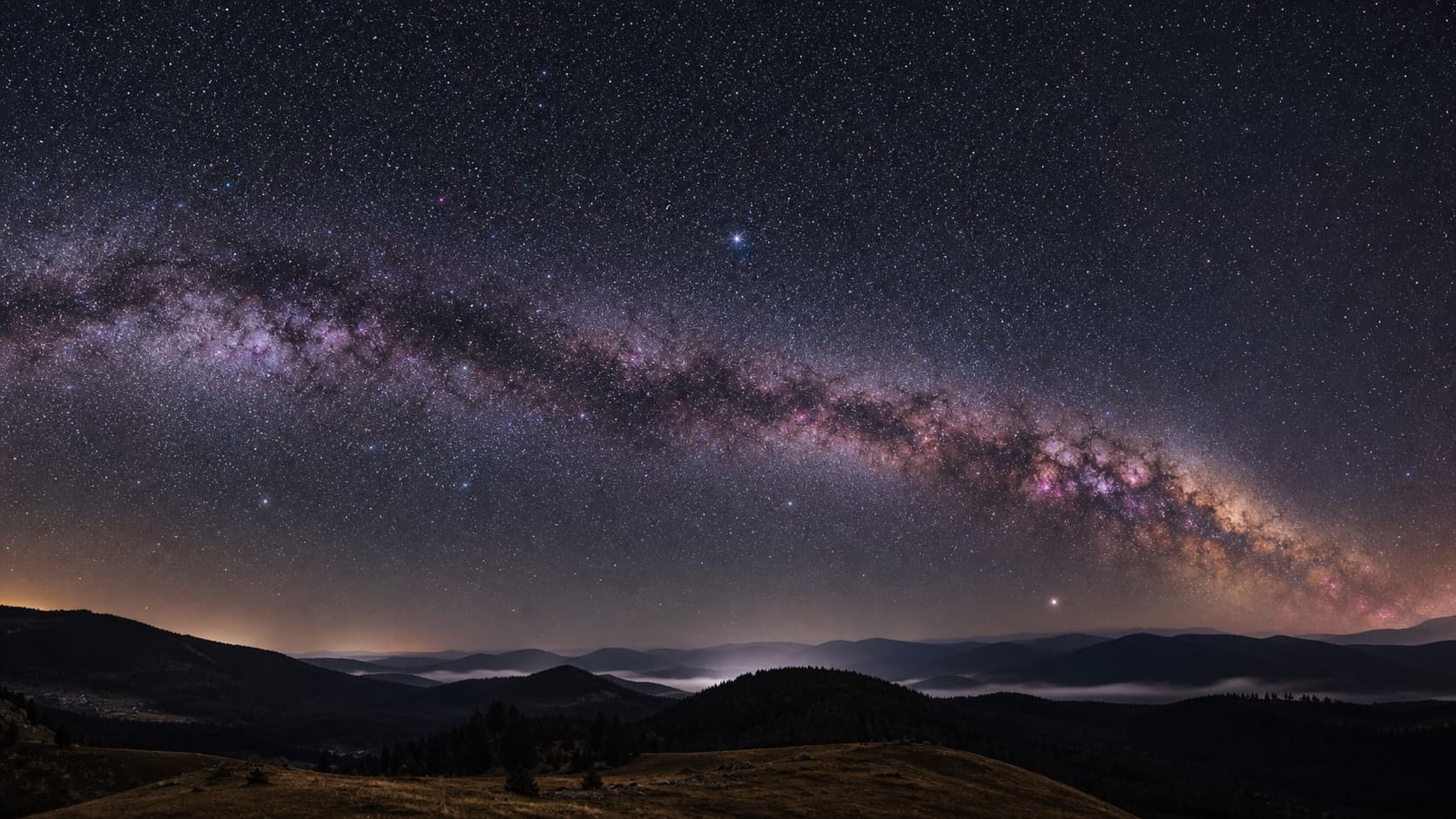
About 60 percent of North Americans, and 80 percent of Europeans, can’t see the Milky Way from where they live.
Modern light pollution has erased it from most of the inhabited world. Seeing the Milky Way isn’t the casual backyard experience many people imagine — for most of us, it requires a deliberate trip.
It’s worth it.
Once you’ve seen the Milky Way arching over a dark horizon, the experience tends to stick with you. This is the practical guide to making it happen.
What you’re actually looking at
The Milky Way isn’t a separate thing — it’s our own galaxy, seen from the inside. The pale glowing band across the sky is the combined light of hundreds of billions of distant stars in our galaxy’s spiral disk, blending together because they’re too dense and too faint to resolve individually.
When the band is brightest, you’re looking toward the galactic center — the densely packed core of our galaxy, in the direction of Sagittarius. When it’s faintest, you’re looking outward, away from the core.
We covered the science side at The Milky Way: Where We Live. This post is the practical “go see it” side.
Condition 1: darkness
The biggest factor.
The Milky Way is faint — total integrated brightness comparable to a thin crescent moon spread across half the sky. Any light-pollution glow at all washes it out.
Rough darkness threshold: Bortle Class 3 or darker (see The Best Dark Sky Parks for the full Bortle scale). From Bortle 4 (rural-suburban transition), the Milky Way is barely a smudge if you know exactly where to look.
From Bortle 5 (typical suburban), it’s effectively invisible.
How to get there: drive 1 to 2 hours out of any major city. Use LightPollutionMap.info to find the closest Bortle 3-or-darker zone to your home.
Condition 2: no moon
A full moon is so bright it washes out the Milky Way even from the darkest site on Earth.
A half moon is enough to mute it significantly. Even a quarter moon makes the experience worse.
Plan your trip for the week before or after a new moon — the moon will either not have risen yet, or will already have set, leaving you a few hours of true darkness. Check a moon-phase calendar for the date you’re planning.
Best window: new moon ± 5 days.
Acceptable: new moon ± 7 days. Risky: anything closer to a full moon.
Set a location and this becomes a list of the actual dark nights near you — how many hours each one gives you, and between which times. The new moon is only the middle of the window.
New moons come round every 29 or 30 days.
Condition 3: the right season
Northern Hemisphere
The bright central part of the Milky Way (toward the galactic center, in Sagittarius) is up in the evening from late spring through early autumn. Specifically:
- March–April: rising in the east just before dawn
- May–June: up by midnight, high before dawn
- July–August (peak): high overhead from 10 PM onward
- September: still visible in the early evening
- October–February: galactic center below horizon at night
The outer (less bright) part of the Milky Way is visible year-round, but it’s much less impressive than the galactic center view. Most photographs and descriptions of “the Milky Way” refer to the central section.
Southern Hemisphere
From Sydney, Cape Town, or Buenos Aires, the galactic center passes nearly overhead. Visible most of the year, with peak viewing from June through September (Southern Hemisphere winter).
Condition 4: a clear night
Obvious but worth saying.
Even thin high cloud (cirrus) will mute the Milky Way significantly. Check the cloud forecast for the date, and ideally pick a night with humidity below 60 percent and no high-cloud advisories.
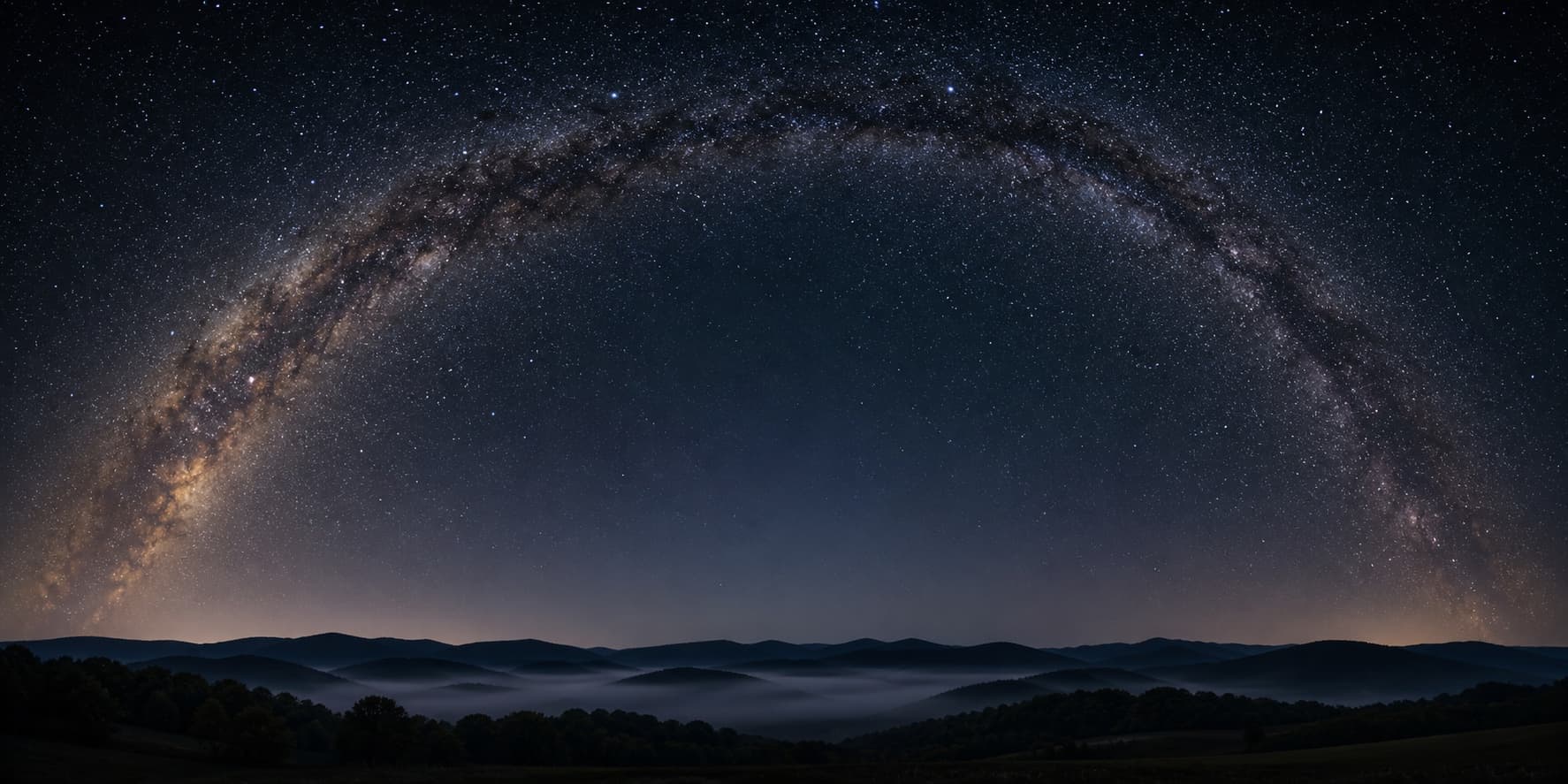
Where exactly to look
Once you have darkness, no moon, and a clear sky during the right season:
From the Northern Hemisphere in summer, look south, then trace upward.
You’ll see a pale band stretching from horizon to overhead, brightest where it crosses the southern horizon (that’s the galactic center, in Sagittarius). The band runs upward and northward through Cygnus (overhead) and Cassiopeia (north).
From the Southern Hemisphere, the band runs nearly overhead in winter, with the galactic center directly overhead at the peak of the season.
What you should actually see
From Bortle 3 (rural)
A clear pale band stretching across the sky.
Some hints of darker patches within it (dust lanes). No real structure detail.
From Bortle 2 (typical dark site)
The Milky Way looks “structured” — bright knots, dark dust lanes, distinct bulges around the galactic center. Genuinely impressive.
From Bortle 1 (excellent dark sky)
The Milky Way casts a shadow on the ground. You can see the dark Coalsack Nebula and Great Rift cleanly.
Zodiacal light visible.
Stars number in the thousands rather than hundreds. The kind of view that humans had access to essentially everywhere before electric lighting.
Common mistakes
- Looking too soon after sunset. Astronomical twilight lasts about 90 minutes; the Milky Way won’t be at its best until at least 2 hours after sunset.
- Not waiting for eye adaptation. The Milky Way looks dramatically more visible after 20 minutes of dark adaptation. A single look at a phone resets the timer.
- Going on a half-moon night. Even one phase off from new moon can mute the experience significantly.
- Expecting it to look like the photos. Long-exposure photographs make the Milky Way appear far brighter and more colorful than the naked-eye view. To your eye, it’s pale, white-gray, and subtle — but still genuinely beautiful.
What apps help
PhotoPills and Stellarium Mobile both have Milky-Way-locator features — point your phone at the sky and they’ll show where the galactic center will rise and when. PhotoPills is paid (~$10) and is the standard among Milky-Way photographers.
For lighter use, free apps like Sky Tonight or Stellarium Free (desktop) will show you where the Milky Way is in the sky on any date. Detailed comparisons at The Best Stargazing Apps in 2026.
Combining a Milky Way trip with a meaningful date
For some people, a Milky Way trip coincides with a birthday, an anniversary, or just a planned getaway with someone they care about. The combination — an extraordinary night under the galaxy plus a date that mattered — is one of the strongest reasons to make the trip.
The bridge: the sky you saw, made permanent
If you do manage to see the Milky Way on a meaningful date, you can render that exact sky — same constellations, same Milky Way arch, same location — as a print to hang at home. The trip becomes a wall.
Plug the date and location into the SkyWhen customizer and the preview will show the sky from that night. The preview is free.
For trip planning, see The Best Dark Sky Parks . For the science, see The Milky Way: Where We Live .
For photographing it once you’re there, see How to Photograph the Stars .
FAQ
Can I see the Milky Way from my city?
From most major cities, no — light pollution makes it invisible. From small towns and rural areas (Bortle 3 or darker), yes. Drive 1 to 2 hours out of any city to reach reliably dark skies.
When is the best time to see the Milky Way?
May through September from the Northern Hemisphere, with July and August being peak. June through September from the Southern Hemisphere. Always on or near a new moon, late evening or after midnight.
Does the moon need to be down to see the Milky Way?
Effectively yes — even a half moon brightens the sky enough to wash out most of the Milky Way. Plan trips within a week of a new moon.
Why does the Milky Way look different in photographs than to my eye?
Long-exposure photographs collect far more light than your eye does in real time, and modern editing brings out colors human vision can’t perceive in low light. The naked-eye Milky Way is real and beautiful, but pale white-gray and subtle.
What part of the Milky Way is brightest?
The galactic center, in the direction of Sagittarius. It’s brightest in summer evenings from the Northern Hemisphere and winter evenings from the Southern Hemisphere.