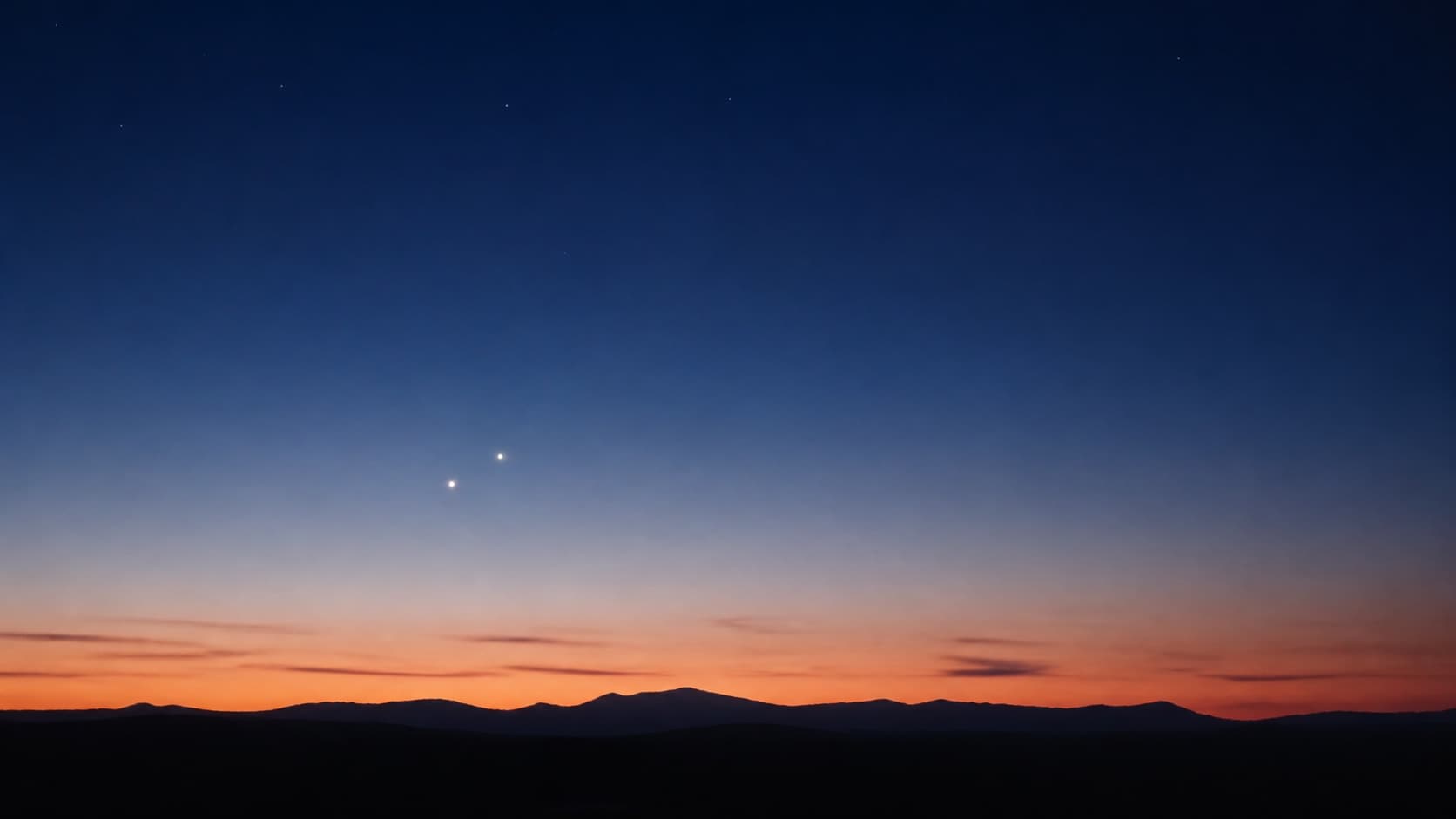
A planetary conjunction is when two or more planets appear close together in the sky from Earth’s point of view.
They’re not actually close in space — the planets stay tens or hundreds of millions of kilometers apart. The closeness is a line-of-sight effect, the same way two airplanes on different flight paths can look like they’re about to touch in the sky.
Most conjunctions are quiet, gentle events. But every few years a particularly tight or unusual alignment shows up — three planets together, a planet with a crescent moon, or a rare pairing of the two brightest planets in the sky.
The live tool above tells you which planets are above the horizon right now, with the compass direction and altitude — useful for tracking a conjunction as it builds. Standalone page at skywhen.com/tools/sky-tonight.
What a conjunction actually is
The planets all orbit the sun in roughly the same flat plane — astronomers call it the ecliptic.
Because of that, planets never wander all over the sky; they stay on a single narrow band overhead. (That band, broadly speaking, is the same one the sun and moon travel.)
From Earth, the planets appear to move along that band at different speeds. Mercury and Venus move fastest; Saturn and Jupiter move slowest.
When a fast planet catches up to a slow one in our line of sight, the two appear to merge for a few nights. That’s a conjunction.
In space, the planets are hundreds of millions of kilometers apart even at the tightest conjunctions. The closeness is purely a perspective effect — they look close to each other from where we’re standing.
The different types
Planet–planet
Two or more planets within a few degrees of each other.
The most common version of a conjunction. Venus–Jupiter pairings are the most striking because both are very bright; Mars–Mercury are dimmer and require careful timing because Mercury doesn’t climb very high above the horizon.
Planet–moon
A planet and a crescent moon close together. These happen frequently — the moon crosses the ecliptic every couple of weeks — but the visually striking ones are when the moon is a thin crescent and the planet is bright Venus or Jupiter.
Great conjunction
Specifically the meeting of Jupiter and Saturn — the two slowest visible planets. It happens roughly every 20 years and is called “great” because of how rare and slow the alignment is.
The last one was December 2020, when Jupiter and Saturn appeared only 0.1 degrees apart — the closest in 400 years. The next one is October 2040.
Multi-planet alignment
Three or more planets within a small section of sky.
Rare and visually striking, though usually the planets are still several degrees apart rather than truly stacked. Most of the “five-planet alignments” or “seven-planet alignments” that make the news are planets spread across 30–60 degrees of sky, not piled into a single point.
What conjunctions actually look like
For most conjunctions, you’ll see two bright dots near each other in the sky.
The colors are different: Venus is brilliant white, Jupiter is bright cream, Mars is reddish-orange, Saturn is yellowish. With a small telescope or even good binoculars at the tightest conjunctions, you can sometimes see Saturn’s rings and Jupiter’s moons in the same field of view.
The visual closeness varies a lot.
A “tight” conjunction is under one degree of separation — about twice the width of the full moon. A more typical conjunction is 2–5 degrees apart, which is still close to the eye but clearly two separate objects.
The 2026 conjunctions worth watching
Venus and Saturn — March 8
Bright Venus and pale Saturn less than a degree apart, low in the western evening twilight.
Venus dazzles; Saturn is a steadier yellowish dot beside it. Catch them soon after sunset, before they set.
Mercury and Saturn — April 20
A close one — under half a degree — but a challenge, low in the dawn twilight in the east. Both planets sit near the horizon, so you need a flat, unobstructed view in the last hour before sunrise.
Venus and Jupiter — June 10
The marquee conjunction of the year.
The two brightest planets sitting side by side in the evening sky, in the west after sunset. Bright enough to shrug off city lights — the easiest conjunction of 2026 to catch.
Mars and the Beehive Cluster — October 7–9
Not a planet-planet conjunction technically, but visually beautiful.
Mars drifts through the heart of the Beehive Cluster (M44, a loose group of stars in Cancer) over a few nights, high in the pre-dawn sky. Worth a look with binoculars.
Mars and Jupiter — November 16
Mars and Jupiter about a degree apart, riding high in the pre-dawn sky. The best-placed conjunction of the year — no horizon-hugging required, just look up before sunrise.
How to watch a conjunction
Most conjunctions require no equipment — just a clear horizon in the right direction at the right time.
- Find the time. Pre-dawn or post-sunset, depending on which planets and what point in their orbits. Most conjunctions are visible for a 30–60 minute window.
- Find the horizon. Many conjunctions sit low in the sky, so an unobstructed view east or west matters. Tops of hills, beaches, and the upper floors of buildings all work.
- Bring binoculars (optional). A small pair makes Jupiter’s moons visible alongside the conjunction, and resolves Saturn’s rings.
- Phone cameras work well. Night mode on iPhone or Pixel will capture a clean conjunction photo handheld, especially after twilight has dimmed the sky.
The bigger pattern
Every conjunction is a snapshot of the slow choreography of the solar system — planets moving on their own orbital schedules, occasionally lined up by accident from our vantage point. The Jupiter–Saturn great conjunctions trace out a slow pattern across the zodiac that takes 60 years to repeat at the same point in the sky.
Historical conjunctions have been documented for thousands of years.
Ancient Babylonian, Chinese, and Greek astronomers tracked them carefully. Several scholars have proposed that the “Star of Bethlehem” described in early Christian texts may have been the very tight 7 BC Jupiter–Saturn triple conjunction, though there’s no certainty.
The bridge: a planet alignment on your date
One of the things that’s easy to forget is that every personalized star map captures whatever planetary conjunctions were happening on the chosen date.
If a beautiful Venus–Jupiter pairing was overhead during your wedding, your map will show it. If Saturn was bright in the evening of your kid’s birth night, it’ll be there too.
Plug in a date you remember at the SkyWhen customizer and the preview will show the planets exactly where they were that night, with their actual brightness. The preview is free.
For the year’s full event list, see The 2026 Sky Calendar. For how to identify the bright planets you’re looking at, see How to Identify Bright Stars and Planets.
FAQ
What is a planetary conjunction?
Two or more planets appearing close together in the sky from Earth’s perspective. They’re not close in actual space — the closeness is a line-of-sight effect.
How often do conjunctions happen?
Multiple times a year. Venus, Mercury, and Mars have a lot of conjunctions because they move quickly relative to the slower outer planets.
The rare ones are Jupiter–Saturn great conjunctions (every 20 years) and multi-planet alignments of three or more bright planets.
When is the next great conjunction?
October 31, 2040 — the next meeting of Jupiter and Saturn. The 2020 great conjunction was unusually close (0.1 degrees) and was widely covered as the “Christmas Star.”
Can a planetary alignment affect Earth?
No, despite occasional popular claims. The gravitational influence of all the planets combined is millions of times weaker than the sun’s pull on Earth. A perfect alignment of all planets would have negligible physical effect.
How do I see a conjunction with binoculars?
Aim them at the brighter planet during the visible window. The pair will fit comfortably in a typical 7×50 binocular field of view. For Saturn-rich conjunctions, you may see the rings; for Jupiter-rich ones, you’ll see one to four of its largest moons as bright dots beside it.